Loading...
Deng Xiaoping vs Julius Caesar
Julius Caesar leads by 16.8 pts · 2 figures compared
…
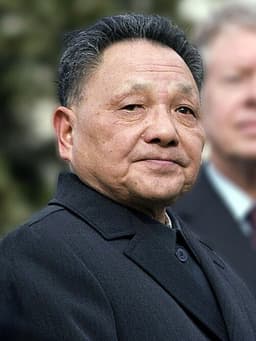
Deng Xiaoping
Politician · Modern
66.0Total

Julius Caesar
General · Ancient
82.8Total
Basic Information
Born
1904
-100
Died
1997
-44
Era
Modern
Ancient
Nationality
China
Roman Republic
Occupation
Politician
General
Civilization
Eastern
Western
Score Comparison
Military (10%)
30.0
88.0
Political (20%)
90.0
78.0
Influence (20%)
68.0
85.0
Legacy (20%)
65.0
82.0
Leadership (15%)
78.0
80.0
Strategy (15%)
45.0
85.0
TOTAL
66.0
82.8
Deng Xiaoping — Complete Timeline
1978 AD
Third Plenum of the 11th Central CommitteePolitical Action
Deng Xiaoping consolidated power and announced the policy of Reform and Opening-Up. This meeting marked the end of Maoist class struggle as the national priority and shifted focus to economic modernization, initiating market-oriented reforms.
Economic ReformOpening-UpChina Modernization
Impact: globalconstructive
1980 AD
Establishment of Special Economic ZonesReform◆ Major
Deng Xiaoping approved the creation of Special Economic Zones in Shenzhen, Zhuhai, Shantou, and Xiamen. These zones offered tax incentives and market freedoms to attract foreign investment and technology, serving as experimental laboratories for capitalist practices within a socialist framework.
Economic ZonesForeign InvestmentMarket Reforms
Impact: nationalconstructive
1984 AD
Sino-British Joint Declaration on Hong KongPolitical Action◆ Major
Deng Xiaoping negotiated with British Prime Minister Margaret Thatcher to agree on the return of Hong Kong to Chinese sovereignty in 1997. The declaration established the 'One Country, Two Systems' principle, allowing Hong Kong to maintain its capitalist system for 50 years.
Hong KongDiplomacyOne Country Two Systems
Impact: globalconstructive
1989 AD
Tiananmen Square Protests CrackdownPolitical Action
Deng Xiaoping authorized the military to suppress pro-democracy protests in Tiananmen Square. The crackdown resulted in hundreds of civilian deaths and injuries, leading to international condemnation and a tightening of political control while economic reforms continued.
TiananmenSuppressionHuman Rights
Impact: globaldestructive
1992 AD
Southern Tour (Nanxun)Political Action◆ Major
Deng Xiaoping traveled to southern China to reaffirm the course of economic reform after conservative backlash. His speeches in Shenzhen and other cities revitalized market-oriented policies, accelerating foreign investment and pushing China toward a socialist market economy.
Economic ReformNanxunMarket Economy
Impact: nationalconstructive
Julius Caesar — Complete Timeline
58 BC
Gallic WarsWar◆ Major
Caesar, as proconsul of Gaul, launched a series of campaigns that conquered all of Gaul (modern France, Belgium, and parts of Switzerland). He fought numerous battles, including against the Helvetii, the Belgae, and the Gallic chieftain Vercingetorix. The wars brought immense wealth and a loyal army to Caesar.
Gallic WarsConquestRoman Expansion
Impact: regional
49 BC
Crossing the RubiconPolitical Action◆ Major
Caesar led Legio XIII across the Rubicon River into Italy, defying the Roman Senate's order to disband his army. This act triggered a civil war against Pompey and the Optimates, ultimately leading to Caesar's dictatorship and the end of the Roman Republic.
Roman Civil WarEnd of RepublicPower Struggle
Impact: global
48 BC
Battle of PharsalusWar◆ Major
Caesar's outnumbered army defeated the larger forces of Pompey the Great at Pharsalus in Greece. Caesar's tactical use of a reserve line to counter Pompey's cavalry charge proved decisive. Pompey fled to Egypt, where he was assassinated, leaving Caesar as the undisputed master of the Roman world.
Roman Civil WarBattleDecisive Victory
Impact: regional
44 BC
Appointment as Dictator for LifePolitical Action◆ Major
The Roman Senate appointed Caesar dictator perpetuo (dictator for life), granting him unprecedented personal power. This move concentrated military, legislative, and judicial authority in one person, effectively ending the Roman Republic's traditional system of checks and balances and alarming many senators.
DictatorshipEnd of RepublicPower Consolidation
Impact: regionaldestructive
Assassination on the Ides of MarchPolitical Action◆ Major
A group of Roman senators, led by Marcus Junius Brutus and Gaius Cassius Longinus, stabbed Caesar to death at a meeting of the Senate in the Theatre of Pompey. The assassination was intended to restore the Republic, but instead triggered another civil war that led to the rise of the Roman Empire.
AssassinationRoman PoliticsEnd of Republic
Impact: globaldestructive
Expert Analysis
Julius Caesar vs Deng Xiaoping: Historical Comparison
Julius Caesar, a Roman general who transformed the Republic, and Deng Xiaoping, a Chinese politician who modernized a communist state, represent contrasting eras and domains of power.
Dimension Analysis
**Military: Julius Caesar 88 / Deng Xiaoping 45**
Caesar conquered Gaul, defeated Pompey, and revolutionized Roman warfare with personal loyalty and speed. Deng was a political commissar, not a battlefield commander, and his military role was limited to organizational support during the Chinese Civil War.
**Political: Julius Caesar 78 / Deng Xiaoping 88**
Caesar centralized power through dictatorship and reforms like the Julian calendar, but his assassination exposed instability. Deng engineered China’s economic opening, dismantled Maoist orthodoxy, and established a pragmatic, market-oriented system that endured without personal cultism.
**Influence: Julius Caesar 85 / Deng Xiaoping 78**
Caesar’s name became synonymous with imperial authority across Western civilization, influencing governance and military strategy for centuries. Deng’s influence is largely confined to modern China, though his reforms reshaped global trade and lifted hundreds of millions from poverty.
**Legacy: Julius Caesar 82 / Deng Xiaoping 75**
Caesar’s legacy includes the end of the Roman Republic, the rise of the Empire, and a cultural archetype of ambition. Deng’s legacy is more fragile—his reforms succeeded but face tensions between state control and capitalist inequality, and his reputation is less mythologized.
**Leadership: Julius Caesar 82 / Deng Xiaoping 78**
Caesar led by charisma, personal courage, and direct command, inspiring fierce loyalty and fear. Deng led by strategic patience, behind-the-scenes negotiation, and gradual policy shifts, avoiding personal glory while achieving systemic change.
Verdict
Julius Caesar leads due to his superior military prowess, broader historical influence, and more enduring cultural legacy.
FAQ
Q: Who ranks higher? A: Julius Caesar ranks higher overall, scoring 83 vs. Deng’s 74, driven by decisive advantages in military and strategic dimensions.
Rankings
🥇
Julius CaesarLeader
Mil: 88.0Pol: 78.0Inf: 85.0
82.8
🥈
Deng Xiaoping
Mil: 30.0Pol: 90.0Inf: 68.0
66.0
+16.8 behind
How This Comparison Works
Algorithm
Each figure is scored on 6 dimensions (0—100 scale) based on structured historical data: Military (10%), Political (20%), Influence (20%), Legacy (20%), Leadership (15%), Strategy (15%). The weighted total produces the final ranking.
Data Sources
Scores are computed from structured sub-indicators in the database. Scale factors adjust for era (Ancient ×0.85, Modern ×1.0) and civilization size (Eastern ×1.05, Other ×0.80) to account for differences in population and military scale.
Maximum 3 Figures
Comparisons are limited to 2—3 figures to ensure readability and statistical meaningfulness.
Error Margins
±5 points per dimension — Sub-scores are derived from historical records with inherent uncertainty. Two figures within 5 points on a dimension should be considered roughly equivalent in that area.
Total Score Accuracy
±3 points overall — The weighted combination of 6 dimensions produces a total score with approximately ±3 points of uncertainty. Differences of less than 3 points are not statistically significant— the figures are effectively tied.
Known Limitations
- Historical records are incomplete and uneven across civilizations
- Figures from oral-tradition societies may be underrepresented
- Occupation labels can misclassify multi-role figures
- Scores measure capability and impact, not moral character
- Quantitative scoring is a comparison tool, not absolute truth
Capability Radar
Military (10%) — Battles & Warfare
Battles
36
95
Win Rate
37
92
Expansion
41
97
Political (20%) — Governance & Reform
Reform
95
90
Diplomacy
80
85
Economy
95
82
Influence (20%) — Cultural & Global Reach
Cultural
70
88
Global
90
94
Legacy (20%) — Historical Impact
Historical
90
95
Longevity
85
96
Leadership (15%) — Power & Stability
Tenure
85
75
Stability
75
60
Strategy (15%) — Tactics & Innovation
Strategy
47
94
Tactics
48
96
Reform
49
88
Similar Comparisons
Comments & Discussion
RomanPhalanx6/16/2026
Come on, Deng Xiaoping vs Caesar? That's like comparing a spreadsheet to a thunderstorm. Caesar didn't just conquer Gaul—he rewrote the rules of warfare. His siege of Alesia is still studied in military academies today as the textbook example of siegecraft and counter-siege. Deng's 'Reform and Opening Up' was impressive economically, but let's be real: he never charged into battle, never faced a mutiny, never crossed an ocean with legions. Caesar's influence permeates every dictatorship and republic that followed—the very word 'Kaiser' comes from his name. Deng's legacy? A factory floor and a stock market. Give me the man who crossed the Rubicon any day.
Chronicler40816/16/2026
评分看似客观,但军事维度88 vs 45的差距让我皱眉。邓作为淮海战役总前委成员,虽非一线将帅,但后勤动员和战略协调能力被严重低估。按同一标准,凯撒在高卢的胜利更多依赖军团纪律和罗马资源,而非个人天才。若计算单位资源产出比,邓领导的改革开放动员了十亿人,经济增速连续三十年超9%,这种系统性影响力在评分中仅得78?建议引入“制度变革系数”和“人口影响权重”重新加权。
SharpScroll906/16/2026
凯撒与邓公的比较很有意思,但西方中心史观容易忽略中国语境。凯撒终结共和开启帝制,影响西方两千年的政体演变;而邓的“摸着石头过河”开创了社会主义与市场经济的共存模式,这在马克思主义史上是空前的。评分中邓的军事分仅45,但别忘了,没有邓主持的百万大裁军和军队现代化,就没有后来台海危机中的战略威慑。另外,邓在党内斗争中三次沉浮最终掌权,其政治韧性堪比凯撒跨过卢比孔河。