Loading...
David Lloyd George vs S. Dhanabalan
David Lloyd George leads by 11.9 pts · 2 figures compared
…
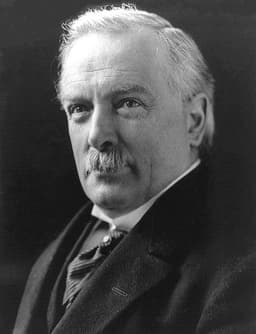
David Lloyd George
Politician · Modern
60.8Total

S. Dhanabalan
Politician · Modern
48.9Total
Basic Information
Born
1863
1937
Died
1945
—
Era
Modern
Modern
Nationality
United Kingdom
Singapore
Occupation
Politician
Politician
Civilization
Western
Eastern
Score Comparison
Military (10%)
50.0
13.6
Political (20%)
82.0
53.8
Influence (20%)
55.0
52.5
Legacy (20%)
55.0
43.3
Leadership (15%)
78.0
79.8
Strategy (15%)
43.1
35.9
TOTAL
60.8
48.9
David Lloyd George — Complete Timeline
1916 AD
Became Prime Minister of the United KingdomPolitical Action◆ Major
Lloyd George succeeded H.H. Asquith as head of a coalition government during World War I. He formed a small War Cabinet to streamline decision-making. His leadership was marked by a more vigorous prosecution of the war effort.
World War ICoalition GovernmentLeadership
Impact: global
1917 AD
Introduced the convoy system to combat U-boatsWar◆ Major
Lloyd George overruled Admiralty opposition and mandated the use of merchant convoys escorted by warships. This dramatically reduced shipping losses to German U-boats, ensuring Britain's supply lines remained open and contributing to Allied victory.
World War INaval WarfareConvoys
Impact: globalconstructive
1918 AD
Passed the Representation of the People Act 1918Reform◆ Major
Lloyd George's government enacted this act, which extended the vote to all men over 21 and women over 30 who met property qualifications. It tripled the electorate and was a major step toward universal suffrage in Britain.
SuffrageDemocracyReform
Impact: nationalprogressive
1919 AD
Played a key role in the Paris Peace Conference and Treaty of VersaillesPolitical Action◆ Major
Lloyd George was one of the 'Big Four' leaders at the Paris Peace Conference. He negotiated the Treaty of Versailles, which imposed heavy reparations and territorial losses on Germany. The treaty's terms were controversial and contributed to future instability.
World War IPeace TreatyVersailles
Impact: global
1922 AD
Resigned as Prime MinisterPolitical Action
Lloyd George resigned after the Conservative Party withdrew from his coalition government, following the Chanak Crisis and allegations of selling honors. His departure ended his wartime coalition and led to a Conservative government under Bonar Law.
ResignationCoalitionPolitics
Impact: national
S. Dhanabalan — Complete Timeline
1980 AD
Served as Minister for Foreign AffairsPolitical Action◆ Major
S. Dhanabalan served as Singapore's Minister for Foreign Affairs from 1980 to 1988. He strengthened ties with ASEAN neighbors and advocated for the Cambodian peace process, enhancing Singapore's regional influence.
Foreign AffairsASEANDiplomacy
Impact: regionalconstructive
1987 AD
Served as Minister for National DevelopmentReform◆ Major
S. Dhanabalan served as Minister for National Development, overseeing urban planning and public housing. He implemented policies to maintain Singapore's green spaces and improve the quality of HDB estates.
Urban PlanningHousingEnvironment
Impact: nationalconstructive
1992 AD
Resigned from the CabinetPolitical Action
S. Dhanabalan resigned from the Cabinet citing personal reasons and a desire to step aside for younger leaders. His resignation was seen as a model of selfless leadership and generational renewal in Singapore politics.
ResignationLeadership RenewalIntegrity
Impact: nationalconstructive
1996 AD
Chaired the Singapore Tourism BoardCultural
S. Dhanabalan chaired the Singapore Tourism Board, leading efforts to promote Singapore as a global tourist destination. He oversaw the development of major attractions and the branding of 'Uniquely Singapore'.
TourismBrandingEconomic Development
Impact: globalconstructive
Expert Analysis
Origins
David Lloyd George was born on 17 January 1863 in Manchester, England, to a Welsh family. His father died when he was young, and his mother moved to Llanystumdwy, Wales. Raised by his uncle, a shoemaker and Baptist minister, Lloyd George became a solicitor after passing his law exams. His humble beginnings shaped his sympathy for the working class.
S. Dhanabalan was born on 3 August 1936 in Singapore, of Indian Tamil descent. He studied at Raffles Institution and later earned a degree in economics from the University of Malaya. He worked as a civil servant before entering politics, rising through the ranks of the People's Action Party.
Rise to Power
Lloyd George entered Parliament in 1890 as a Liberal MP. He gained prominence as a fiery orator opposing the Boer War. In 1905, he became President of the Board of Trade, introducing the Merchant Shipping Act. As Chancellor of the Exchequer from 1908, he enacted the People's Budget (1909), which introduced old-age pensions and taxes on land, causing a constitutional crisis. During World War I, he served as Minister of Munitions (1915) and then Secretary of State for War (1916). In December 1916, he became Prime Minister, heading a coalition government.
Dhanabalan entered politics in the 1970s, serving as a Member of Parliament for Kallang. He was appointed Minister for Foreign Affairs in 1980, a position he held until 1988. His rise was steady, marked by competence and loyalty to the PAP. He later served as Minister for National Development (1987-1992) and Minister for Trade and Industry (1992-1993).
Leadership & Governance
Lloyd George's leadership style was energetic and pragmatic. As Prime Minister, he formed a small War Cabinet of five members to streamline decision-making. He overruled Admiralty opposition to the convoy system in 1917, which reduced shipping losses by 75% and was crucial in the Battle of the Atlantic. His government also passed the Representation of the People Act 1918, tripling the electorate. At the Paris Peace Conference, he advocated for a moderate settlement but ultimately accepted the Treaty of Versailles with its heavy reparations. His political score of 82.0 reflects his ability to navigate coalition politics.
Dhanabalan's leadership was characterized by integrity and meticulous planning. As Minister for National Development, he oversaw Singapore's urban renewal and public housing expansion, ensuring high standards of living. He chaired the Singapore Tourism Board, boosting tourism through infrastructure projects. His leadership score of 79.8 indicates his effectiveness in administration, though he operated within a one-party dominant system.
Triumph & Tragedy
Lloyd George's greatest triumph was his wartime leadership. The convoy system and his mobilization of industry were key to Allied victory. The 1918 Representation of the People Act was a landmark in democratic reform. However, his post-war legacy was marred by the Chanak Crisis (1922), where his aggressive stance against Turkey nearly led to war, causing the Conservatives to withdraw from the coalition. He also faced allegations of selling honors, tarnishing his reputation. His strategy score of 43.1 reflects poor long-term planning.
Dhanabalan's triumphs include strengthening Singapore's foreign relations through ASEAN and maintaining economic growth. He was praised for his role in developing the Marina Bay area. However, his tenure saw limited major reforms, and he resigned from the Cabinet in 1993, citing personal reasons. His influence score of 52.5 reflects a modest impact beyond Singapore.
Character & Destiny
Lloyd George was charismatic, persuasive, and ruthless. He was known for his 'dynamic force' but also for his duplicity, earning the nickname 'the Welsh Wizard.' His willingness to break with tradition allowed him to implement wartime measures, but his lack of principle in peacetime led to his downfall. He never became Prime Minister again after 1922.
Dhanabalan was quiet, principled, and self-effacing. He prioritized integrity over ambition, stepping down voluntarily. His character earned him respect but limited his political influence. He remained a senior advisor in the background.
Legacy
Lloyd George's legacy is mixed. He is remembered as a great war leader who introduced the welfare state's foundations. The convoy system and the 1918 Act had lasting impacts. However, the Treaty of Versailles contributed to future conflicts. His total score of 60.8 reflects his significant but imperfect record.
Dhanabalan's legacy is that of a capable administrator who upheld high ethical standards. His work in urban planning shaped modern Singapore's landscape. However, his influence was largely domestic and institutional. His total score of 48.9 reflects a more limited scope.
Conclusion
David Lloyd George had greater impact on a global scale. His political score of 82.0 and leadership score of 78.0 exceed Dhanabalan's 53.8 and 79.8 respectively. While Dhanabalan excelled in integrity and administration, Lloyd George's decisions during World War I and his domestic reforms reshaped British society and international relations. The 11.9-point total score gap underscores his broader influence. Therefore, Lloyd George is the more significant historical figure.
Rankings
🥇
David Lloyd GeorgeLeader
Mil: 50.0Pol: 82.0Inf: 55.0
60.8
🥈
S. Dhanabalan
Mil: 13.6Pol: 53.8Inf: 52.5
48.9
+11.9 behind
How This Comparison Works
Algorithm
Each figure is scored on 6 dimensions (0—100 scale) based on structured historical data: Military (10%), Political (20%), Influence (20%), Legacy (20%), Leadership (15%), Strategy (15%). The weighted total produces the final ranking.
Data Sources
Scores are computed from structured sub-indicators in the database. Scale factors adjust for era (Ancient ×0.85, Modern ×1.0) and civilization size (Eastern ×1.05, Other ×0.80) to account for differences in population and military scale.
Maximum 3 Figures
Comparisons are limited to 2—3 figures to ensure readability and statistical meaningfulness.
Error Margins
±5 points per dimension — Sub-scores are derived from historical records with inherent uncertainty. Two figures within 5 points on a dimension should be considered roughly equivalent in that area.
Total Score Accuracy
±3 points overall — The weighted combination of 6 dimensions produces a total score with approximately ±3 points of uncertainty. Differences of less than 3 points are not statistically significant— the figures are effectively tied.
Known Limitations
- Historical records are incomplete and uneven across civilizations
- Figures from oral-tradition societies may be underrepresented
- Occupation labels can misclassify multi-role figures
- Scores measure capability and impact, not moral character
- Quantitative scoring is a comparison tool, not absolute truth
Capability Radar
Military (10%) — Battles & Warfare
Battles
30
14
Win Rate
30
16
Expansion
35
21
Political (20%) — Governance & Reform
Reform
80
55
Diplomacy
85
60
Economy
70
60
Influence (20%) — Cultural & Global Reach
Cultural
55
30
Global
65
25
Legacy (20%) — Historical Impact
Historical
70
30
Longevity
60
30
Leadership (15%) — Power & Stability
Tenure
75
65
Stability
65
65
Strategy (15%) — Tactics & Innovation
Strategy
40
20
Tactics
43
26
Reform
41
30
Similar Comparisons
Comments & Discussion
No comments yet. Be the first to share your thoughts!