Loading...
Daniel OConnell vs Julius Caesar
Julius Caesar leads by 25.8 pts · 2 figures compared
…
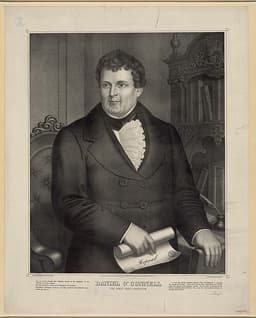
Daniel OConnell
Politician · Modern
57.0Total

Julius Caesar
General · Ancient
82.8Total
Basic Information
Born
1775
-100
Died
1847
-44
Era
Modern
Ancient
Nationality
Ireland
Roman Republic
Occupation
Politician
General
Civilization
Western
Western
Score Comparison
Military (10%)
50.0
88.0
Political (20%)
72.0
78.0
Influence (20%)
55.0
85.0
Legacy (20%)
52.0
82.0
Leadership (15%)
68.0
80.0
Strategy (15%)
42.7
85.0
TOTAL
57.0
82.8
Daniel OConnell — Complete Timeline
1823 AD
Catholic Association FoundedPolitical Action◆ Major
O'Connell founded the Catholic Association to campaign for Catholic emancipation. The organization used mass membership and the 'Catholic Rent' (a penny a month subscription) to mobilize Irish Catholics politically.
Catholic EmancipationPolitical OrganizationMass Mobilization
Impact: nationalprogressive
1828 AD
Election to ParliamentPolitical Action◆ Major
O'Connell won a by-election in County Clare, defeating a Protestant candidate. As a Catholic, he was legally barred from taking his seat, forcing the British government to pass the Catholic Relief Act 1829 to avoid civil unrest.
ElectionCatholic EmancipationPolitical Crisis
Impact: nationalprogressive
1829 AD
Catholic Relief Act 1829Reform
The British Parliament passed the Catholic Relief Act, allowing Catholics to sit in Parliament and hold most public offices. O'Connell's campaign was the primary cause, though the act also raised the property qualification for Irish voters.
Catholic EmancipationLegislationReform
Impact: nationalprogressive
1840 AD
Repeal Association FoundedPolitical Action◆ Major
O'Connell founded the Repeal Association to campaign for the repeal of the Acts of Union 1800 and the restoration of an Irish parliament. The movement used mass meetings, known as 'monster meetings', to demonstrate popular support.
RepealNationalismMass Politics
Impact: nationalprogressive
1843 AD
Monster Meeting at TaraPolitical Action
O'Connell held a massive 'monster meeting' at the Hill of Tara, attracting an estimated 750,000 people. These peaceful demonstrations demonstrated the strength of the Repeal movement but alarmed the British government.
Monster MeetingRepealMass Mobilization
Impact: nationalprogressive
1844 AD
Trial for ConspiracyPolitical Action◆ Major
O'Connell was tried and convicted for conspiracy to incite rebellion, based on his Repeal campaign speeches. He was sentenced to a year in prison but was released after three months by the House of Lords on appeal.
TrialImprisonmentRepeal
Impact: national
Julius Caesar — Complete Timeline
58 BC
Gallic WarsWar◆ Major
Caesar, as proconsul of Gaul, launched a series of campaigns that conquered all of Gaul (modern France, Belgium, and parts of Switzerland). He fought numerous battles, including against the Helvetii, the Belgae, and the Gallic chieftain Vercingetorix. The wars brought immense wealth and a loyal army to Caesar.
Gallic WarsConquestRoman Expansion
Impact: regional
49 BC
Crossing the RubiconPolitical Action◆ Major
Caesar led Legio XIII across the Rubicon River into Italy, defying the Roman Senate's order to disband his army. This act triggered a civil war against Pompey and the Optimates, ultimately leading to Caesar's dictatorship and the end of the Roman Republic.
Roman Civil WarEnd of RepublicPower Struggle
Impact: global
48 BC
Battle of PharsalusWar◆ Major
Caesar's outnumbered army defeated the larger forces of Pompey the Great at Pharsalus in Greece. Caesar's tactical use of a reserve line to counter Pompey's cavalry charge proved decisive. Pompey fled to Egypt, where he was assassinated, leaving Caesar as the undisputed master of the Roman world.
Roman Civil WarBattleDecisive Victory
Impact: regional
44 BC
Appointment as Dictator for LifePolitical Action◆ Major
The Roman Senate appointed Caesar dictator perpetuo (dictator for life), granting him unprecedented personal power. This move concentrated military, legislative, and judicial authority in one person, effectively ending the Roman Republic's traditional system of checks and balances and alarming many senators.
DictatorshipEnd of RepublicPower Consolidation
Impact: regionaldestructive
Assassination on the Ides of MarchPolitical Action◆ Major
A group of Roman senators, led by Marcus Junius Brutus and Gaius Cassius Longinus, stabbed Caesar to death at a meeting of the Senate in the Theatre of Pompey. The assassination was intended to restore the Republic, but instead triggered another civil war that led to the rise of the Roman Empire.
AssassinationRoman PoliticsEnd of Republic
Impact: globaldestructive
Expert Analysis
daniel-oconnell-vs-julius-caesar
# The General and the Liberator
On a winter morning in 44 BCE, Julius Caesar walked into the Senate chamber in Rome, unarmed and unguarded, surrounded by men he had pardoned and promoted. Moments later, he lay bleeding at the foot of Pompey’s statue, stabbed twenty-three times by the very senators who had once called him father. Eighteen centuries later, in the summer of 1844, Daniel O’Connell stood in a Dublin courtroom, his voice calm but weary, as a jury convicted him of conspiracy to incite rebellion. He would spend three months in prison before the House of Lords overturned the verdict, and he would return to a hero’s welcome. Two men, both champions of the powerless against entrenched power. One built an empire on blood and iron; the other forged a nation with words and mass meetings. Why did one fall to daggers and the other to old age?
Origins
Julius Caesar was born into the chaos of the late Roman Republic, a world of civil wars, bankrupt aristocrats, and a Senate that had forgotten how to govern. His family, the Julii, claimed descent from Venus, but they were politically marginal. His father died when Caesar was sixteen, leaving him to navigate a world where survival meant alliances with men like Marius and Cinna—and later, the dictator Sulla, who marked Caesar for death. By contrast, Daniel O’Connell was born in 1775 into Catholic Ireland, a land of penal laws, landless peasants, and a Protestant Ascendancy that treated the majority as a conquered race. His family were minor gentry, squeezed between poverty and pride. Where Caesar learned early that power came from the sword, O’Connell learned that power came from the people—because the sword was held by others.
Rise to Power
Caesar’s path was a ladder of military commands and political gambles. He was quaestor in Spain, aedile in Rome, pontifex maximus, then governor of Gaul. Each step was financed by debt and justified by victory. His conquest of Gaul (58–50 BCE) was not merely a war; it was a personal empire built on the bodies of a million Gauls. He crossed the Rubicon in 49 BCE not because he wanted civil war, but because his enemies had left him no legal path to power. O’Connell’s rise was quieter but no less revolutionary. He trained as a barrister in London and Dublin, where he saw that law could be a weapon for the weak. In 1823, he founded the Catholic Association, not as a secret society, but as a mass-membership organization that charged a penny a month—affordable for every Irish peasant. His victory came not on a battlefield but at the ballot box: in 1828, he won a by-election in County Clare, forcing the British government to choose between civil war and Catholic emancipation. They chose emancipation, passing the Catholic Relief Act in 1829.
Leadership & Governance
Caesar ruled as a military autocrat disguised as a reformer. As dictator, he reorganized the calendar, extended citizenship to provincials, launched public works, and reduced debt. But his governance was always provisional, always dependent on the loyalty of his legions. He pardoned his enemies—Brutus, Cassius, Cicero—and promoted them, believing that generosity would bind them to him. It did not. O’Connell governed by persuasion alone. He never held executive power; his authority came from the hundreds of thousands who gathered at his “monster meetings”—the largest of which, at the Hill of Tara in 1843, drew an estimated 750,000 people. He preached nonviolence with religious fervor, calling his movement “moral force.” Where Caesar commanded, O’Connell convinced. Where Caesar rewarded, O’Connell mobilized.
Triumph & Tragedy
Caesar’s greatest moment was his triumph over Gaul: the wealth, the slaves, the captured chieftains paraded through Rome. But his greatest failure was his inability to see that the Republic he sought to save was already dead. His assassination on the Ides of March, 44 BCE, was a tragedy not of ambition but of miscalculation—he thought his enemies would learn to love him. O’Connell’s triumph was the Catholic Relief Act of 1829, a victory that changed the course of Irish and British history. His tragedy came later. When the Great Famine struck Ireland in 1845, his Repeal movement collapsed. He was old, ill, and broken by the failure of his peaceful methods against a government that would rather see millions starve than grant self-rule. He died in 1847, en route to Rome, a pilgrim without a country.
Character & Destiny
Caesar was a gambler who calculated odds with cold precision. He wrote his own commentaries, controlled his own image, and believed that fortune favored the bold. His personality—charming, ruthless, impatient—drove him to seize power when he could have waited. That same impatience made him careless in his final days. O’Connell was a lawyer who believed in the power of reason and the sanctity of law. He was verbose, sentimental, and stubborn. He refused to arm his followers because he knew that violence would destroy everything he had built. His personality—patient, legalistic, deeply Catholic—made him a revolutionary who never raised a sword. In the end, Caesar’s destiny was to be remembered as the man who destroyed the Republic to save it; O’Connell’s, as the man who proved that a nation could be born without a single drop of blood.
Legacy
Caesar’s legacy is written in stone and blood. His name became a title—Kaiser, Tsar—and his reforms outlived the Republic he buried. The Roman Empire, with all its glories and horrors, was his monument. O’Connell’s legacy is quieter but equally profound. He invented modern mass politics: the political party, the fundraising machine, the peaceful protest. His methods inspired Gandhi, Martin Luther King Jr., and every movement that has ever marched without weapons. Where Caesar gave the world an empire, O’Connell gave it a blueprint.
Conclusion
Standing at the Hill of Tara in 1843, O’Connell looked out at a sea of nearly a million faces and told them that they would win freedom without firing a shot. He was right, and he was wrong. Ireland would not be free until long after his death, and even then, it was freedom bought with blood. But O’Connell’s great insight—that power does not only come from the point of a sword—was one that Caesar, for all his genius, never understood. The general conquered Gaul, crossed the Rubicon, and changed the world. The liberator conquered nothing, crossed no rivers, and changed the world just as much. One fell to daggers; the other to time. Both, in the end, became legends. But only one taught the world that a crowd, unarmed and unafraid, can be mightier than any legion.
Rankings
🥇
Julius CaesarLeader
Mil: 88.0Pol: 78.0Inf: 85.0
82.8
🥈
Daniel OConnell
Mil: 50.0Pol: 72.0Inf: 55.0
57.0
+25.8 behind
How This Comparison Works
Algorithm
Each figure is scored on 6 dimensions (0—100 scale) based on structured historical data: Military (10%), Political (20%), Influence (20%), Legacy (20%), Leadership (15%), Strategy (15%). The weighted total produces the final ranking.
Data Sources
Scores are computed from structured sub-indicators in the database. Scale factors adjust for era (Ancient ×0.85, Modern ×1.0) and civilization size (Eastern ×1.05, Other ×0.80) to account for differences in population and military scale.
Maximum 3 Figures
Comparisons are limited to 2—3 figures to ensure readability and statistical meaningfulness.
Error Margins
±5 points per dimension — Sub-scores are derived from historical records with inherent uncertainty. Two figures within 5 points on a dimension should be considered roughly equivalent in that area.
Total Score Accuracy
±3 points overall — The weighted combination of 6 dimensions produces a total score with approximately ±3 points of uncertainty. Differences of less than 3 points are not statistically significant— the figures are effectively tied.
Known Limitations
- Historical records are incomplete and uneven across civilizations
- Figures from oral-tradition societies may be underrepresented
- Occupation labels can misclassify multi-role figures
- Scores measure capability and impact, not moral character
- Quantitative scoring is a comparison tool, not absolute truth
Capability Radar
Military (10%) — Battles & Warfare
Battles
28
95
Win Rate
31
92
Expansion
35
97
Political (20%) — Governance & Reform
Reform
85
90
Diplomacy
80
85
Economy
30
82
Influence (20%) — Cultural & Global Reach
Cultural
65
88
Global
55
94
Legacy (20%) — Historical Impact
Historical
70
95
Longevity
60
96
Leadership (15%) — Power & Stability
Tenure
40
75
Stability
60
60
Strategy (15%) — Tactics & Innovation
Strategy
40
94
Tactics
38
96
Reform
44
88
Similar Comparisons
Comments & Discussion
GALLIC GUERRILLA6/17/2026
Caesar conquered Gaul with 50,000 legionaries; O'Connell mobilized millions with a speech. If they swapped weapons, Caesar would've been crushed at Clontarf by British bayonets, and O'Connell would've been stabbed in the Senate within a week. Moral force beats military force only when the enemy has a conscience—Rome didn't, Britain did (barely). O'Connell's secret weapon wasn't eloquence; it was Victorian guilt.
神鸦不渡6/17/2026
恺撒在卢比孔河赌得太大,渡河就是叛国,不渡就是灭门。奥康奈尔赌的是英国人的法治精神,1844年勋爵院推翻判决,证明他赌对了。恺撒的敌人选匕首,因为罗马法律对独裁者无效;奥康奈尔的敌人选陪审团,因为英国法律对煽动者还有点用。两者都没错,只是时代选择了不同的毒药。
DATA DECONSTRUCTOR6/17/2026
Let's crunch: Caesar's Commentaries claim 1 million Gauls killed, but modern archaeology suggests maybe 400,000 tops. O'Connell's Monster Meetings allegedly had 3 million attendees at Tara in 1843—but that's the population of Dublin today, not back then. Both men were master propagandists who knew numbers win arguments. The real difference? Caesar's stats justified genocide; O'Connell's justified peaceful protest. Same math, opposite morals.
凤凰折翼6/17/2026
共和派杀恺撒,不是为了自由,是为了保住自己的特权。六十三名元老,没有一个出身平民。奥康奈尔面对的敌人更诚实:英国贵族直接说“天主教徒不配投票”。恺撒的悲剧在于,他解放了平民却成了暴君;奥康奈尔的胜利在于,他解放了天主教徒却拒绝了冤大头。一个用独裁换改革,一个用妥协换权利,后者至少没被捅死。
TACTICAL PARADOX6/17/2026
Caesar never commanded a battle he couldn't win with tactics; O'Connell never led a revolt he couldn't win with petitions. Caesar at Alesia used double circumvallation—trapping both the Gauls inside and their relief outside. O'Connell used moral circumvallation: trap the British by their own laws, with public opinion as the outer wall. Both brilliant, but Caesar's walls lasted centuries; O'Connell's collapsed the moment Irish famine hit.