Loading...
This comparison has not been analyzed yet.
One-time AI generation (~1 minute). Scores and timeline are already available below.
Count Andrassy vs Soong Chu-yu
Count Andrassy leads by 14.3 pts · 2 figures compared
…
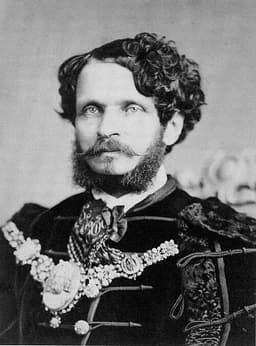
Count Andrassy
Politician · Modern
58.1Total

Soong Chu-yu
Politician · Modern
43.8Total
Basic Information
Born
1823
1942
Died
1890
—
Era
Modern
Modern
Nationality
Austria
China
Occupation
Politician
Politician
Civilization
Western
Eastern
Score Comparison
Military (10%)
48.9
14.3
Political (20%)
72.0
43.7
Influence (20%)
60.0
48.6
Legacy (20%)
49.2
40.0
Leadership (15%)
72.0
67.0
Strategy (15%)
43.2
36.0
TOTAL
58.1
43.8
Count Andrassy — Complete Timeline
1871 AD
Appointment as Foreign Minister of Austria-HungaryPolitical Action◆ Major
Andrassy was appointed Foreign Minister of Austria-Hungary by Emperor Franz Joseph. He was the first Hungarian to hold this position, reflecting the dual monarchy's structure.
AppointmentForeign PolicyDual Monarchy
Impact: national
1878 AD
Congress of BerlinPolitical Action◆ Major
Andrassy represented Austria-Hungary at the Congress of Berlin, which revised the Treaty of San Stefano. He secured the right to occupy and administer Bosnia and Herzegovina, expanding Habsburg influence in the Balkans.
CongressBalkansTerritorial Expansion
Impact: regionalconstructive
1879 AD
Dual Alliance with GermanyPolitical Action
Andrassy negotiated the Dual Alliance between Austria-Hungary and Germany. This defensive treaty committed both powers to mutual support in case of a Russian attack, forming the core of the Central Powers in World War I.
AllianceGermanyCentral Powers
Impact: regionalconstructive
Resignation as Foreign MinisterPolitical Action◆ Major
Andrassy resigned as Foreign Minister after the Dual Alliance was signed. He cited health reasons and a desire to return to Hungarian politics, but his resignation also reflected tensions within the empire.
ResignationHungaryPolitics
Impact: national
Soong Chu-yu — Complete Timeline
2000 AD
Founded the People First PartyPolitical Action◆ Major
James Soong founded the People First Party (PFP) in Taiwan after leaving the Kuomintang. The party positioned itself as a centrist alternative, attracting voters dissatisfied with the KMT and DPP.
Party FoundingPolitical Movement
Impact: nationalconstructive
Ran for President of TaiwanPolitical Action◆ Major
James Soong ran as an independent candidate in the 2000 Taiwanese presidential election, finishing second with 36.8% of the vote. His candidacy split the KMT vote, contributing to Chen Shui-bian's victory.
Presidential ElectionPolitical Campaign
Impact: national
2004 AD
Ran for President of TaiwanPolitical Action◆ Major
James Soong ran for president again in 2004 as the PFP candidate, finishing third with 6.8% of the vote. He failed to gain significant traction, and the election was won by Chen Shui-bian.
Presidential ElectionPolitical Campaign
Impact: national
2012 AD
Ran for President of TaiwanPolitical Action
James Soong ran for president for the third time in 2012 as the PFP candidate, finishing third with 2.8% of the vote. His campaign focused on cross-strait relations and economic issues.
Presidential ElectionPolitical Campaign
Impact: national
This comparison has not been analyzed yet.
One-time AI generation (~1 minute). Scores and timeline are already available below.
Rankings
🥇
Count AndrassyLeader
Mil: 48.9Pol: 72.0Inf: 60.0
58.1
🥈
Soong Chu-yu
Mil: 14.3Pol: 43.7Inf: 48.6
43.8
+14.3 behind
How This Comparison Works
Algorithm
Each figure is scored on 6 dimensions (0—100 scale) based on structured historical data: Military (10%), Political (20%), Influence (20%), Legacy (20%), Leadership (15%), Strategy (15%). The weighted total produces the final ranking.
Data Sources
Scores are computed from structured sub-indicators in the database. Scale factors adjust for era (Ancient ×0.85, Modern ×1.0) and civilization size (Eastern ×1.05, Other ×0.80) to account for differences in population and military scale.
Maximum 3 Figures
Comparisons are limited to 2—3 figures to ensure readability and statistical meaningfulness.
Error Margins
±5 points per dimension — Sub-scores are derived from historical records with inherent uncertainty. Two figures within 5 points on a dimension should be considered roughly equivalent in that area.
Total Score Accuracy
±3 points overall — The weighted combination of 6 dimensions produces a total score with approximately ±3 points of uncertainty. Differences of less than 3 points are not statistically significant— the figures are effectively tied.
Known Limitations
- Historical records are incomplete and uneven across civilizations
- Figures from oral-tradition societies may be underrepresented
- Occupation labels can misclassify multi-role figures
- Scores measure capability and impact, not moral character
- Quantitative scoring is a comparison tool, not absolute truth
Capability Radar
Military (10%) — Battles & Warfare
Battles
26
13
Win Rate
34
18
Expansion
37
20
Political (20%) — Governance & Reform
Reform
60
30
Diplomacy
75
40
Economy
55
35
Influence (20%) — Cultural & Global Reach
Cultural
40
20
Global
50
10
Legacy (20%) — Historical Impact
Historical
55
25
Longevity
40
15
Leadership (15%) — Power & Stability
Tenure
65
45
Stability
60
25
Strategy (15%) — Tactics & Innovation
Strategy
40
20
Tactics
41
27
Reform
43
29
Similar Comparisons
Comments & Discussion
No comments yet. Be the first to share your thoughts!