Loading...
Count Andrassy vs Julius Caesar
Julius Caesar leads by 24.7 pts · 2 figures compared
…
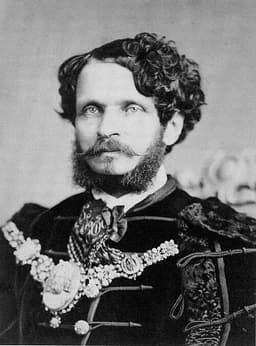
Count Andrassy
Politician · Modern
58.1Total

Julius Caesar
General · Ancient
82.8Total
Basic Information
Born
1823
-100
Died
1890
-44
Era
Modern
Ancient
Nationality
Austria
Roman Republic
Occupation
Politician
General
Civilization
Western
Western
Score Comparison
Military (10%)
48.9
88.0
Political (20%)
72.0
78.0
Influence (20%)
60.0
85.0
Legacy (20%)
49.2
82.0
Leadership (15%)
72.0
80.0
Strategy (15%)
43.2
85.0
TOTAL
58.1
82.8
Count Andrassy — Complete Timeline
1871 AD
Appointment as Foreign Minister of Austria-HungaryPolitical Action◆ Major
Andrassy was appointed Foreign Minister of Austria-Hungary by Emperor Franz Joseph. He was the first Hungarian to hold this position, reflecting the dual monarchy's structure.
AppointmentForeign PolicyDual Monarchy
Impact: national
1878 AD
Congress of BerlinPolitical Action◆ Major
Andrassy represented Austria-Hungary at the Congress of Berlin, which revised the Treaty of San Stefano. He secured the right to occupy and administer Bosnia and Herzegovina, expanding Habsburg influence in the Balkans.
CongressBalkansTerritorial Expansion
Impact: regionalconstructive
1879 AD
Dual Alliance with GermanyPolitical Action
Andrassy negotiated the Dual Alliance between Austria-Hungary and Germany. This defensive treaty committed both powers to mutual support in case of a Russian attack, forming the core of the Central Powers in World War I.
AllianceGermanyCentral Powers
Impact: regionalconstructive
Resignation as Foreign MinisterPolitical Action◆ Major
Andrassy resigned as Foreign Minister after the Dual Alliance was signed. He cited health reasons and a desire to return to Hungarian politics, but his resignation also reflected tensions within the empire.
ResignationHungaryPolitics
Impact: national
Julius Caesar — Complete Timeline
58 BC
Gallic WarsWar◆ Major
Caesar, as proconsul of Gaul, launched a series of campaigns that conquered all of Gaul (modern France, Belgium, and parts of Switzerland). He fought numerous battles, including against the Helvetii, the Belgae, and the Gallic chieftain Vercingetorix. The wars brought immense wealth and a loyal army to Caesar.
Gallic WarsConquestRoman Expansion
Impact: regional
49 BC
Crossing the RubiconPolitical Action◆ Major
Caesar led Legio XIII across the Rubicon River into Italy, defying the Roman Senate's order to disband his army. This act triggered a civil war against Pompey and the Optimates, ultimately leading to Caesar's dictatorship and the end of the Roman Republic.
Roman Civil WarEnd of RepublicPower Struggle
Impact: global
48 BC
Battle of PharsalusWar◆ Major
Caesar's outnumbered army defeated the larger forces of Pompey the Great at Pharsalus in Greece. Caesar's tactical use of a reserve line to counter Pompey's cavalry charge proved decisive. Pompey fled to Egypt, where he was assassinated, leaving Caesar as the undisputed master of the Roman world.
Roman Civil WarBattleDecisive Victory
Impact: regional
44 BC
Appointment as Dictator for LifePolitical Action◆ Major
The Roman Senate appointed Caesar dictator perpetuo (dictator for life), granting him unprecedented personal power. This move concentrated military, legislative, and judicial authority in one person, effectively ending the Roman Republic's traditional system of checks and balances and alarming many senators.
DictatorshipEnd of RepublicPower Consolidation
Impact: regionaldestructive
Assassination on the Ides of MarchPolitical Action◆ Major
A group of Roman senators, led by Marcus Junius Brutus and Gaius Cassius Longinus, stabbed Caesar to death at a meeting of the Senate in the Theatre of Pompey. The assassination was intended to restore the Republic, but instead triggered another civil war that led to the rise of the Roman Empire.
AssassinationRoman PoliticsEnd of Republic
Impact: globaldestructive
Expert Analysis
count-andrassy-vs-julius-caesar
# The Crossroads of Power: Caesar and Andrássy
On a cold March morning in 44 BCE, Julius Caesar walked into the Senate chamber, dismissing a warning from a soothsayer. Moments later, he lay bleeding on the marble floor, stabbed twenty-three times by men he had once called friends. Nineteen centuries later and a thousand miles north, Count Gyula Andrássy sat in a Viennese palace, calmly affixing his signature to a treaty that would reshape Europe—and then quietly resigned, choosing to walk away from power while he still could. One man died clutching at the hem of history; the other let it slip through his fingers deliberately. Both stood at the fulcrum of their age, yet their paths could not have diverged more sharply. What drives a man to grasp for empire, and what compels another to step back from the brink?
Origins
Julius Caesar was born into the chaos of a dying republic. His family, the Julii, claimed descent from the goddess Venus, but their political fortunes had long since faded. Rome in the first century BCE was a world of civil wars, slave revolts, and senatorial corruption—a system buckling under the weight of its own ambition. Caesar’s father died when he was sixteen, leaving him to navigate the treacherous waters of Roman politics with little more than a name and a fierce hunger for glory. He learned early that in a world where loyalty was bought and sold, the only currency that mattered was power.
Count Gyula Andrássy, by contrast, was born in 1823 into the secure, ornate world of the Hungarian nobility. His father was a loyal servant of the Habsburg monarchy, and young Andrássy grew up in the shadow of the Austrian Empire—a sprawling, multi-ethnic realm held together by dynastic loyalty and cautious reform. Where Caesar’s Rome was a battlefield of open ambition, Andrássy’s Vienna was a chessboard of delicate diplomacy. The Hungarian nobleman learned not to conquer, but to negotiate; not to seize, but to persuade.
Rise to Power
Caesar’s ascent was a masterclass in audacity. He borrowed fortunes to fund lavish games and bribe voters, then used his military command in Gaul to build a personal army loyal to him alone. The crossing of the Rubicon in 49 BCE was not just a river—it was the point of no return, a declaration that he would rather rule a shattered republic than serve a broken one. By the time he declared himself dictator for life, he had crushed his rivals in a civil war that left Rome’s old order in ruins.
Andrássy’s rise was quieter but no less strategic. As a young Hungarian nationalist, he was even sentenced to death in absentia for his role in the 1848 revolution—a sharp reminder of the risks of defiance. But after a decade in exile, he returned with a different approach. He realized that Hungary could not break free from Austria, so he chose to reshape the empire from within. In 1871, Emperor Franz Joseph appointed him Foreign Minister—the first Hungarian to hold that post—and Andrássy used that position to forge the Austro-Hungarian Compromise of 1867, effectively turning his nation into a co-equal partner in the Dual Monarchy.
Leadership & Governance
Caesar ruled as a military autocrat. His genius lay in speed and decisiveness: he conquered Gaul in eight years, defeated Pompey’s larger armies with lightning marches, and reformed Rome’s calendar, grain dole, and provincial administration with the same ruthless efficiency. But his governance was a one-man show. He centralized power, packed the Senate with his supporters, and treated opposition as treason. His leadership was brilliant—and brittle. When he fell, there was no system to replace him, only another civil war.
Andrássy governed as a diplomat and architect of alliances. His greatest achievement was the Congress of Berlin in 1878, where he secured Austria-Hungary’s occupation of Bosnia-Herzegovina without triggering a general European war. More critically, in 1879 he negotiated the Dual Alliance with Germany—a defensive pact that would anchor European diplomacy for decades. Andrássy’s leadership was patient, pragmatic, and built on trust. He understood that in the world of great powers, survival depended not on crushing rivals but on binding them to your interests.
Triumph & Tragedy
Caesar’s triumph was the conquest of Gaul, a campaign that added a vast, wealthy province to Rome and made him the most powerful man in the Mediterranean. His tragedy was that he could not conceive of a world where he was not the center of it. The Ides of March was not just an assassination; it was the logical end of a life that had no room for equals. He died because he refused to share power.
Andrássy’s triumph was the Dual Alliance, a treaty that gave Austria-Hungary a powerful ally and a measure of security in a dangerous continent. His tragedy was more subtle: he resigned the same year, citing health and a desire to return to private life. But the alliance he forged would outlive him, and its rigid commitments would help drag Europe into the catastrophe of 1914. Andrássy’s tragedy was not his own death, but the unintended consequences of his success.
Character & Destiny
Caesar’s character was driven by an insatiable need for personal glory. He once remarked, “I had rather be first in a little Iberian village than second in Rome.” This hunger made him unstoppable—and ultimately ungovernable. His destiny was to destroy the Republic and plant the seeds of the Empire, but he could not be the emperor himself. He was too dangerous to live, too powerful to control.
Andrássy’s character was shaped by a deep realism. He knew that Hungary could not dominate Europe, but it could influence it. He once said, “We must be the rudder, not the sail.” His destiny was to build a system that would preserve his nation’s place in the world—and then step aside before his own ambition could undo it. He was a survivor, not a conqueror.
Legacy
Caesar’s legacy is monumental. His name became a title—Kaiser, Tsar—and his reforms laid the foundation for the Roman Empire. He is remembered as a military genius, a political revolutionary, and a cautionary tale about the costs of unchecked ambition. His scores—Military 88, Political 78, Influence 85, Legacy 82—reflect a man who changed the world, for better and worse.
Andrássy’s legacy is quieter but enduring. He is remembered as the statesman who stabilized the Habsburg monarchy and gave Hungary a voice in European affairs. His scores—Political 81, Leadership 79, Legacy 68—reveal a man who built structures, not monuments. The Dual Alliance he forged shaped the alliances of World War I, and his diplomatic style influenced generations of Central European statesmen.
Conclusion
Caesar and Andrássy represent two poles of leadership: the conqueror and the conciliator. One sought to remake the world in his image; the other sought to find his nation’s place within it. Caesar’s story ends in blood and betrayal; Andrássy’s ends in a quiet resignation. Yet both understood a fundamental truth: that power is not a possession but a relationship. The question is not how much you can take, but what you leave behind. Caesar left an empire; Andrássy left an alliance. In the end, perhaps the greatest difference is not in what they achieved, but in what they were willing to risk—and what they were wise enough to let go.
Rankings
🥇
Julius CaesarLeader
Mil: 88.0Pol: 78.0Inf: 85.0
82.8
🥈
Count Andrassy
Mil: 48.9Pol: 72.0Inf: 60.0
58.1
+24.7 behind
How This Comparison Works
Algorithm
Each figure is scored on 6 dimensions (0—100 scale) based on structured historical data: Military (10%), Political (20%), Influence (20%), Legacy (20%), Leadership (15%), Strategy (15%). The weighted total produces the final ranking.
Data Sources
Scores are computed from structured sub-indicators in the database. Scale factors adjust for era (Ancient ×0.85, Modern ×1.0) and civilization size (Eastern ×1.05, Other ×0.80) to account for differences in population and military scale.
Maximum 3 Figures
Comparisons are limited to 2—3 figures to ensure readability and statistical meaningfulness.
Error Margins
±5 points per dimension — Sub-scores are derived from historical records with inherent uncertainty. Two figures within 5 points on a dimension should be considered roughly equivalent in that area.
Total Score Accuracy
±3 points overall — The weighted combination of 6 dimensions produces a total score with approximately ±3 points of uncertainty. Differences of less than 3 points are not statistically significant— the figures are effectively tied.
Known Limitations
- Historical records are incomplete and uneven across civilizations
- Figures from oral-tradition societies may be underrepresented
- Occupation labels can misclassify multi-role figures
- Scores measure capability and impact, not moral character
- Quantitative scoring is a comparison tool, not absolute truth
Capability Radar
Military (10%) — Battles & Warfare
Battles
26
95
Win Rate
34
92
Expansion
37
97
Political (20%) — Governance & Reform
Reform
60
90
Diplomacy
75
85
Economy
55
82
Influence (20%) — Cultural & Global Reach
Cultural
40
88
Global
50
94
Legacy (20%) — Historical Impact
Historical
55
95
Longevity
40
96
Leadership (15%) — Power & Stability
Tenure
65
75
Stability
60
60
Strategy (15%) — Tactics & Innovation
Strategy
40
94
Tactics
41
96
Reform
43
88
Similar Comparisons
Comments & Discussion
No comments yet. Be the first to share your thoughts!