Loading...
Constantine the Great vs King David
Constantine the Great leads by 0.2 pts · 2 figures compared
…
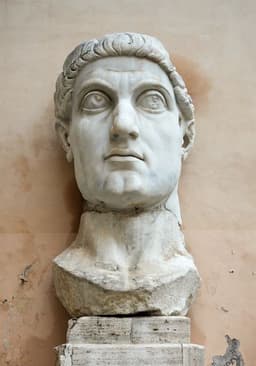
Constantine the Great
Emperor · Ancient
75.5Total

King David
Emperor · Ancient
75.3Total
Basic Information
Born
272
-1010
Died
337
-970
Era
Ancient
Ancient
Nationality
Roman Empire
Israel
Occupation
Emperor
Emperor
Civilization
Western
Middle Eastern
Score Comparison
Military (10%)
78.0
72.0
Political (20%)
82.0
72.0
Influence (20%)
75.0
88.0
Legacy (20%)
70.0
70.0
Leadership (15%)
80.0
72.0
Strategy (15%)
72.0
70.0
TOTAL
75.5
75.3
Constantine the Great — Complete Timeline
312 AD
Battle of the Milvian BridgeWar◆ Major
Constantine defeated his rival Maxentius at the Milvian Bridge near Rome. According to tradition, Constantine saw a vision of a cross in the sky with the words 'In this sign, conquer.' The victory made Constantine the sole ruler of the Western Roman Empire and led to his conversion to Christianity.
Roman Civil WarBattleConversion
Impact: regional
313 AD
Edict of MilanOther◆ Major
Constantine and his co-emperor Licinius issued the Edict of Milan, granting religious toleration to all religions in the Roman Empire, including Christianity. The edict ended the persecution of Christians, restored confiscated church property, and established Christianity as a legally recognized religion.
Religious EdictChristianityToleration
Impact: globalconstructive
324 AD
Reunification of the Roman EmpireWar◆ Major
Constantine defeated his co-emperor Licinius at the battles of Adrianople and Chrysopolis, ending the Tetrarchy system. He became the sole ruler of the entire Roman Empire, reuniting the Western and Eastern halves under his control. This reunification was the last time the Roman Empire was united under a single ruler.
Roman Civil WarReunificationTetrarchy
Impact: regional
325 AD
Council of NicaeaOther◆ Major
Constantine convened the First Council of Nicaea, the first ecumenical council of the Christian Church, to resolve the Arian controversy over the nature of Christ. The council produced the Nicene Creed, affirming the divinity of Christ and establishing a unified Christian doctrine. Constantine presided over the council.
Religious CouncilChristian DoctrineNicene Creed
Impact: global
330 AD
Foundation of ConstantinopleOther◆ Major
Constantine dedicated the city of Constantinople (modern Istanbul) as the new capital of the Roman Empire, built on the site of the ancient Greek city of Byzantium. The city was strategically located on the Bosporus strait, controlling trade routes between Europe and Asia. It became the capital of the Eastern Roman Empire for over a thousand years.
City FoundationCapitalByzantine Empire
Impact: globalconstructive
King David — Complete Timeline
1010 BC
Anointed as King of JudahPolitical Action◆ Major
After Saul's death, David was anointed king over the tribe of Judah at Hebron. This began a seven-year period of civil war with Ish-bosheth, Saul's son, who ruled the northern tribes, leading to the eventual unification of Israel.
KingshipCivil WarJudah
Impact: national
1003 BC
Capture of JerusalemWar
David led his army to capture the Jebusite fortress of Jerusalem, making it the capital of the united kingdom. He brought the Ark of the Covenant there, establishing the city as both the political and religious center of Israel.
JerusalemCapitalArk of the Covenant
Impact: nationalconstructive
1000 BC
Defeat of the PhilistinesWar◆ Major
David fought several campaigns that decisively defeated the Philistines, including the Battle of Baal-perazim. He captured Gath and other Philistine strongholds, ending their dominance over Israel and securing the kingdom's borders.
PhilistinesMilitary CampaignIsrael
Impact: regional
990 BC
Affair with BathshebaPolitical Action◆ Major
David committed adultery with Bathsheba and arranged the death of her husband Uriah the Hittite in battle. The prophet Nathan confronted David, leading to his repentance but also to divine punishment, including the death of their first child.
ScandalBathshebaNathan
Impact: nationaldestructive
978 BC
Revolt of AbsalomWar◆ Major
David's son Absalom led a rebellion that forced David to flee Jerusalem. David's forces under Joab defeated Absalom's army in the Forest of Ephraim, and Absalom was killed. David returned to Jerusalem but the kingdom was weakened.
RebellionCivil WarAbsalom
Impact: nationaltragic
Expert Analysis
Origins
Constantine the Great (272–337) was born in Naissus (modern-day Serbia) to Flavius Valerius Constantius, a Roman army officer, and Helena, a woman of humble origins. His father became Caesar of the Western Roman Empire, and Constantine rose through military ranks, eventually being proclaimed emperor by his troops after his father's death in 306. King David (c. 1040–970 BCE) was the youngest son of Jesse, a shepherd from Bethlehem. He was anointed by the prophet Samuel while still a boy, chosen by God to replace King Saul. David's early life as a shepherd and his defeat of Goliath established him as a folk hero.
Rise to Power
Constantine's rise was marked by a series of civil wars. After defeating Maxentius at the Battle of the Milvian Bridge in 312, he claimed to have seen a vision of the Christian cross with the words "In hoc signo vinces" (in this sign, conquer). He then issued the Edict of Milan in 313, legalizing Christianity throughout the empire. By 324, he defeated Licinius and reunified the Roman Empire under his sole rule. David's rise began after Saul's jealousy forced him into exile. He became king of Judah after Saul's death and later conquered the northern tribes, unifying Israel. His capture of Jerusalem from the Jebusites made it his capital.
Leadership & Governance
Constantine was a pragmatic and visionary ruler. He reorganized the Roman state, separating civil and military authority, and reformed the currency. His most significant act was the foundation of Constantinople (modern Istanbul) in 330, establishing a new Christian capital. He convened the First Council of Nicaea in 325, which produced the Nicene Creed, standardizing Christian doctrine. David's leadership combined military prowess with administrative skill. He centralized Israel's government, established Jerusalem as both political and religious center, and organized the priesthood. However, his governance was marred by personal failings that led to internal strife.
Triumph & Tragedy
Constantine's triumphs include his military victories, the legalization of Christianity, and the foundation of Constantinople. His reign brought stability after decades of civil war. Tragically, his later years were marked by family conflicts, including the execution of his eldest son Crispus and his wife Fausta. David's triumphs are legendary: his victory over Goliath, unification of Israel, and conquests that expanded the kingdom. His tragedy centers on his adultery with Bathsheba and the subsequent murder of her husband Uriah, which brought divine punishment. This led to family turmoil, including the revolt of his son Absalom, which nearly cost David his throne.
Character & Destiny
Constantine's character was a blend of ambition, piety, and ruthlessness. He was a skilled administrator and military commander who used Christianity to unify his empire. His destiny was to transform the Roman world from pagan to Christian, a legacy that shaped Western civilization. David's character was complex: a man after God's own heart, yet deeply flawed. He was a poet, warrior, and king whose destiny was to establish a dynasty from which, according to Christian belief, Jesus Christ would descend. Both men were instrumental in the spread of monotheism.
Legacy
Constantine's legacy is immense. He ended the persecution of Christians, set the stage for Christianity to become the state religion, and created a new imperial capital that endured for a millennium. His reign marks the transition from the Roman to the Byzantine Empire. David's legacy is equally profound. He is revered as the ideal king in Judaism, and his line is central to messianic prophecy in both Judaism and Christianity. The United Kingdom of Israel under David became a symbol of national unity. In terms of historical impact, Constantine's influence on the political and religious landscape of Europe is arguably greater, while David's spiritual legacy is more personal and enduring.
Conclusion
Constantine the Great (score: 76) and King David (score: 74) are both transformative figures, but Constantine's broader impact on world history gives him a slight edge. His legalization of Christianity and foundation of Constantinople reshaped the Roman Empire and laid the foundations for medieval Christendom. David's unification of Israel and his role as the progenitor of a messianic line are monumental within Judeo-Christian tradition, but his influence is more confined to the religious sphere. While David's personal story is more compelling, Constantine's institutional changes were more far-reaching. Therefore, Constantine is the more historically significant figure.
Rankings
🥇
Constantine the GreatLeader
Mil: 78.0Pol: 82.0Inf: 75.0
75.5
🥈
King David
Mil: 72.0Pol: 72.0Inf: 88.0
75.3
+0.2 behind
How This Comparison Works
Algorithm
Each figure is scored on 6 dimensions (0—100 scale) based on structured historical data: Military (10%), Political (20%), Influence (20%), Legacy (20%), Leadership (15%), Strategy (15%). The weighted total produces the final ranking.
Data Sources
Scores are computed from structured sub-indicators in the database. Scale factors adjust for era (Ancient ×0.85, Modern ×1.0) and civilization size (Eastern ×1.05, Other ×0.80) to account for differences in population and military scale.
Maximum 3 Figures
Comparisons are limited to 2—3 figures to ensure readability and statistical meaningfulness.
Error Margins
±5 points per dimension — Sub-scores are derived from historical records with inherent uncertainty. Two figures within 5 points on a dimension should be considered roughly equivalent in that area.
Total Score Accuracy
±3 points overall — The weighted combination of 6 dimensions produces a total score with approximately ±3 points of uncertainty. Differences of less than 3 points are not statistically significant— the figures are effectively tied.
Known Limitations
- Historical records are incomplete and uneven across civilizations
- Figures from oral-tradition societies may be underrepresented
- Occupation labels can misclassify multi-role figures
- Scores measure capability and impact, not moral character
- Quantitative scoring is a comparison tool, not absolute truth
Capability Radar
Military (10%) — Battles & Warfare
Battles
85
75
Win Rate
80
85
Expansion
85
80
Political (20%) — Governance & Reform
Reform
95
80
Diplomacy
90
75
Economy
80
70
Influence (20%) — Cultural & Global Reach
Cultural
95
95
Global
95
90
Legacy (20%) — Historical Impact
Historical
95
95
Longevity
95
95
Leadership (15%) — Power & Stability
Tenure
85
85
Stability
70
65
Strategy (15%) — Tactics & Innovation
Strategy
85
85
Tactics
75
80
Reform
90
70
Similar Comparisons
Comments & Discussion
No comments yet. Be the first to share your thoughts!