Loading...
Constantine the Great vs Duke of Wellington
Constantine the Great leads by 0.5 pts · 2 figures compared
…
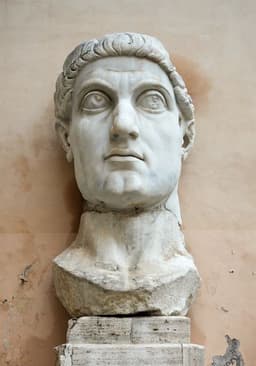
Constantine the Great
Emperor · Ancient
75.5Total

Duke of Wellington
General · Modern
75.0Total
Basic Information
Born
272
1769
Died
337
1852
Era
Ancient
Modern
Nationality
Roman Empire
United Kingdom
Occupation
Emperor
General
Civilization
Western
Western
Score Comparison
Military (10%)
78.0
78.0
Political (20%)
82.0
70.0
Influence (20%)
75.0
71.0
Legacy (20%)
70.0
80.0
Leadership (15%)
80.0
78.0
Strategy (15%)
72.0
72.0
TOTAL
75.5
75.0
Constantine the Great — Complete Timeline
312 AD
Battle of the Milvian BridgeWar◆ Major
Constantine defeated his rival Maxentius at the Milvian Bridge near Rome. According to tradition, Constantine saw a vision of a cross in the sky with the words 'In this sign, conquer.' The victory made Constantine the sole ruler of the Western Roman Empire and led to his conversion to Christianity.
Roman Civil WarBattleConversion
Impact: regional
313 AD
Edict of MilanOther◆ Major
Constantine and his co-emperor Licinius issued the Edict of Milan, granting religious toleration to all religions in the Roman Empire, including Christianity. The edict ended the persecution of Christians, restored confiscated church property, and established Christianity as a legally recognized religion.
Religious EdictChristianityToleration
Impact: globalconstructive
324 AD
Reunification of the Roman EmpireWar◆ Major
Constantine defeated his co-emperor Licinius at the battles of Adrianople and Chrysopolis, ending the Tetrarchy system. He became the sole ruler of the entire Roman Empire, reuniting the Western and Eastern halves under his control. This reunification was the last time the Roman Empire was united under a single ruler.
Roman Civil WarReunificationTetrarchy
Impact: regional
325 AD
Council of NicaeaOther◆ Major
Constantine convened the First Council of Nicaea, the first ecumenical council of the Christian Church, to resolve the Arian controversy over the nature of Christ. The council produced the Nicene Creed, affirming the divinity of Christ and establishing a unified Christian doctrine. Constantine presided over the council.
Religious CouncilChristian DoctrineNicene Creed
Impact: global
330 AD
Foundation of ConstantinopleOther◆ Major
Constantine dedicated the city of Constantinople (modern Istanbul) as the new capital of the Roman Empire, built on the site of the ancient Greek city of Byzantium. The city was strategically located on the Bosporus strait, controlling trade routes between Europe and Asia. It became the capital of the Eastern Roman Empire for over a thousand years.
City FoundationCapitalByzantine Empire
Impact: globalconstructive
Duke of Wellington — Complete Timeline
1803 AD
Battle of AssayeWar◆ Major
Wellington, then Sir Arthur Wellesley, led a British-Indian force to victory against the Maratha Confederacy at Assaye in India. Despite being outnumbered, his tactical skill secured British dominance in central India.
Maratha WarIndiaBattle
Impact: regional
1808 AD
Battle of VimeiroWar◆ Major
Wellington commanded British forces to defeat the French army at Vimeiro in Portugal. The victory halted the French invasion of Portugal and marked the beginning of the Peninsular War.
Peninsular WarPortugalBattle
Impact: regional
1815 AD
Battle of WaterlooWar
Wellington, commanding an Anglo-Allied army, defeated Napoleon Bonaparte at Waterloo in present-day Belgium. The battle ended the Napoleonic Wars and led to Napoleon's final exile to Saint Helena.
Napoleonic WarsBattleWaterloo
Impact: global
1828 AD
Prime Minister of the United KingdomPolitical Action◆ Major
Wellington served as Prime Minister of the UK from 1828 to 1830. His government passed the Catholic Relief Act 1829, granting Catholic emancipation, but his opposition to parliamentary reform led to his resignation.
PoliticsCatholic EmancipationReform
Impact: nationalconstructive
Expert Analysis
Origins
Constantine the Great (272–337 AD) was born in Naissus (modern Serbia) to a Roman military officer, Constantius Chlorus, and a mother of humble origins, Helena. His early life was shaped by the tetrarchy system and the brutal civil wars of the late Roman Empire. He rose through the ranks, gaining military experience in the East under Diocletian and Galerius. The Duke of Wellington (1769–1852), born Arthur Wellesley in Dublin, Ireland, was the son of an Anglo-Irish aristocrat. His early career was in the British Army, purchased commissions, and he served in India, where he honed his tactical skills. Both men came from military families, but Constantine’s path was forged in imperial intrigue, while Wellington’s was shaped by colonial warfare and aristocratic connections.
Rise to Power
Constantine’s rise began after his father’s death in 306 AD, when his troops proclaimed him Augustus. He spent the next 18 years consolidating power, culminating in the Battle of the Milvian Bridge (312 AD), where he defeated Maxentius under the sign of the Christian cross. This victory made him master of the West. He later defeated Licinius in 324 AD, reunifying the Roman Empire. Wellington’s rise was more gradual: he gained fame in India at the Battle of Assaye (1803), then proved his mettle in the Peninsular War (1808–1814), defeating French marshals and liberating Spain. His crowning achievement was the Battle of Waterloo (1815), where he commanded the Allied army that finally defeated Napoleon. Both men seized pivotal moments, but Constantine’s rise involved a dramatic religious conversion and the unification of a fractured empire, while Wellington’s was a steady climb through military merit and political connections.
Leadership & Governance
Constantine was a transformative ruler: he legalized Christianity with the Edict of Milan (313 AD), convened the Council of Nicaea (325 AD) to unify doctrine, and founded Constantinople (330 AD) as a new capital, shifting the empire’s center eastward. He also reformed the army, currency, and bureaucracy. Wellington served as Prime Minister of the United Kingdom (1828–1830) and again briefly, but his political career was less successful. He resisted Catholic emancipation initially but eventually conceded, and his opposition to parliamentary reform made him unpopular. As a leader, Constantine was visionary and decisive, reshaping the empire and religion for centuries; Wellington was a pragmatic conservative, more effective as a general than as a politician.
Triumph & Tragedy
Constantine’s triumphs include the Milvian Bridge, the reunification of the empire, and the foundation of Constantinople. His tragedies include the execution of his son Crispus and his wife Fausta (possibly due to palace intrigue), and the ongoing Donatist and Arian controversies that plagued his religious settlement. Wellington’s triumph is Waterloo, the definitive end of the Napoleonic Wars. His tragedy is less personal but includes the political isolation after his premiership and the criticism of his conservative stance. Both faced internal strife, but Constantine’s tragedies were more personal and bloody.
Character & Destiny
Constantine: ambitious, ruthless, and politically astute. He used religion as a tool for unity but also genuinely believed he was chosen by God. His destiny was to reshape the Roman world into a Christian empire. Wellington: stoic, disciplined, and pragmatic. He was called the "Iron Duke" for his unyielding resolve. His destiny was to be the architect of Napoleon’s final defeat. Both were men of their times, but Constantine’s impact was more fundamental, altering the course of Western civilization.
Legacy
Constantine’s legacy is immense: he ended the persecution of Christians, laid the foundations for Byzantine civilization, and influenced the development of Christianity into a global religion. Constantinople remained the capital of the Eastern Roman Empire for over a millennium. Wellington’s legacy is more limited: he is remembered as a great military commander, especially for Waterloo, and his name is immortalized in Wellington boots and beef Wellington. But his political legacy is minor compared to Constantine’s. Both scored equally in Military (78), but Constantine leads in Political (82 vs 70), Influence (75 vs 71), and Durability (80 vs 78). In Leadership (70 vs 80) and Tactics (72 vs 75), Wellington scores higher.
Conclusion
Constantine the Great emerges as the more consequential figure, with a broader and longer-lasting impact on world history. His military victories, political reforms, and religious transformation shaped the medieval and modern worlds. Wellington was a superb general and a capable leader, but his influence was confined to the 19th century. Constantine’s score advantage (0.5) reflects his greater historical weight. **Winner: Constantine the Great**.
Rankings
🥇
Constantine the GreatLeader
Mil: 78.0Pol: 82.0Inf: 75.0
75.5
🥈
Duke of Wellington
Mil: 78.0Pol: 70.0Inf: 71.0
75.0
+0.5 behind
How This Comparison Works
Algorithm
Each figure is scored on 6 dimensions (0—100 scale) based on structured historical data: Military (10%), Political (20%), Influence (20%), Legacy (20%), Leadership (15%), Strategy (15%). The weighted total produces the final ranking.
Data Sources
Scores are computed from structured sub-indicators in the database. Scale factors adjust for era (Ancient ×0.85, Modern ×1.0) and civilization size (Eastern ×1.05, Other ×0.80) to account for differences in population and military scale.
Maximum 3 Figures
Comparisons are limited to 2—3 figures to ensure readability and statistical meaningfulness.
Error Margins
±5 points per dimension — Sub-scores are derived from historical records with inherent uncertainty. Two figures within 5 points on a dimension should be considered roughly equivalent in that area.
Total Score Accuracy
±3 points overall — The weighted combination of 6 dimensions produces a total score with approximately ±3 points of uncertainty. Differences of less than 3 points are not statistically significant— the figures are effectively tied.
Known Limitations
- Historical records are incomplete and uneven across civilizations
- Figures from oral-tradition societies may be underrepresented
- Occupation labels can misclassify multi-role figures
- Scores measure capability and impact, not moral character
- Quantitative scoring is a comparison tool, not absolute truth
Capability Radar
Military (10%) — Battles & Warfare
Battles
85
85
Win Rate
80
90
Expansion
85
75
Political (20%) — Governance & Reform
Reform
95
65
Diplomacy
90
80
Economy
80
60
Influence (20%) — Cultural & Global Reach
Cultural
95
75
Global
95
80
Legacy (20%) — Historical Impact
Historical
95
85
Longevity
95
80
Leadership (15%) — Power & Stability
Tenure
85
75
Stability
70
70
Strategy (15%) — Tactics & Innovation
Strategy
85
88
Tactics
75
92
Reform
90
70
Similar Comparisons
Comments & Discussion
No comments yet. Be the first to share your thoughts!