Loading...
This comparison has not been analyzed yet.
One-time AI generation (~1 minute). Scores and timeline are already available below.
Constans II vs Teti
Constans II leads by 17.5 pts · 2 figures compared
…
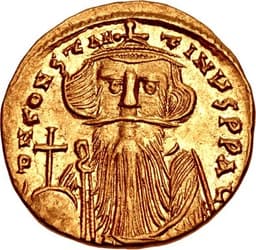
Constans II
Emperor · Ancient
55.2Total

Teti
Emperor · Ancient
37.7Total
Basic Information
Born
-630
-2340
Died
—
-2320
Era
Ancient
Ancient
Nationality
Byzantine Empire
Old Kingdom Egypt
Occupation
Emperor
Emperor
Civilization
Western
Middle Eastern
Score Comparison
Military (10%)
55.0
25.9
Political (20%)
68.0
27.9
Influence (20%)
51.0
47.9
Legacy (20%)
44.2
37.5
Leadership (15%)
65.0
39.0
Strategy (15%)
60.0
36.8
TOTAL
55.2
37.7
Constans II — Complete Timeline
648 AD
Issued the Typos of ConstansPolitical Action
Constans II issued the Typos, an edict that forbade discussion of the Monothelite controversy. The edict aimed to end religious strife but was condemned by the Papacy and failed to restore unity.
Religious PolicyChurch ControversyByzantine Empire
Impact: regional
663 AD
Visited RomePolitical Action◆ Major
Constans II became the last Byzantine emperor to visit Rome. He was received by Pope Vitalian and spent twelve days in the city, stripping it of many bronze ornaments and statues to be sent to Constantinople.
Imperial VisitRomeByzantine Empire
Impact: regional
668 AD
Murdered in SyracusePolitical Action◆ Major
While residing in Syracuse, Sicily, Constans II was assassinated in his bath by a chamberlain. His death was part of a conspiracy, and his son Constantine IV succeeded him after suppressing the usurper Mezezius.
AssassinationByzantine EmpireSuccession Crisis
Impact: nationaltragic
674 AD
Defended Constantinople against the Arab siegeWar◆ Major
Constans II's son, Constantine IV, was actually the emperor during the first Arab siege of Constantinople. Constans II himself faced Arab raids but did not command the defense of the capital during the major siege.
Arab-Byzantine WarsSiegeByzantine Empire
Impact: regional
Teti — Complete Timeline
2340 BC
Founding of the Sixth DynastyPolitical Action◆ Major
Teti founded the Sixth Dynasty of Egypt, possibly through marriage to a daughter of Unas. His accession marked a continuation of the Old Kingdom, but also the beginning of a period of increasing decentralization and the growing power of provincial officials.
Dynasty VIFoundationOld Kingdom
Impact: national
Construction of the Pyramid of Teti at SaqqaraCultural◆ Major
Teti built his pyramid at Saqqara, near that of Unas. The pyramid originally stood about 52 meters high and contained Pyramid Texts in the burial chamber. The complex included a mortuary temple and a satellite pyramid for the queen.
ArchitecturePyramidSaqqara
Impact: nationalconstructive
2320 BC
Assassination by his own bodyguardsPolitical Action◆ Major
Teti was assassinated in a palace conspiracy involving his own bodyguards, as recorded in the Turin King List and later Egyptian tradition. This event marked a period of instability and may have been related to the growing power of the nobility.
AssassinationPalace ConspiracyInstability
Impact: nationaltragic
This comparison has not been analyzed yet.
One-time AI generation (~1 minute). Scores and timeline are already available below.
Rankings
🥇
Constans IILeader
Mil: 55.0Pol: 68.0Inf: 51.0
55.2
🥈
Teti
Mil: 25.9Pol: 27.9Inf: 47.9
37.7
+17.5 behind
How This Comparison Works
Algorithm
Each figure is scored on 6 dimensions (0—100 scale) based on structured historical data: Military (10%), Political (20%), Influence (20%), Legacy (20%), Leadership (15%), Strategy (15%). The weighted total produces the final ranking.
Data Sources
Scores are computed from structured sub-indicators in the database. Scale factors adjust for era (Ancient ×0.85, Modern ×1.0) and civilization size (Eastern ×1.05, Other ×0.80) to account for differences in population and military scale.
Maximum 3 Figures
Comparisons are limited to 2—3 figures to ensure readability and statistical meaningfulness.
Error Margins
±5 points per dimension — Sub-scores are derived from historical records with inherent uncertainty. Two figures within 5 points on a dimension should be considered roughly equivalent in that area.
Total Score Accuracy
±3 points overall — The weighted combination of 6 dimensions produces a total score with approximately ±3 points of uncertainty. Differences of less than 3 points are not statistically significant— the figures are effectively tied.
Known Limitations
- Historical records are incomplete and uneven across civilizations
- Figures from oral-tradition societies may be underrepresented
- Occupation labels can misclassify multi-role figures
- Scores measure capability and impact, not moral character
- Quantitative scoring is a comparison tool, not absolute truth
Capability Radar
Military (10%) — Battles & Warfare
Battles
55
10
Win Rate
50
10
Expansion
30
10
Political (20%) — Governance & Reform
Reform
55
15
Diplomacy
50
15
Economy
45
15
Influence (20%) — Cultural & Global Reach
Cultural
40
15
Global
25
10
Legacy (20%) — Historical Impact
Historical
45
20
Longevity
30
15
Leadership (15%) — Power & Stability
Tenure
65
20
Stability
35
5
Strategy (15%) — Tactics & Innovation
Strategy
50
10
Tactics
45
10
Reform
40
10
Similar Comparisons
Comments & Discussion
No comments yet. Be the first to share your thoughts!