Loading...
Constans II vs Napoleon Bonaparte
Napoleon Bonaparte leads by 15.7 pts · 2 figures compared
…
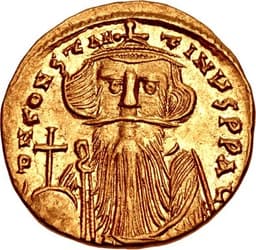
Constans II
Emperor · Ancient
55.2Total

Napoleon Bonaparte
General · Modern
70.9Total
Basic Information
Born
-630
1769
Died
—
1821
Era
Ancient
Modern
Nationality
Byzantine Empire
France
Occupation
Emperor
General
Civilization
Western
Western
Score Comparison
Military (10%)
55.0
94.0
Political (20%)
68.0
72.0
Influence (20%)
51.0
40.0
Legacy (20%)
44.2
80.0
Leadership (15%)
65.0
78.0
Strategy (15%)
60.0
90.0
TOTAL
55.2
70.9
Constans II — Complete Timeline
648 AD
Issued the Typos of ConstansPolitical Action
Constans II issued the Typos, an edict that forbade discussion of the Monothelite controversy. The edict aimed to end religious strife but was condemned by the Papacy and failed to restore unity.
Religious PolicyChurch ControversyByzantine Empire
Impact: regional
663 AD
Visited RomePolitical Action◆ Major
Constans II became the last Byzantine emperor to visit Rome. He was received by Pope Vitalian and spent twelve days in the city, stripping it of many bronze ornaments and statues to be sent to Constantinople.
Imperial VisitRomeByzantine Empire
Impact: regional
668 AD
Murdered in SyracusePolitical Action◆ Major
While residing in Syracuse, Sicily, Constans II was assassinated in his bath by a chamberlain. His death was part of a conspiracy, and his son Constantine IV succeeded him after suppressing the usurper Mezezius.
AssassinationByzantine EmpireSuccession Crisis
Impact: nationaltragic
674 AD
Defended Constantinople against the Arab siegeWar◆ Major
Constans II's son, Constantine IV, was actually the emperor during the first Arab siege of Constantinople. Constans II himself faced Arab raids but did not command the defense of the capital during the major siege.
Arab-Byzantine WarsSiegeByzantine Empire
Impact: regional
Napoleon Bonaparte — Complete Timeline
1799 AD
Coup of 18 BrumaireOther◆ Major
Napoleon Bonaparte, with support from his brother Lucien and key political figures, overthrew the Directory in a bloodless coup. He established the Consulate with himself as First Consul, effectively becoming the ruler of France. This event ended the French Revolution's most unstable period.
French RevolutionCoupRise to Power
Impact: regional
1804 AD
Promulgation of the Napoleonic CodeOther◆ Major
Napoleon enacted the Civil Code of the French, known as the Napoleonic Code, a comprehensive set of laws that replaced the fragmented feudal legal systems. The code established legal equality, protected property rights, and secularized law. It became the basis for legal systems in many European and world countries.
Legal ReformNapoleonic CodeCivil Law
Impact: globalconstructive
1805 AD
Battle of AusterlitzWar◆ Major
Napoleon's Grande Arm
Napoleonic WarsBattleDecisive Victory
Impact: global
1812 AD
Invasion of RussiaWar◆ Major
Napoleon led the Grande Arm
Napoleonic WarsInvasionDisaster
Impact: globaldestructive
1815 AD
Battle of WaterlooWar◆ Major
Napoleon's French army was defeated by the combined forces of the Duke of Wellington's Anglo-Allied army and Gebhard Leberecht von Bl
Napoleonic WarsBattleFinal Defeat
Impact: globaldestructive
Expert Analysis
constans-ii-vs-napoleon-bonaparte
# The Emperor and the General: Two Paths to Power in a World of Chaos
On a sweltering August morning in 663, a Byzantine emperor stepped onto the ancient streets of Rome for the first time in nearly two centuries. The city that had once ruled the world was now a shadow of itself—its aqueducts broken, its population a fraction of what it had been, its great monuments crumbling under the weight of neglect and Lombard raids. The man who walked those streets, Constans II, was no triumphant conqueror. He was a fugitive from his own capital, a ruler whose empire was besieged on every side, and whose visit to the Eternal City would prove to be the last any Byzantine emperor would ever make. Just over a century later, another man would stand at the threshold of history—a young Corsican artillery officer who would, within a few short years, crown himself emperor of France and redraw the map of Europe with the stroke of a pen. How did these two figures, both born to rule in eras of crisis, arrive at such vastly different fates? The answer lies not in the stars, but in the soil of their times and the steel of their characters.
Origins
Napoleon Bonaparte was born in 1769 on the island of Corsica, a land that had only recently passed from Genoese to French control. His family was minor nobility, but their status was precarious, their fortunes modest. The young Napoleon grew up speaking Italian-accented French, an outsider in the very nation he would one day lead. This sense of being an outsider, of having something to prove, would burn in him like a forge-fire throughout his life. The French Revolution, which erupted when he was twenty, shattered the old order and opened a path for talent over birth. For a brilliant young artilleryman, it was the opportunity of a millennium.
Constans II, by contrast, was born into the purple—literally. His birth name was Heraclius Constantine, and he was the son of Emperor Constantine III, grandson of the great Heraclius who had saved the empire from the Persians. He was born around 630, at the height of the Arab conquests that had already stripped the Byzantine Empire of Syria, Palestine, Egypt, and Mesopotamia. His childhood was spent in the shadow of catastrophe, watching the empire shrink year by year, knowing that the world his grandfather had ruled was slipping away forever. He was not an outsider; he was the last heir of a dying order.
Rise to Power
Napoleon’s rise was meteoric. In 1793, at the age of twenty-four, he drove the British from the port of Toulon, earning promotion to brigadier general. By 1796, he was commanding the Army of Italy, where his lightning campaigns against the Austrians made him a national hero. In 1799, he seized power in a coup d’état, becoming First Consul of France. By 1804, he crowned himself Emperor. Each step was a gamble, each victory a foundation for the next. He understood, as few have, that in revolutionary times, audacity is the only currency that matters.
Constans II’s path was far more constrained. He became emperor in 641 at age eleven, after a chaotic succession that saw his father die and his uncle briefly seize power. He spent his youth watching the empire survive by the skin of its teeth—losing Egypt to the Arabs in 642, seeing the first Arab naval raids against Cyprus and Rhodes. When he came of age, he inherited not a revolutionary army but a depleted treasury, not a unified nation but a fractured empire torn by religious disputes over the nature of Christ. His rise was not a conquest; it was a survival.
Leadership & Governance
Napoleon governed with the energy of a force of nature. He reorganized French law into the Napoleonic Code, a system of civil law that would influence legal systems across Europe and the world. He centralized the administration, created the Bank of France, reformed education, and established the Legion of Honor. His military genius—rated 94 in strategy—was matched by his political skill—rated 75—though the latter would ultimately fail him. He understood power as a tool for transformation, and he wielded it without hesitation.
Constans II governed with the caution of a man who knew the ground was shifting beneath his feet. His political score of 62 reflects a ruler who managed, just barely, to hold his empire together. In 648, he issued the Typos, an edict that forbade discussion of the Monothelite controversy—a theological dispute over whether Christ had one will or two. It was a political compromise, an attempt to silence an argument that was tearing the empire apart. But it satisfied no one. The Pope condemned it, the eastern provinces ignored it, and the controversy simmered on. His military score of 39 suggests a ruler who was more administrator than warrior, more survivor than conqueror.
Triumph & Tragedy
Napoleon’s greatest triumph was Austerlitz in 1805, where he crushed the combined armies of Russia and Austria in a battle that remains a masterpiece of military art. His greatest tragedy was the invasion of Russia in 1812, where the vastness of the land and the cruelty of the winter destroyed his Grande Armée. He was exiled to Elba, returned, and was finally defeated at Waterloo in 1815. His score of 94 in military genius and 80 in leadership could not save him from his own hubris.
Constans II’s triumph was more modest: he was the last Byzantine emperor to visit Rome, in 663, a symbolic act that reminded the West that the empire still existed. His tragedy came five years later, in 668, when he was assassinated in his bath in Syracuse by a chamberlain. He died not on a battlefield, but in a bathtub, murdered by a servant. His son Constantine IV would go on to defend Constantinople against the Arab siege of 674—a victory that Constans II did not live to see.
Character & Destiny
Napoleon’s character was a paradox: brilliant and ruthless, visionary and vain, capable of inspiring devotion and provoking hatred in equal measure. He once said, “Impossible is a word to be found only in the dictionary of fools.” That confidence drove him to conquer Europe—and to lose it all. His destiny was shaped by his refusal to accept limits, a refusal that was both his greatest strength and his fatal flaw.
Constans II’s character was shaped by necessity. He was a cautious pragmatist, a ruler who knew that the empire could not afford grand ambitions. He moved the court to Syracuse in 663, perhaps planning to make it a new capital, but the move was seen as abandonment of Constantinople. His murder suggests a ruler who had lost the loyalty of those closest to him. His destiny was to be a placeholder between the great Heraclius and the successful Constantine IV—a ruler remembered not for what he achieved, but for what he failed to prevent.
Legacy
Napoleon’s legacy is vast and contested. He is remembered as a military genius, a reformer, and a tyrant. The Napoleonic Code remains the foundation of civil law in much of the world. His campaigns are studied in military academies. His name is synonymous with ambition, brilliance, and the dangers of unchecked power. His scores—82 in influence, 78 in legacy—reflect a figure who changed the course of history.
Constans II’s legacy is far more modest. He is remembered, if at all, as the last emperor to visit Rome, and as the emperor who was murdered in his bath. His score of 72 in influence and 62 in legacy reflects a ruler who was swept along by events rather than shaping them. He did not transform his empire; he merely kept it alive.
Conclusion
What separates these two men is not talent, but time. Napoleon was born into a world of revolution, where the old structures were collapsing and a man of genius could reshape reality. Constans II was born into a world of collapse, where the only goal was to hold on. Napoleon’s tragedy was that he could not stop; Constans II’s tragedy was that he could not start. In the end, both were consumed by the forces they tried to command. But one left a legacy that still shapes the world, while the other left only a footnote in the long, slow twilight of an empire. The difference is not in the man, but in the moment—and in the willingness to seize it.
Rankings
🥇
Napoleon BonaparteLeader
Mil: 94.0Pol: 72.0Inf: 40.0
70.9
🥈
Constans II
Mil: 55.0Pol: 68.0Inf: 51.0
55.2
+15.7 behind
How This Comparison Works
Algorithm
Each figure is scored on 6 dimensions (0—100 scale) based on structured historical data: Military (10%), Political (20%), Influence (20%), Legacy (20%), Leadership (15%), Strategy (15%). The weighted total produces the final ranking.
Data Sources
Scores are computed from structured sub-indicators in the database. Scale factors adjust for era (Ancient ×0.85, Modern ×1.0) and civilization size (Eastern ×1.05, Other ×0.80) to account for differences in population and military scale.
Maximum 3 Figures
Comparisons are limited to 2—3 figures to ensure readability and statistical meaningfulness.
Error Margins
±5 points per dimension — Sub-scores are derived from historical records with inherent uncertainty. Two figures within 5 points on a dimension should be considered roughly equivalent in that area.
Total Score Accuracy
±3 points overall — The weighted combination of 6 dimensions produces a total score with approximately ±3 points of uncertainty. Differences of less than 3 points are not statistically significant— the figures are effectively tied.
Known Limitations
- Historical records are incomplete and uneven across civilizations
- Figures from oral-tradition societies may be underrepresented
- Occupation labels can misclassify multi-role figures
- Scores measure capability and impact, not moral character
- Quantitative scoring is a comparison tool, not absolute truth
Capability Radar
Military (10%) — Battles & Warfare
Battles
55
95
Win Rate
50
90
Expansion
30
95
Political (20%) — Governance & Reform
Reform
55
95
Diplomacy
50
80
Economy
45
85
Influence (20%) — Cultural & Global Reach
Cultural
40
85
Global
25
90
Legacy (20%) — Historical Impact
Historical
45
95
Longevity
30
90
Leadership (15%) — Power & Stability
Tenure
65
85
Stability
35
70
Strategy (15%) — Tactics & Innovation
Strategy
50
95
Tactics
45
98
Reform
40
92
Similar Comparisons
Comments & Discussion
No comments yet. Be the first to share your thoughts!