Loading...
Constans II vs Julius Caesar
Julius Caesar leads by 27.6 pts · 2 figures compared
…
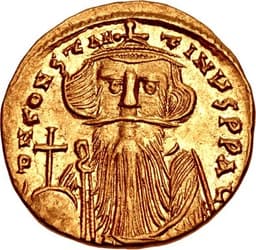
Constans II
Emperor · Ancient
55.2Total

Julius Caesar
General · Ancient
82.8Total
Basic Information
Born
-630
-100
Died
—
-44
Era
Ancient
Ancient
Nationality
Byzantine Empire
Roman Republic
Occupation
Emperor
General
Civilization
Western
Western
Score Comparison
Military (10%)
55.0
88.0
Political (20%)
68.0
78.0
Influence (20%)
51.0
85.0
Legacy (20%)
44.2
82.0
Leadership (15%)
65.0
80.0
Strategy (15%)
60.0
85.0
TOTAL
55.2
82.8
Constans II — Complete Timeline
648 AD
Issued the Typos of ConstansPolitical Action
Constans II issued the Typos, an edict that forbade discussion of the Monothelite controversy. The edict aimed to end religious strife but was condemned by the Papacy and failed to restore unity.
Religious PolicyChurch ControversyByzantine Empire
Impact: regional
663 AD
Visited RomePolitical Action◆ Major
Constans II became the last Byzantine emperor to visit Rome. He was received by Pope Vitalian and spent twelve days in the city, stripping it of many bronze ornaments and statues to be sent to Constantinople.
Imperial VisitRomeByzantine Empire
Impact: regional
668 AD
Murdered in SyracusePolitical Action◆ Major
While residing in Syracuse, Sicily, Constans II was assassinated in his bath by a chamberlain. His death was part of a conspiracy, and his son Constantine IV succeeded him after suppressing the usurper Mezezius.
AssassinationByzantine EmpireSuccession Crisis
Impact: nationaltragic
674 AD
Defended Constantinople against the Arab siegeWar◆ Major
Constans II's son, Constantine IV, was actually the emperor during the first Arab siege of Constantinople. Constans II himself faced Arab raids but did not command the defense of the capital during the major siege.
Arab-Byzantine WarsSiegeByzantine Empire
Impact: regional
Julius Caesar — Complete Timeline
58 BC
Gallic WarsWar◆ Major
Caesar, as proconsul of Gaul, launched a series of campaigns that conquered all of Gaul (modern France, Belgium, and parts of Switzerland). He fought numerous battles, including against the Helvetii, the Belgae, and the Gallic chieftain Vercingetorix. The wars brought immense wealth and a loyal army to Caesar.
Gallic WarsConquestRoman Expansion
Impact: regional
49 BC
Crossing the RubiconPolitical Action◆ Major
Caesar led Legio XIII across the Rubicon River into Italy, defying the Roman Senate's order to disband his army. This act triggered a civil war against Pompey and the Optimates, ultimately leading to Caesar's dictatorship and the end of the Roman Republic.
Roman Civil WarEnd of RepublicPower Struggle
Impact: global
48 BC
Battle of PharsalusWar◆ Major
Caesar's outnumbered army defeated the larger forces of Pompey the Great at Pharsalus in Greece. Caesar's tactical use of a reserve line to counter Pompey's cavalry charge proved decisive. Pompey fled to Egypt, where he was assassinated, leaving Caesar as the undisputed master of the Roman world.
Roman Civil WarBattleDecisive Victory
Impact: regional
44 BC
Appointment as Dictator for LifePolitical Action◆ Major
The Roman Senate appointed Caesar dictator perpetuo (dictator for life), granting him unprecedented personal power. This move concentrated military, legislative, and judicial authority in one person, effectively ending the Roman Republic's traditional system of checks and balances and alarming many senators.
DictatorshipEnd of RepublicPower Consolidation
Impact: regionaldestructive
Assassination on the Ides of MarchPolitical Action◆ Major
A group of Roman senators, led by Marcus Junius Brutus and Gaius Cassius Longinus, stabbed Caesar to death at a meeting of the Senate in the Theatre of Pompey. The assassination was intended to restore the Republic, but instead triggered another civil war that led to the rise of the Roman Empire.
AssassinationRoman PoliticsEnd of Republic
Impact: globaldestructive
Expert Analysis
constans-ii-vs-julius-caesar
# The Crossing and the Sinking
On a winter day in 49 BCE, Julius Caesar stood at the banks of the Rubicon, a small river in northern Italy. He knew that to cross it with his army meant civil war, and that civil war meant the end of the Roman Republic as it had existed for centuries. He crossed anyway, uttering what became a legend: *“The die is cast.”* Seven centuries later and two thousand miles away, another emperor stood on the shores of Sicily, watching the sun set over a sea that no longer felt like home. Constans II, the last Roman emperor to visit Rome, would die in a bathhouse in Syracuse, murdered by his own chamberlain. One man changed the world by crossing a river; the other was swallowed by it.
Origins
Caesar was born into the patrician Julian clan, but the family had fallen from its former glory. His youth was spent in the violent, competitive world of late Republican politics—where alliances shifted like sand and a man’s life could be forfeit for backing the wrong faction. He learned early that survival meant ambition, and ambition meant risk. He fled Rome during Sulla’s proscriptions, served in Asia Minor, and was captured by pirates—whom he later crucified, as promised. The Republic he grew up in was already decaying, its institutions buckling under the weight of empire.
Constans II, by contrast, was born into a world already in ruins. The Roman Empire had split, the western half had fallen, and the eastern remnant—the Byzantine Empire—was fighting for its life against Persians, Arabs, and Slavs. He became emperor at age eleven, inheriting a throne rocked by theological controversy and military collapse. His father had died of tuberculosis; his uncle was murdered. The boy-emperor grew up in a palace where the question was not how to conquer the world, but how to keep it from being conquered.
Rise to Power
Caesar’s rise was a masterclass in calculated audacity. He climbed the *cursus honorum*—quaestor, aedile, praetor, consul—borrowing vast sums to fund public spectacles that bought popularity. He forged the First Triumvirate with Pompey and Crassus, then used his consulship to secure a command in Gaul. There, over eight years, he conquered a territory larger than Italy itself, writing his own propaganda in the *Commentaries* that schoolchildren still read. His legions became his personal army, loyal to him alone.
Constans II’s rise was not a climb but a stumble into power. At eleven, he was crowned co-emperor with his brother Heraclonas, but a palace coup soon removed his rivals. He spent his early reign fighting off Arab invasions that had already taken Syria, Palestine, and Egypt. In 648, he issued the Typos, an edict forbidding discussion of the Monothelite controversy—a theological dispute about Christ’s nature that had split the empire. It was a political act, not a religious one: he wanted peace, not truth. But the edict satisfied no one, and the controversy festered.
Leadership & Governance
Caesar governed like a storm. As dictator, he reformed the calendar, granted citizenship to provincials, and launched public works that employed the poor. He filled the Senate with his supporters, undermining the old aristocracy. His military genius was undeniable—the siege of Alesia, the lightning campaign at Pharsalus, the daring landing in Britain—but his political wisdom was brittle. He centralized power, but failed to build institutions that could survive him. When he made himself dictator for life, he lit the fuse.
Constans II governed like a man trying to plug a leaking ship with his fingers. He lost Cyprus and Rhodes to the Arabs, watched the Slavs settle in the Balkans, and saw the Lombards take much of Italy. His one bold move was visiting Rome in 663—the first Byzantine emperor to do so in two centuries. He stripped the city of its remaining treasures, including the bronze tiles from the Pantheon, to fund his defense. The gesture was symbolic, but empty: he could not hold the West, and his eastern provinces were bleeding. He moved his court to Syracuse, trying to anchor the empire closer to its lost heart, but it only isolated him further.
Triumph & Tragedy
Caesar’s greatest moment was also his most tragic. On the Ides of March, 44 BCE, he entered the Senate chamber and was stabbed twenty-three times by men he had pardoned, promoted, and trusted. His triumph was total—he had conquered Gaul, defeated Pompey, and remade Rome—but his tragedy was that he never saw the empire he created. He died thinking he had saved the Republic; in truth, he had killed it.
Constans II’s tragedy was quieter. He died in 668, in a bath in Syracuse, assassinated by a chamberlain named Andrew. The circumstances remain murky—perhaps a conspiracy, perhaps a personal grudge. His son Constantine IV would go on to defend Constantinople against the Arab siege of 674, a victory that saved the empire. But Constans II never saw it. He died as he had lived: trying to hold together something that was already breaking apart.
Character & Destiny
Caesar was a gambler who understood that history favors the bold. His personality—arrogant, charismatic, ruthless—drove every decision. He crossed the Rubicon because he could not imagine losing. He pardoned his enemies because he believed his own myth. That same confidence made him great and doomed him. He could not see that the Republic’s traditions were stronger than his ambition, or that the men he spared would become his murderers.
Constans II was a survivor, not a conqueror. He lacked Caesar’s vision and his ruthlessness. He tried to govern through compromise and edicts, but the world he inherited did not reward patience. He was a competent administrator in an age that demanded a warrior. His character—cautious, pragmatic, isolated—reflected his circumstances. He was not a man who would cross a river and change history; he was a man who would drown in a bath.
Legacy
Caesar’s legacy is the Roman Empire itself. Every emperor who followed—Augustus, Trajan, Constantine—ruled in the shadow he cast. His name became a title: Kaiser, Tsar. His reforms reshaped Western civilization. He is remembered as a genius, a tyrant, and a cautionary tale.
Constans II is remembered, if at all, as a footnote. He was the last emperor to visit Rome, but the visit was a failure. He tried to end a theological dispute, but the dispute outlasted him. His son saved the empire; he merely held the line. In the history of Byzantium, he is a placeholder—a ruler who kept the ship afloat but never steered it.
Conclusion
One crossed a river and changed the world. The other crossed a sea and was forgotten. The difference is not simply in talent or ambition, but in the shape of the times. Caesar lived when the Republic was ripe for transformation; Constans II lived when the empire was ripe for dissolution. Both were Roman emperors, but one built an empire and the other tried to save one. History remembers the builder, not the caretaker. The die is cast; the bathwater grows cold.
Rankings
🥇
Julius CaesarLeader
Mil: 88.0Pol: 78.0Inf: 85.0
82.8
🥈
Constans II
Mil: 55.0Pol: 68.0Inf: 51.0
55.2
+27.6 behind
How This Comparison Works
Algorithm
Each figure is scored on 6 dimensions (0—100 scale) based on structured historical data: Military (10%), Political (20%), Influence (20%), Legacy (20%), Leadership (15%), Strategy (15%). The weighted total produces the final ranking.
Data Sources
Scores are computed from structured sub-indicators in the database. Scale factors adjust for era (Ancient ×0.85, Modern ×1.0) and civilization size (Eastern ×1.05, Other ×0.80) to account for differences in population and military scale.
Maximum 3 Figures
Comparisons are limited to 2—3 figures to ensure readability and statistical meaningfulness.
Error Margins
±5 points per dimension — Sub-scores are derived from historical records with inherent uncertainty. Two figures within 5 points on a dimension should be considered roughly equivalent in that area.
Total Score Accuracy
±3 points overall — The weighted combination of 6 dimensions produces a total score with approximately ±3 points of uncertainty. Differences of less than 3 points are not statistically significant— the figures are effectively tied.
Known Limitations
- Historical records are incomplete and uneven across civilizations
- Figures from oral-tradition societies may be underrepresented
- Occupation labels can misclassify multi-role figures
- Scores measure capability and impact, not moral character
- Quantitative scoring is a comparison tool, not absolute truth
Capability Radar
Military (10%) — Battles & Warfare
Battles
55
95
Win Rate
50
92
Expansion
30
97
Political (20%) — Governance & Reform
Reform
55
90
Diplomacy
50
85
Economy
45
82
Influence (20%) — Cultural & Global Reach
Cultural
40
88
Global
25
94
Legacy (20%) — Historical Impact
Historical
45
95
Longevity
30
96
Leadership (15%) — Power & Stability
Tenure
65
75
Stability
35
60
Strategy (15%) — Tactics & Innovation
Strategy
50
94
Tactics
45
96
Reform
40
88
Similar Comparisons
Comments & Discussion
No comments yet. Be the first to share your thoughts!