Loading...
Constans II vs Gyges of Lydia
Constans II leads by 3.8 pts · 2 figures compared
…
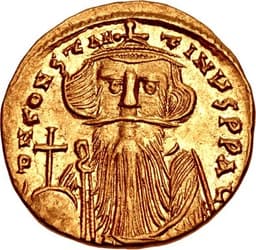
Constans II
Emperor · Ancient
55.2Total

Gyges of Lydia
Emperor · Ancient
51.4Total
Basic Information
Born
-630
-716
Died
—
-678
Era
Ancient
Ancient
Nationality
Byzantine Empire
Lydia
Occupation
Emperor
Emperor
Civilization
Western
Middle Eastern
Score Comparison
Military (10%)
55.0
45.0
Political (20%)
68.0
48.0
Influence (20%)
51.0
57.2
Legacy (20%)
44.2
50.0
Leadership (15%)
65.0
62.2
Strategy (15%)
60.0
35.7
TOTAL
55.2
51.4
Constans II — Complete Timeline
648 AD
Issued the Typos of ConstansPolitical Action
Constans II issued the Typos, an edict that forbade discussion of the Monothelite controversy. The edict aimed to end religious strife but was condemned by the Papacy and failed to restore unity.
Religious PolicyChurch ControversyByzantine Empire
Impact: regional
663 AD
Visited RomePolitical Action◆ Major
Constans II became the last Byzantine emperor to visit Rome. He was received by Pope Vitalian and spent twelve days in the city, stripping it of many bronze ornaments and statues to be sent to Constantinople.
Imperial VisitRomeByzantine Empire
Impact: regional
668 AD
Murdered in SyracusePolitical Action◆ Major
While residing in Syracuse, Sicily, Constans II was assassinated in his bath by a chamberlain. His death was part of a conspiracy, and his son Constantine IV succeeded him after suppressing the usurper Mezezius.
AssassinationByzantine EmpireSuccession Crisis
Impact: nationaltragic
674 AD
Defended Constantinople against the Arab siegeWar◆ Major
Constans II's son, Constantine IV, was actually the emperor during the first Arab siege of Constantinople. Constans II himself faced Arab raids but did not command the defense of the capital during the major siege.
Arab-Byzantine WarsSiegeByzantine Empire
Impact: regional
Gyges of Lydia — Complete Timeline
716 BC
Usurpation of the Lydian thronePolitical Action
Gyges murdered King Candaules and married his queen, seizing control of Lydia. This act founded the Mermnad dynasty and ended the Heraclid line, establishing Gyges as the first king of the new dynasty.
Dynastic ChangeUsurpationLydia
Impact: regionaldestructive
687 BC
Submission to AssyriaPolitical Action
Gyges sent tribute to the Assyrian king Ashurbanipal, acknowledging Assyrian suzerainty in exchange for military support against the Cimmerians. This alliance marked Lydia's entry into Near Eastern power politics.
DiplomacyAssyriaTribute
Impact: regional
680 BC
Cimmerian invasion of LydiaWar◆ Major
Cimmerian nomads invaded Lydia during Gyges' reign, attacking the capital Sardis. Gyges repelled the invasion with Assyrian aid, but the conflict weakened Lydia and set a precedent for future Cimmerian attacks.
Cimmerian InvasionWarLydia
Impact: regionaldestructive
Introduction of coinage in LydiaInvention◆ Major
Gyges is credited with introducing the first standardized coinage, made of electrum, in Lydia. This innovation facilitated trade and taxation, becoming a model for currency systems across the ancient world.
Economic InnovationCoinageTrade
Impact: globalconstructive
678 BC
Death in battle against the CimmeriansWar◆ Major
Gyges was killed in a battle against the Cimmerians, who overran Lydia after he broke his alliance with Assyria. His death ended his reign and left the kingdom vulnerable to further attacks.
Death in BattleCimmerian InvasionLydia
Impact: regionaltragic
Expert Analysis
Origins
Constans II (born 630 CE) was the son of Emperor Constantine III and a grandson of Heraclius. He grew up in the palace of Constantinople, immersed in court intrigues and the ongoing Arab-Byzantine wars. His early education emphasized military and administrative skills. Gyges of Lydia (reigned c. 680-644 BCE) was a noble of the Heraclid court. According to Herodotus, he rose from a bodyguard to usurper, murdering King Candaules and marrying the queen. Gyges lacked royal lineage but seized power through ambition and opportunity.
Rise to Power
Constans II became co-emperor in 641 CE at age 11 after his father's death. He was crowned sole emperor in 642 after his uncle Heraclonas was deposed. His early reign focused on stabilizing the empire against Arab raids and internal religious strife. Gyges's rise was more dramatic: he killed Candaules, married the queen, and claimed the throne. He faced opposition from the Heraclid faction but consolidated power by founding the Mermnad dynasty. Around 660 BCE, he sent tribute to Assyria's Ashurbanipal to secure support against the Cimmerians.
Leadership & Governance
Constans II ruled an empire in crisis. He issued the Typos (648 CE) to suppress the Monothelite controversy, but it was condemned by Pope Martin I, leading to conflict. He reorganized the themes (military districts) and defended Constantinople, though the first Arab siege occurred under his son. He visited Rome in 663 CE, stripping treasures to fund his wars. Gyges introduced coinage—standardized electrum coins—revolutionizing trade and taxation. He also expanded Lydia's borders, attacking Greek cities like Miletus and Smyrna. Both were pragmatic: Constans focused on survival, Gyges on innovation and expansion.
Triumph & Tragedy
Constans's greatest success was maintaining the empire's territorial integrity despite Arab pressure. His tragedy was his murder in his bath in Syracuse (668 CE) by a chamberlain, after losing support due to his unpopular religious policies and fiscal demands. Gyges's triumph was founding a dynasty and introducing coinage, scoring 57.2 in influence. His failure was dying in battle against the Cimmerians (c. 644 BCE) after breaking his alliance with Assyria, leaving Lydia vulnerable. Gyges scored 35.7 in strategy, reflecting poor diplomatic decisions.
Character & Destiny
Constans II was a capable but controversial leader. His religious edicts show a desire for unity but alienated the Church. His visit to Rome demonstrated symbolic ambition but yielded little practical benefit. His murder highlights his deteriorating relationships. Gyges was ambitious and ruthless, usurping power through murder. His openness to Assyrian alliance showed pragmatism, but his eventual betrayal of Assyria proved fatal. Herodotus notes Gyges's greed and the curse of the Heraclids, shaping his tragic end.
Legacy
Constans II's legacy is mixed: he is the last emperor to visit Rome, but his religious policies were condemned. His administrative reforms laid groundwork for later Byzantine resilience. Gyges's coinage had lasting impact, spreading to Greece and beyond, scoring 50.0 in legacy. The Mermnad dynasty continued until Croesus. Constans scores 44.2 in legacy, lower due to his murder and limited long-term influence.
Conclusion
Constans II (total score 55.2) had a higher overall impact than Gyges (51.4). While Gyges introduced coinage, Constans navigated a larger empire through existential threats. His political score (68.0 vs 48.0) and military score (55.0 vs 45.0) reflect his broader responsibilities. Constans's leadership in crisis outweighs Gyges's innovations, though both were flawed. Constans II had greater impact on world history through preserving the Byzantine state.
Rankings
🥇
Constans IILeader
Mil: 55.0Pol: 68.0Inf: 51.0
55.2
🥈
Gyges of Lydia
Mil: 45.0Pol: 48.0Inf: 57.2
51.4
+3.8 behind
How This Comparison Works
Algorithm
Each figure is scored on 6 dimensions (0—100 scale) based on structured historical data: Military (10%), Political (20%), Influence (20%), Legacy (20%), Leadership (15%), Strategy (15%). The weighted total produces the final ranking.
Data Sources
Scores are computed from structured sub-indicators in the database. Scale factors adjust for era (Ancient ×0.85, Modern ×1.0) and civilization size (Eastern ×1.05, Other ×0.80) to account for differences in population and military scale.
Maximum 3 Figures
Comparisons are limited to 2—3 figures to ensure readability and statistical meaningfulness.
Error Margins
±5 points per dimension — Sub-scores are derived from historical records with inherent uncertainty. Two figures within 5 points on a dimension should be considered roughly equivalent in that area.
Total Score Accuracy
±3 points overall — The weighted combination of 6 dimensions produces a total score with approximately ±3 points of uncertainty. Differences of less than 3 points are not statistically significant— the figures are effectively tied.
Known Limitations
- Historical records are incomplete and uneven across civilizations
- Figures from oral-tradition societies may be underrepresented
- Occupation labels can misclassify multi-role figures
- Scores measure capability and impact, not moral character
- Quantitative scoring is a comparison tool, not absolute truth
Capability Radar
Military (10%) — Battles & Warfare
Battles
55
20
Win Rate
50
25
Expansion
30
30
Political (20%) — Governance & Reform
Reform
55
35
Diplomacy
50
30
Economy
45
70
Influence (20%) — Cultural & Global Reach
Cultural
40
45
Global
25
40
Legacy (20%) — Historical Impact
Historical
45
60
Longevity
30
55
Leadership (15%) — Power & Stability
Tenure
65
40
Stability
35
40
Strategy (15%) — Tactics & Innovation
Strategy
50
20
Tactics
45
15
Reform
40
10
Similar Comparisons
Comments & Discussion
No comments yet. Be the first to share your thoughts!