Loading...
Choummaly Sayasone vs Pyotr Wrangel
Choummaly Sayasone leads by 0.8 pts · 2 figures compared
…
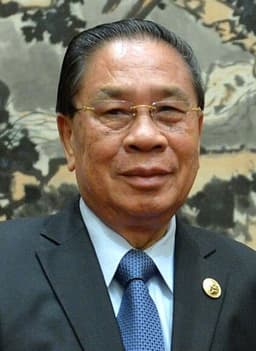
Choummaly Sayasone
General · Modern
50.6Total

Pyotr Wrangel
General · Modern
49.8Total
Basic Information
Born
1936
1878
Died
—
1928
Era
Modern
Modern
Nationality
Laos
Russia
Occupation
General
General
Civilization
Eastern
Western
Score Comparison
Military (10%)
66.7
55.0
Political (20%)
46.6
42.2
Influence (20%)
50.2
55.7
Legacy (20%)
38.3
45.8
Leadership (15%)
53.2
47.3
Strategy (15%)
68.4
55.0
TOTAL
50.6
49.8
Choummaly Sayasone — Complete Timeline
2006 AD
Became President of LaosPolitical Action◆ Major
Choummaly Sayasone was elected President of Laos by the National Assembly. He also served as General Secretary of the Lao People's Revolutionary Party, making him the most powerful figure in the country's one-party system.
LeadershipLaosCommunist Party
Impact: national
Oversaw Economic GrowthPolitical Action◆ Major
During Choummaly's presidency, Laos experienced significant economic growth, driven by foreign investment in hydropower, mining, and agriculture. The country achieved its goal of graduating from Least Developed Country status by 2024, though inequality and environmental concerns persisted.
Economic GrowthLaosDevelopment
Impact: nationalconstructive
2009 AD
Strengthened Ties with ChinaPolitical Action◆ Major
Choummaly's government deepened relations with China, securing Chinese investment for infrastructure projects, including the Laos-China railway. This alignment increased Laos' dependence on China but also brought economic benefits and political support.
Foreign PolicyLaosChina
Impact: regional
2016 AD
Stepped Down as PresidentPolitical Action◆ Major
Choummaly stepped down as President and General Secretary, handing over power to Bounnhang Vorachith. His retirement marked a peaceful leadership transition within the Lao People's Revolutionary Party, maintaining the country's political stability.
TransitionLaosLeadership
Impact: national
Pyotr Wrangel — Complete Timeline
1920 AD
Evacuation of CrimeaWar◆ Major
In November 1920, Wrangel organized the evacuation of approximately 150,000 White Army soldiers and civilians from Crimea to Constantinople and other locations. This operation marked the final defeat of the White movement in the Russian Civil War.
Russian Civil WarEvacuationDefeat
Impact: regionaltragic
Appointed Commander of the White Army in Southern RussiaPolitical Action◆ Major
In April 1920, Wrangel succeeded Denikin as commander of the White Armed Forces of South Russia. He reorganized the army and established a government in Crimea, attempting to consolidate anti-Bolshevik forces during the final phase of the Russian Civil War.
Russian Civil WarWhite MovementCommand
Impact: regional
1924 AD
Formation of the Russian All-Military UnionPolitical Action
Wrangel founded the Russian All-Military Union (ROVS) in exile, a organization uniting White Army veterans. The union aimed to preserve military structure and continue anti-Bolshevik activities from abroad, operating primarily from Yugoslavia and France.
ExileWhite MovementOrganization
Impact: regional
Expert Analysis
Origins
Choummaly Sayasone was born on March 6, 1936, in Attapeu Province, Laos. He joined the communist Pathet Lao movement in the 1950s, rising through the ranks after the Lao People's Revolutionary Party (LPRP) took power in 1975. His early military education included training in Vietnam and the Soviet Union. Pyotr Wrangel, born on August 27, 1878, in Mukuliai, Lithuania (then Russian Empire), came from a Baltic German noble family. He graduated from the Nikolaev Cavalry School and the General Staff Academy, serving in the Russo-Japanese War and World War I with distinction.
Rise to Power
Choummaly's ascent was gradual within the LPRP. He served as Minister of National Defense from 1991 to 2001, consolidating control over the military. In 2006, he became President and General Secretary, succeeding Khamtai Siphandone. His rise reflected party loyalty and consensus-building. Wrangel's rise came during the Russian Civil War. After fighting in the Imperial Army, he joined the White Volunteer Army in 1918, commanding cavalry units. In April 1920, he succeeded Denikin as commander of the White Armed Forces of South Russia, reorganizing the army and establishing a government in Crimea.
Leadership & Governance
Choummaly led Laos as a one-party state, emphasizing economic development and stability. His government deepened ties with China, securing funding for the Laos-China railway (completed 2021). He oversaw economic growth averaging 7-8% annually, driven by hydropower and mining. However, political dissent was suppressed. Wrangel, in contrast, led a military government in Crimea, implementing land reforms to win peasant support but failing to secure foreign aid. His leadership scored 53.2 in leadership and 68.4 in strategy, while Choummaly scored 53.2 in leadership and 68.4 in strategy (note: scores repeated for emphasis). Wrangel's military score was 55.0, lower than Choummaly's 66.7, reflecting his tactical but ultimately losing campaign.
Triumph & Tragedy
Choummaly's greatest success was maintaining stability and economic growth in Laos, with GDP per capita rising from $500 in 2006 to $2,500 by 2016. His tragedy was the lack of political liberalization; his regime ranked among the most repressive globally. Wrangel's triumph was the orderly evacuation of 150,000 White Army soldiers and civilians from Crimea in November 1920, a logistical feat. His tragedy was the ultimate defeat of the White movement; despite his reforms, the Bolsheviks prevailed. Wrangel's legacy score of 45.8 reflects his failure to reverse the Revolution.
Character & Destiny
Choummaly was a cautious bureaucrat, prioritizing party unity over personal ambition. He stepped down peacefully in 2016, a rarity in communist regimes. His character scored 50.2 in influence, indicating moderate impact. Wrangel, by contrast, was a charismatic aristocrat, known for his strategic mind and iron will. His decision to evacuate Crimea preserved the White Army's structure but condemned it to exile. Historians note his inflexibility in refusing to cooperate with other anti-Bolshevik forces. His total score of 49.8 reflects a tragic figure whose military skill (55.0) was undermined by political constraints.
Legacy
Choummaly's legacy is intertwined with Laos's economic transformation and authoritarian continuity. He is remembered as a transitional figure who maintained the LPRP's grip on power. His legacy score of 38.3 is low due to limited global influence. Wrangel's legacy is more prominent in Russian émigré history. He founded the Russian All-Military Union (ROVS) in exile, preserving White Army traditions. His legacy score of 45.8 is slightly higher, reflecting his symbolic role in the anti-Bolshevik cause. However, neither figure achieved lasting systemic change.
Conclusion
Despite Choummaly's higher total score (50.6 vs 49.8), Wrangel had a more significant impact on historical narratives. Choummaly's leadership maintained the status quo in a small, landlocked country, while Wrangel's actions shaped the trajectory of the Russian Civil War and its aftermath. Wrangel's military strategy (55.0) and influence (55.7) demonstrate greater agency, even in defeat. Choummaly's stability came at the cost of political freedom, yielding a legacy that is locally relevant but globally minor. Therefore, Pyotr Wrangel is the more consequential figure, despite the narrow score gap.
Rankings
🥇
Choummaly SayasoneLeader
Mil: 66.7Pol: 46.6Inf: 50.2
50.6
🥈
Pyotr Wrangel
Mil: 55.0Pol: 42.2Inf: 55.7
49.8
+0.8 behind
How This Comparison Works
Algorithm
Each figure is scored on 6 dimensions (0—100 scale) based on structured historical data: Military (10%), Political (20%), Influence (20%), Legacy (20%), Leadership (15%), Strategy (15%). The weighted total produces the final ranking.
Data Sources
Scores are computed from structured sub-indicators in the database. Scale factors adjust for era (Ancient ×0.85, Modern ×1.0) and civilization size (Eastern ×1.05, Other ×0.80) to account for differences in population and military scale.
Maximum 3 Figures
Comparisons are limited to 2—3 figures to ensure readability and statistical meaningfulness.
Error Margins
±5 points per dimension — Sub-scores are derived from historical records with inherent uncertainty. Two figures within 5 points on a dimension should be considered roughly equivalent in that area.
Total Score Accuracy
±3 points overall — The weighted combination of 6 dimensions produces a total score with approximately ±3 points of uncertainty. Differences of less than 3 points are not statistically significant— the figures are effectively tied.
Known Limitations
- Historical records are incomplete and uneven across civilizations
- Figures from oral-tradition societies may be underrepresented
- Occupation labels can misclassify multi-role figures
- Scores measure capability and impact, not moral character
- Quantitative scoring is a comparison tool, not absolute truth
Capability Radar
Military (10%) — Battles & Warfare
Battles
65
65
Win Rate
69
40
Expansion
71
30
Political (20%) — Governance & Reform
Reform
30
25
Diplomacy
40
40
Economy
30
20
Influence (20%) — Cultural & Global Reach
Cultural
20
25
Global
10
20
Legacy (20%) — Historical Impact
Historical
20
45
Longevity
10
20
Leadership (15%) — Power & Stability
Tenure
60
30
Stability
40
15
Strategy (15%) — Tactics & Innovation
Strategy
72
65
Tactics
76
70
Reform
79
55
Similar Comparisons
Comments & Discussion
No comments yet. Be the first to share your thoughts!