Loading...
Choummaly Sayasone vs Napoleon Bonaparte
Napoleon Bonaparte leads by 20.3 pts · 2 figures compared
…
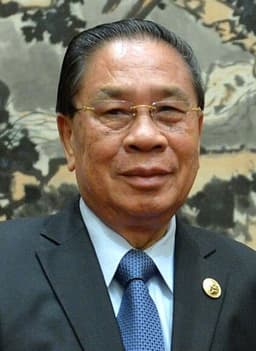
Choummaly Sayasone
General · Modern
50.6Total

Napoleon Bonaparte
General · Modern
70.9Total
Basic Information
Born
1936
1769
Died
—
1821
Era
Modern
Modern
Nationality
Laos
France
Occupation
General
General
Civilization
Eastern
Western
Score Comparison
Military (10%)
66.7
94.0
Political (20%)
46.6
72.0
Influence (20%)
50.2
40.0
Legacy (20%)
38.3
80.0
Leadership (15%)
53.2
78.0
Strategy (15%)
68.4
90.0
TOTAL
50.6
70.9
Choummaly Sayasone — Complete Timeline
2006 AD
Became President of LaosPolitical Action◆ Major
Choummaly Sayasone was elected President of Laos by the National Assembly. He also served as General Secretary of the Lao People's Revolutionary Party, making him the most powerful figure in the country's one-party system.
LeadershipLaosCommunist Party
Impact: national
Oversaw Economic GrowthPolitical Action◆ Major
During Choummaly's presidency, Laos experienced significant economic growth, driven by foreign investment in hydropower, mining, and agriculture. The country achieved its goal of graduating from Least Developed Country status by 2024, though inequality and environmental concerns persisted.
Economic GrowthLaosDevelopment
Impact: nationalconstructive
2009 AD
Strengthened Ties with ChinaPolitical Action◆ Major
Choummaly's government deepened relations with China, securing Chinese investment for infrastructure projects, including the Laos-China railway. This alignment increased Laos' dependence on China but also brought economic benefits and political support.
Foreign PolicyLaosChina
Impact: regional
2016 AD
Stepped Down as PresidentPolitical Action◆ Major
Choummaly stepped down as President and General Secretary, handing over power to Bounnhang Vorachith. His retirement marked a peaceful leadership transition within the Lao People's Revolutionary Party, maintaining the country's political stability.
TransitionLaosLeadership
Impact: national
Napoleon Bonaparte — Complete Timeline
1799 AD
Coup of 18 BrumaireOther◆ Major
Napoleon Bonaparte, with support from his brother Lucien and key political figures, overthrew the Directory in a bloodless coup. He established the Consulate with himself as First Consul, effectively becoming the ruler of France. This event ended the French Revolution's most unstable period.
French RevolutionCoupRise to Power
Impact: regional
1804 AD
Promulgation of the Napoleonic CodeOther◆ Major
Napoleon enacted the Civil Code of the French, known as the Napoleonic Code, a comprehensive set of laws that replaced the fragmented feudal legal systems. The code established legal equality, protected property rights, and secularized law. It became the basis for legal systems in many European and world countries.
Legal ReformNapoleonic CodeCivil Law
Impact: globalconstructive
1805 AD
Battle of AusterlitzWar◆ Major
Napoleon's Grande Arm
Napoleonic WarsBattleDecisive Victory
Impact: global
1812 AD
Invasion of RussiaWar◆ Major
Napoleon led the Grande Arm
Napoleonic WarsInvasionDisaster
Impact: globaldestructive
1815 AD
Battle of WaterlooWar◆ Major
Napoleon's French army was defeated by the combined forces of the Duke of Wellington's Anglo-Allied army and Gebhard Leberecht von Bl
Napoleonic WarsBattleFinal Defeat
Impact: globaldestructive
Expert Analysis
choummaly-sayasone-vs-napoleon-bonaparte
# The Emperor and the Enigma
In the winter of 1812, Napoleon Bonaparte watched his Grand Army burn Moscow, only to watch it freeze on the retreat. In the summer of 2006, Choummaly Sayasone walked into a marble hall in Vientiane to accept the presidency of Laos. One man commanded half a million soldiers; the other presided over a nation of six million rice farmers. One redrew the map of Europe; the other kept his country quiet. What drives such different destinies? The answer lies not in the size of their ambitions but in the shape of their worlds.
Origins
Napoleon was born in 1769 on Corsica, an island that had just passed from Genoa to France. His family was minor nobility, poor enough to feel the sting of class but proud enough to resent it. He spoke Italian before French, and his childhood was soaked in the bitterness of a conquered people. The French Revolution, which erupted when he was twenty, tore open every ceiling. A young artillery officer could rise not by birth but by brilliance. That is exactly what he did.
Choummaly Sayasone was born in 1936 in southern Laos, then part of French Indochina. His family were farmers, and his youth was shaped not by revolution but by war—first the Japanese occupation, then the French return, then the American escalation. Laos was a battlefield for other people’s conflicts. Choummaly joined the communist Pathet Lao in the 1950s, not out of ideology alone but because it offered the only path to national independence. His world was small, poor, and surrounded by giants: Vietnam, Thailand, China. Survival meant alignment, not conquest.
Rise to Power
Napoleon’s rise was a thunderclap. At twenty-four, he crushed a royalist uprising in Paris with a “whiff of grapeshot.” At twenty-six, he conquered Italy. At thirty, he staged a coup and made himself First Consul. At thirty-five, he crowned himself Emperor. Every step was a gamble, and every gamble paid off. He understood that in revolutionary France, legitimacy came from victory. He gave France glory, and France gave him power.
Choummaly’s rise was a slow tide. He joined the Pathet Lao in 1954, fought in the jungle for two decades, and watched his comrades take power in 1975. He rose through the party bureaucracy, serving as defense minister and party deputy. In 2006, at age seventy, he was elected President and General Secretary—not through a coup or a battle, but through a vote of the National Assembly. He was the safe choice, the steady hand. Laos did not need a conqueror; it needed a caretaker.
Leadership & Governance
Napoleon governed like a storm. He centralized the state, created the Napoleonic Code, reformed education, and built roads and canals. He also conscripted millions of men and marched them to their deaths. His genius was administrative as much as military: he understood that law, not force, holds an empire together. But his ambition knew no limit. He invaded Spain, Russia, and every neighbor in between. His political score of 75.0 reflects a man who could organize a nation but could not stop himself from destroying it.
Choummaly governed like a river. He continued the one-party rule of the Lao People’s Revolutionary Party, but he opened the economy. Foreign investment—especially from China—poured into hydropower dams, mining, and railways. Under his watch, Laos grew at seven percent a year. He deepened ties with Vietnam and China, securing infrastructure that his landlocked country desperately needed. His political score of 61.5 is modest, but it measures stability, not spectacle. He did not reform Laos; he kept it afloat.
Triumph & Tragedy
Napoleon’s greatest moment was Austerlitz in 1805, where he destroyed the combined armies of Austria and Russia. His worst was Waterloo in 1815, where his genius failed him on a muddy field in Belgium—or, more precisely, where his health, his generals, and his luck all failed at once. He died in 1821 on Saint Helena, a British prisoner, writing memoirs that would turn his defeats into legend.
Choummaly’s greatest moment was probably the construction of the first Lao-Chinese railway, a project that began under his watch and now connects Vientiane to Kunming. His tragedy is that he had no tragedy. He stepped down in 2016, handed power to Bounnhang Vorachith, and retired quietly. He did not fall; he faded. In the West, we call that success. In history, we call it forgettable.
Character & Destiny
Napoleon was driven by a hunger that no victory could satisfy. “Glory is fleeting,” he once said, “but obscurity is forever.” He could not bear obscurity, so he chose glory, even when it destroyed him. His personality—restless, arrogant, brilliant—shaped every decision. He trusted his star until the star went out.
Choummaly was driven by caution. He had seen what happened to ambitious men in Southeast Asia: Pol Pot in Cambodia, the generals in Burma. He knew that Laos was too small to dream big. So he played the long game, kept his party unified, and stayed in the background. His personality—patient, pragmatic, loyal—shaped a different kind of history: not the history of conquest, but the history of survival.
Legacy
Napoleon left behind a code of law, a myth of national glory, and a continent that would never be the same. He is remembered as a genius and a tyrant, a liberator and a conqueror. His legacy score of 78.0 is high, but it is also contested. He is the subject of thousands of books, movies, and arguments.
Choummaly left behind a stable Laos, a railway, and a string of dams. He is remembered by few outside his country. His legacy score of 53.6 reflects the reality that in the global imagination, a quiet president does not compete with an emperor. But ask a Laotian farmer whether he prefers the age of Napoleon or the age of Choummaly. The answer may surprise you.
Conclusion
We compare Napoleon and Choummaly not because they are equals, but because they are opposites. One shaped the world; the other shaped a corner of it. One died in exile; the other died in retirement. Yet both were generals, both led nations, and both faced the same fundamental question: What do you do with power? Napoleon answered: conquer. Choummaly answered: survive. History remembers the conqueror, but history is written by the living. And the living, most of the time, prefer survival to glory.
Rankings
🥇
Napoleon BonaparteLeader
Mil: 94.0Pol: 72.0Inf: 40.0
70.9
🥈
Choummaly Sayasone
Mil: 66.7Pol: 46.6Inf: 50.2
50.6
+20.3 behind
How This Comparison Works
Algorithm
Each figure is scored on 6 dimensions (0—100 scale) based on structured historical data: Military (10%), Political (20%), Influence (20%), Legacy (20%), Leadership (15%), Strategy (15%). The weighted total produces the final ranking.
Data Sources
Scores are computed from structured sub-indicators in the database. Scale factors adjust for era (Ancient ×0.85, Modern ×1.0) and civilization size (Eastern ×1.05, Other ×0.80) to account for differences in population and military scale.
Maximum 3 Figures
Comparisons are limited to 2—3 figures to ensure readability and statistical meaningfulness.
Error Margins
±5 points per dimension — Sub-scores are derived from historical records with inherent uncertainty. Two figures within 5 points on a dimension should be considered roughly equivalent in that area.
Total Score Accuracy
±3 points overall — The weighted combination of 6 dimensions produces a total score with approximately ±3 points of uncertainty. Differences of less than 3 points are not statistically significant— the figures are effectively tied.
Known Limitations
- Historical records are incomplete and uneven across civilizations
- Figures from oral-tradition societies may be underrepresented
- Occupation labels can misclassify multi-role figures
- Scores measure capability and impact, not moral character
- Quantitative scoring is a comparison tool, not absolute truth
Capability Radar
Military (10%) — Battles & Warfare
Battles
65
95
Win Rate
69
90
Expansion
71
95
Political (20%) — Governance & Reform
Reform
30
95
Diplomacy
40
80
Economy
30
85
Influence (20%) — Cultural & Global Reach
Cultural
20
85
Global
10
90
Legacy (20%) — Historical Impact
Historical
20
95
Longevity
10
90
Leadership (15%) — Power & Stability
Tenure
60
85
Stability
40
70
Strategy (15%) — Tactics & Innovation
Strategy
72
95
Tactics
76
98
Reform
79
92
Similar Comparisons
Comments & Discussion
NapoleonScholar6/17/2026
The comparison treats Choummaly as a figure of quiet destiny, but that’s a romantic gloss. Napoleon remade Europe through sheer will; Choummaly inherited a frozen revolution. The real question is whether Choummaly could have done more—stirred Laos from its rice-paddy slumber. Napoleon failed in Russia, but he tried. Choummaly presided over stagnation. Ambition isn’t just about scale; it’s about the refusal to accept the shape of your world. He accepted too easily.
军事分析家6/17/2026
拿破仑的1812年冬季溃败,并非源于野心过大,而是后勤线的粉碎——五十万大军在俄罗斯寒冬中冻毙,恰恰证明了战略与环境的致命错位。而朱马里·赛雅颂的“平静”,实则是老挝在越南战争泥沼后的生存智慧:六百万稻农的国家,经不起任何宏大叙事。拿破仑输给了自然,朱马里赢给了边界。不是大小的问题,是棋局的不同。
DataSkeptic6/17/2026
You’re mixing apples and oranges here—literally. Napoleon commanded 500,000 men; Choummaly presided over 6 million people. That’s a ratio of 1:12 in soldiers-to-population density. But here’s the kicker: Choummaly’s GDP per capita in 2006 was about $500; Napoleon’s France had a GDP per capita maybe 10x that. Different leagues, different metrics. The comparison is ahistorical because the constraints—economic, geographic, demographic—are utterly incomparable. It’s like comparing a chess master to
古典学者6/17/2026
拿破仑的野心像罗马的凯撒,席卷欧陆却终为现实所困;朱马里却似东方哲君,懂得在夹缝中求存。一个在1812年烧掉莫斯科却丢了军队,一个在2006年默默接过权力。拿破仑的书信里满是战略构想,朱马里的大米政策里藏着务实。不是谁更卓越,而是时势造人——拿破仑的欧洲是火药桶,朱马里的印支半岛是积木塔。历史天平偏向了低调者,但谁更伟大?仁者见仁。
HistoryBuffRebel6/17/2026
Let’s not kid ourselves: the real Napoleon was a tyrant who let 400,000 soldiers die in Russia, while Choummaly kept Laos out of wars for a decade. One stacked bodies; the other stacked rice bags. If ambition means marching into Moscow for nothing, give me the quiet farmer-president any day. And spare me the ‘grandeur’—Napoleon’s legacy is a continent of graves. Choummaly’s legacy is a country that ate, slept, and survived. That’s not small; that’s sanity.