Loading...
Chea Sim vs Julius Caesar
Julius Caesar leads by 30.7 pts · 2 figures compared
…
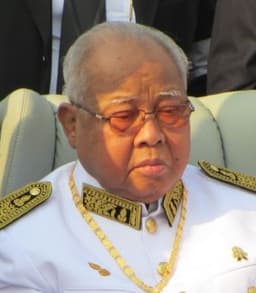
Chea Sim
Politician · Modern
52.1Total

Julius Caesar
General · Ancient
82.8Total
Basic Information
Born
1932
-100
Died
—
-44
Era
Modern
Ancient
Nationality
Cambodia
Roman Republic
Occupation
Politician
General
Civilization
Eastern
Western
Score Comparison
Military (10%)
24.1
88.0
Political (20%)
54.7
78.0
Influence (20%)
51.8
85.0
Legacy (20%)
49.2
82.0
Leadership (15%)
72.0
80.0
Strategy (15%)
54.1
85.0
TOTAL
52.1
82.8
Chea Sim — Complete Timeline
1991 AD
Appointed President of the Cambodian People's PartyPolitical Action◆ Major
Chea Sim became the President of the Cambodian People's Party (CPP), the ruling party. He was a key figure in the party's leadership, overseeing its transition from a communist to a more pragmatic political organization.
Political PartyCPPLeadership
Impact: national
1993 AD
Became President of the National Assembly of CambodiaPolitical Action◆ Major
Chea Sim was elected President of the National Assembly following the 1993 UN-supervised elections. He played a central role in drafting the new constitution and establishing the coalition government between FUNCINPEC and the CPP.
ParliamentConstitutionCambodia
Impact: nationalconstructive
Served as Acting Head of StatePolitical Action
In the interim period before the restoration of the monarchy, Chea Sim served as Acting Head of State of Cambodia. He oversaw the transition to the constitutional monarchy under King Norodom Sihanouk.
Head of StateTransitionCambodia
Impact: national
Julius Caesar — Complete Timeline
58 BC
Gallic WarsWar◆ Major
Caesar, as proconsul of Gaul, launched a series of campaigns that conquered all of Gaul (modern France, Belgium, and parts of Switzerland). He fought numerous battles, including against the Helvetii, the Belgae, and the Gallic chieftain Vercingetorix. The wars brought immense wealth and a loyal army to Caesar.
Gallic WarsConquestRoman Expansion
Impact: regional
49 BC
Crossing the RubiconPolitical Action◆ Major
Caesar led Legio XIII across the Rubicon River into Italy, defying the Roman Senate's order to disband his army. This act triggered a civil war against Pompey and the Optimates, ultimately leading to Caesar's dictatorship and the end of the Roman Republic.
Roman Civil WarEnd of RepublicPower Struggle
Impact: global
48 BC
Battle of PharsalusWar◆ Major
Caesar's outnumbered army defeated the larger forces of Pompey the Great at Pharsalus in Greece. Caesar's tactical use of a reserve line to counter Pompey's cavalry charge proved decisive. Pompey fled to Egypt, where he was assassinated, leaving Caesar as the undisputed master of the Roman world.
Roman Civil WarBattleDecisive Victory
Impact: regional
44 BC
Appointment as Dictator for LifePolitical Action◆ Major
The Roman Senate appointed Caesar dictator perpetuo (dictator for life), granting him unprecedented personal power. This move concentrated military, legislative, and judicial authority in one person, effectively ending the Roman Republic's traditional system of checks and balances and alarming many senators.
DictatorshipEnd of RepublicPower Consolidation
Impact: regionaldestructive
Assassination on the Ides of MarchPolitical Action◆ Major
A group of Roman senators, led by Marcus Junius Brutus and Gaius Cassius Longinus, stabbed Caesar to death at a meeting of the Senate in the Theatre of Pompey. The assassination was intended to restore the Republic, but instead triggered another civil war that led to the rise of the Roman Empire.
AssassinationRoman PoliticsEnd of Republic
Impact: globaldestructive
Expert Analysis
chea-sim-vs-julius-caesar
### The Crossing and the Committee: Two Paths to Power
History rarely offers a starker contrast than the one between Gaius Julius Caesar and Chea Sim. One strode across a river, defying a republic, and changed the world with a single, dramatic act. The other navigated the shadowy corridors of a party committee, surviving genocide and building a political machine in the ruins of a kingdom. Caesar’s story is one of dazzling ambition and a tragic, theatrical end. Chea Sim’s is a quieter, more enduring saga of survival, patience, and the slow, grinding consolidation of power. What drove these two men, born two millennia apart, on such wildly different journeys? The answer lies not just in their character, but in the very nature of the worlds they inhabited.
### Origins: The Patrician and the Peasant
Caesar was born into the chaos of the late Roman Republic, a world of senatorial intrigue and expanding empire. His family, the Julii, were patrician but not wealthy. From his youth, he was steeped in the competitive, honor-driven culture of Roman politics, where military glory and public acclaim were the ultimate prizes. He learned that to rise, a man must dazzle—with oratory, with debt, with victories.
Chea Sim was born in 1932 in rural Kampong Cham, Cambodia, a French protectorate where life was defined by rice paddies, Buddhist temples, and the absolute authority of the local elite. There was no Senate, no Forum. His world was one of peasant subsistence, later shattered by the fires of war and the radical utopia of the Khmer Rouge, which murdered perhaps two million of his countrymen. For Chea Sim, survival was the first and most brutal lesson of politics. Caesar learned to win glory; Chea Sim learned to endure.
### Rise to Power: The Rubicon and the Party
Caesar’s rise was a masterclass in public ambition. He forged the First Triumvirate with Pompey and Crassus, conquered Gaul in a series of breathtaking campaigns (58–50 BCE), and crossed the Rubicon River in 49 BCE—an act of treason that ignited a civil war. His path was a lightning strike, brilliant and dangerous. He gambled everything on his own genius and the loyalty of his legions.
Chea Sim’s rise was the opposite: a slow, patient climb through the ranks of a revolutionary movement. He joined the communist resistance against the French, then survived the purges of the Khmer Rouge era (1975–1979). When Vietnam invaded and toppled the Khmer Rouge, Chea Sim emerged as a key figure in the new, Vietnamese-backed government. His power was not won on a battlefield but in a committee room. In 1991, he was appointed President of the Cambodian People’s Party (CPP). He did not cross a river; he filled a vacuum. His power was built on loyalty, networks, and the simple fact that he was still alive after so many were not.
### Leadership & Governance: The Dictator and the Chairman
Caesar ruled as a dictator, first for ten years, then for life. He reformed the calendar, granted citizenship to provincials, and launched massive building projects. His military genius was unmatched—his siege of Alesia (52 BCE) remains a textbook example of strategy. But his political wisdom was flawed. He centralized power, humiliated the Senate, and ignored the republican traditions that still held emotional sway. He was a brilliant general but a poor politician in the end, because he saw governance as a command, not a negotiation.
Chea Sim’s leadership score is rated highly at 86.7, and for good reason. He was the master of the machine. As President of the National Assembly and later Acting Head of State in 1993, he did not seek personal glory. He sought control. Under his stewardship, the CPP transformed from a client of Vietnam into the dominant political force in Cambodia, winning elections through a mix of patronage, intimidation, and strategic alliance—notably with King Norodom Sihanouk. His military score is low (60.4) because he never commanded an army; his strategy (59.6) was not about tactics but about long-term political entrenchment. He governed by consensus and coercion, not by decree.
### Triumph & Tragedy: The Ides and the Long Twilight
Caesar’s greatest triumph was the conquest of Gaul, which made him the richest and most powerful man in Rome. His tragedy was his assassination on the Ides of March in 44 BCE, stabbed by senators he had pardoned. It was a dramatic, Shakespearean end—a moment that defined the end of the Republic. His death was a failure of trust and a triumph of spectacle.
Chea Sim’s triumph was survival itself. He outlasted the Khmer Rouge, the Vietnamese withdrawal, the UN peacekeeping mission of 1993, and the political turmoil of the 1990s. His tragedy is that he is largely unknown outside Cambodia. He died in 2015, in his bed, still Chairman of the CPP. There was no dramatic fall, no conspiracy of daggers. His tragedy was the tragedy of the bureaucratic strongman: immense power, but a name that fades into the footnotes of history.
### Character & Destiny: The Gambler and the Guardian
Caesar’s character was defined by audacity. He believed in his own star. He took risks that would have destroyed lesser men. His destiny was to be the bridge between Republic and Empire, a role he embraced with terrifying confidence. He was a gambler who won for years, until he finally lost.
Chea Sim’s character was defined by caution. He was a survivor first, a builder second. He never reached for absolute power because he knew that in Cambodia, the man at the top is the first target. His destiny was to be the anchor, not the sail. He built a party that would rule for decades after he was gone. His caution was his genius and his limitation.
### Legacy: The Name and the Machine
Caesar’s legacy is immortal. His name became a title—Kaiser, Tsar. His writings, his reforms, his calendar, and his very life story are taught to every schoolchild in the West. He is the archetype of the ambitious general. His legacy score is 82.0, but that number understates his cultural weight.
Chea Sim’s legacy is less visible but no less real. He helped create the modern Cambodian state, a one-party-dominant system that has brought stability but also corruption and authoritarianism. His legacy score of 69.2 reflects a man who was powerful but not transformative. He did not change the world; he changed a country, and even then, his name is often eclipsed by his successors, Hun Sen and the current king.
### Conclusion: Two Rivers, Two Fates
Standing at the end of their stories, we see two men who answered the same question in opposite ways: How does one seize power? Caesar answered with a sword and a river. Chea Sim answered with a party card and a committee. One burned bright and fast; the other glowed steady and long. The difference was not just in their talents but in their worlds. Caesar’s Rome rewarded the spectacular; Chea Sim’s Cambodia demanded the patient. One was a comet, the other a foundation stone. Both changed their worlds, but only one left a name that echoes through the ages. The other left a system that still runs, quietly, long after the man himself has gone.
Rankings
🥇
Julius CaesarLeader
Mil: 88.0Pol: 78.0Inf: 85.0
82.8
🥈
Chea Sim
Mil: 24.1Pol: 54.7Inf: 51.8
52.1
+30.7 behind
How This Comparison Works
Algorithm
Each figure is scored on 6 dimensions (0—100 scale) based on structured historical data: Military (10%), Political (20%), Influence (20%), Legacy (20%), Leadership (15%), Strategy (15%). The weighted total produces the final ranking.
Data Sources
Scores are computed from structured sub-indicators in the database. Scale factors adjust for era (Ancient ×0.85, Modern ×1.0) and civilization size (Eastern ×1.05, Other ×0.80) to account for differences in population and military scale.
Maximum 3 Figures
Comparisons are limited to 2—3 figures to ensure readability and statistical meaningfulness.
Error Margins
±5 points per dimension — Sub-scores are derived from historical records with inherent uncertainty. Two figures within 5 points on a dimension should be considered roughly equivalent in that area.
Total Score Accuracy
±3 points overall — The weighted combination of 6 dimensions produces a total score with approximately ±3 points of uncertainty. Differences of less than 3 points are not statistically significant— the figures are effectively tied.
Known Limitations
- Historical records are incomplete and uneven across civilizations
- Figures from oral-tradition societies may be underrepresented
- Occupation labels can misclassify multi-role figures
- Scores measure capability and impact, not moral character
- Quantitative scoring is a comparison tool, not absolute truth
Capability Radar
Military (10%) — Battles & Warfare
Battles
50
95
Win Rate
55
92
Expansion
60
97
Political (20%) — Governance & Reform
Reform
40
90
Diplomacy
55
85
Economy
30
82
Influence (20%) — Cultural & Global Reach
Cultural
20
88
Global
30
94
Legacy (20%) — Historical Impact
Historical
50
95
Longevity
45
96
Leadership (15%) — Power & Stability
Tenure
75
75
Stability
45
60
Strategy (15%) — Tactics & Innovation
Strategy
62
94
Tactics
66
96
Reform
69
88
Similar Comparisons
Comments & Discussion
CAESAR'S GHOST6/17/2026
Calling Chea Sim a "Cambodian Caesar" is an insult to both men. Caesar crossed the Rubicon with legions, not party committees. He understood propaganda through his own Commentaries, not through anonymous cadre networks. Chea Sim survived genocide because he learned to be invisible. Caesar embraced death theatrically. One built an empire through sheer audacity; the other built a patronage machine through bureaucratic loyalty. They aren't parallel—they're polar opposites.
数据拆台6/17/2026
科技树完全不对等。凯撒时代靠战利品发军饷,他打高卢一仗就赚了够全罗马花三年的黄金。而谢辛在红色高棉时期算过账吗?农业合作社产出连口粮都保不住,整个国家GDP不如凯撒一次凯旋式的掠夺。一个靠经济杠杆撬动权力,一个在零和贫困中争骨头。你要比政治生存能力?先看谁手里有粮。
CLASSICS NERD6/17/2026
The structural irony is delicious. Caesar's power came from violating the mos maiorum—tradition—by crossing the Rubicon. Chea Sim's power came from mastering the Party's own rigid tradition: committee votes, patronage cycles, and silent removals. Caesar's grave was a political statement; Chea Sim's funeral was a party event. One man defied his culture's rules to rule; the other internalized them so completely he became the rules themselves.
江湖老吏6/17/2026
谢辛最厉害的可不是什么伟大领袖气质,他靠的是"等"字诀。波尔布特杀了一圈,他等;越南人来了,他等;联合国介入,他也在等。每次政局翻牌,他的那一票总在选票箱里,从不出头,永不缺席。凯撒是一剑封喉的刺客,谢辛是收尸时还在数人头的那位。你想想,靠变节和等待活下来的政治动物,真配和罗马的太阳肩并肩?