Loading...
Charles V of France vs Deva Raya II
Deva Raya II leads by 10.8 pts · 2 figures compared
…
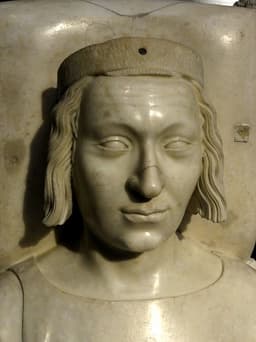
Charles V of France
Emperor · Medieval
59.9Total
Deva Raya II
Emperor · Medieval
70.7Total
Basic Information
Born
1338
1422
Died
1380
1446
Era
Medieval
Medieval
Nationality
France
India
Occupation
Emperor
Emperor
Civilization
Western
Indian
Score Comparison
Military (10%)
55.0
82.0
Political (20%)
59.3
72.0
Influence (20%)
61.0
82.0
Legacy (20%)
56.0
52.0
Leadership (15%)
72.0
78.0
Strategy (15%)
55.0
65.4
TOTAL
59.9
70.7
Charles V of France — Complete Timeline
1364 AD
Reforms of the Royal AdministrationReform◆ Major
Charles V reorganized the French royal administration, establishing a more efficient tax system and a standing army. He appointed capable officials and strengthened the monarchy's control over finances. These reforms provided the resources needed to recover from the Hundred Years' War.
AdministrationTaxationArmy
Impact: nationalconstructive
1368 AD
Establishment of the Royal LibraryCultural
Charles V founded the Royal Library in the Louvre, collecting over 900 manuscripts. He patronized scholars and translators, making works available in French. This library became the foundation of the Biblioth
LibraryPatronageManuscripts
Impact: nationalconstructive
1369 AD
Recovery of Territories from EnglandWar◆ Major
Charles V launched a series of military campaigns under Bertrand du Guesclin to reclaim lands lost to England. Using a strategy of avoiding pitched battles, the French gradually recaptured most of the territories ceded at Br
ReconquestHundred Years' WarDu Guesclin
Impact: regionalconstructive
1370 AD
Construction of the BastilleCultural
Charles V ordered the construction of the Bastille fortress in Paris to protect the city and serve as a royal residence. The fortress later became a symbol of royal authority and a prison. It was a key element of Charles's fortification of Paris.
FortressParisArchitecture
Deva Raya II — Complete Timeline
1425 AD
Campaigns against the Bahmani SultanateWar◆ Major
Deva Raya II led multiple military expeditions against the Bahmani Sultanate, capturing key fortresses such as Mudgal and Raichur. These victories expanded Vijayanagara's northern frontier and secured control over the Raichur Doab region.
WarExpansionBahmani
Impact: regional
1430 AD
Patronage of Literature and ArtsCultural◆ Major
Deva Raya II became a noted patron of Telugu and Sanskrit literature. Poets such as Srinatha and Chamarasa flourished at his court, producing works like 'Haravilasa' and 'Prabodhachandrodaya'. This period is considered a golden age of Telugu literature.
PatronageLiteratureCulture
Impact: nationalconstructive
1433 AD
Embassy to the Ming DynastyPolitical Action
Deva Raya II sent an embassy to the court of the Ming Emperor Xuande in China. The mission established diplomatic and trade relations, leading to the exchange of gifts and the import of Chinese goods such as porcelain and silk.
DiplomacyTradeChina
Impact: globalconstructive
1435 AD
Construction of the Hazara Rama TempleCultural
Deva Raya II commissioned the Hazara Rama Temple in Vijayanagara, dedicated to Lord Rama. The temple features intricate bas-reliefs depicting scenes from the Ramayana and served as a private shrine for the royal family.
ArchitectureTempleHinduism
constructive
Expert Analysis
Origins
Charles V of France (1338-1380), known as Charles the Wise, was born into the Valois dynasty during the Hundred Years' War. His father, John II, was captured at the Battle of Poitiers (1356), leaving Charles as regent at age 18. He received a scholarly education, influenced by the works of Aristotle and Thomas Aquinas, and was tutored by the theologian Nicole Oresme. His early experience managing the kingdom during his father's captivity shaped his cautious, administrative approach.
Deva Raya II (r. 1424-1446) was the most prominent ruler of the Sangama dynasty of the Vijayanagara Empire in South India. Born into a military aristocracy, he was trained in warfare and statecraft from a young age. His grandfather, Deva Raya I, had strengthened the empire, and Deva Raya II inherited a realm poised for expansion. He was a patron of literature and the arts, but his primary focus was military conquest and consolidation.
Rise to Power
Charles V became regent in 1356 after his father's capture. He faced the Jacquerie peasant revolt (1358) and the revolt of Étienne Marcel, which he suppressed with force. Upon John II's death in 1364, Charles ascended the throne. He appointed Bertrand du Guesclin as Constable of France in 1370, shifting strategy from pitched battles to attrition and siege warfare. By avoiding direct confrontations with the English, he gradually recovered territories lost under his predecessors.
Deva Raya II ascended the throne in 1424 after the death of his father, Veera Vijaya Bukka Raya. He quickly consolidated power by quelling internal rebellions and then turned his attention to the Bahmani Sultanate, the primary rival. His first major campaign (1425-1426) resulted in the capture of the fortresses of Mudgal and Raichur. These victories established his reputation as a military leader and expanded Vijayanagara's influence.
Leadership & Governance
Charles V's leadership was characterized by administrative reform and fiscal prudence. He reorganized the royal administration, creating a more efficient tax system (including the fouage, a hearth tax) and a standing army of paid troops. He centralized power by appointing loyal bureaucrats (the Marmousets) and reduced the influence of the nobility. His governance scored 59.3 in political metrics, reflecting his focus on stability over expansion. He also founded the Royal Library in the Louvre, collecting over 900 manuscripts and patronizing translations of classical works.
Deva Raya II's leadership was more martial and expansionist. He led multiple campaigns against the Bahmani Sultanate, using a combination of cavalry and infantry tactics. He also constructed irrigation systems and promoted trade, including an embassy to the Ming dynasty in 1427. His political score of 72.0 indicates effective governance of a large, multi-ethnic empire. He patronized Telugu and Sanskrit literature, with poets like Srinatha and Chamarasa producing works such as "Kashi Khandam" and "Prabodha Chandrodaya." He commissioned the Hazara Rama Temple, adorned with intricate reliefs.
Triumph & Tragedy
Charles V's greatest success was the recovery of French territories from England, including the reconquest of Poitou, Saintonge, and parts of Aquitaine by 1380. His military strategy scored 55.0, but his leadership score of 72.0 reflects his ability to rebuild the kingdom. However, his reign was marked by the ongoing plague and the economic strain of war. His greatest failure was the inability to achieve a decisive victory; the war resumed after his death, and his son Charles VI's mental illness plunged France into chaos.
Deva Raya II's triumphs include the expansion of Vijayanagara's territory to its greatest extent, with control over much of South India. His military score of 82.0 reflects his successful campaigns. He also fostered a cultural renaissance. His tragedy lies in the eventual decline of the Sangama dynasty after his death, as internal strife and the rise of the Bahmani Sultanate eroded his gains. His legacy score of 52.0 indicates that his empire's longevity was limited.
Character & Destiny
Charles V was cautious, scholarly, and methodical. He preferred diplomacy and administrative reform over military glory, earning the epithet "the Wise." His character shaped his destiny: he stabilized France but left a fragile monarchy to his son. Deva Raya II was ambitious, martial, and culturally astute. His aggressive expansionism brought short-term gains but overextended the empire. Both rulers' personalities directly influenced their realms' trajectories.
Legacy
Charles V's legacy is the restoration of French royal authority and the foundation for future victories in the Hundred Years' War. His administrative reforms influenced later French absolutism. The Royal Library became the basis for the Bibliothèque nationale de France. Deva Raya II's legacy is the cultural and architectural splendor of Vijayanagara, exemplified by the Hazara Rama Temple. His patronage of Telugu literature spurred a golden age. However, his military conquests did not endure.
Conclusion
Charles V had a more lasting impact on France's political structure, while Deva Raya II achieved greater immediate military and cultural success. Based on scores, Deva Raya II leads with a total of 70.7 against Charles V's 59.9, and his military (82.0 vs 55.0) and influence (82.0 vs 61.0) are significantly higher. However, Charles V's administrative reforms created a more stable legacy. Taking a stance, Deva Raya II had greater overall impact due to his expansion of the Vijayanagara Empire and cultural patronage, but Charles V's governance model was more influential for France's future. The score gap of 10.8 points supports Deva Raya II's superiority in this comparison.
Rankings
🥇
Deva Raya IILeader
Mil: 82.0Pol: 72.0Inf: 82.0
70.7
🥈
Charles V of France
Mil: 55.0Pol: 59.3Inf: 61.0
59.9
+10.8 behind
How This Comparison Works
Algorithm
Each figure is scored on 6 dimensions (0—100 scale) based on structured historical data: Military (10%), Political (20%), Influence (20%), Legacy (20%), Leadership (15%), Strategy (15%). The weighted total produces the final ranking.
Data Sources
Scores are computed from structured sub-indicators in the database. Scale factors adjust for era (Ancient ×0.85, Modern ×1.0) and civilization size (Eastern ×1.05, Other ×0.80) to account for differences in population and military scale.
Maximum 3 Figures
Comparisons are limited to 2—3 figures to ensure readability and statistical meaningfulness.
Error Margins
±5 points per dimension — Sub-scores are derived from historical records with inherent uncertainty. Two figures within 5 points on a dimension should be considered roughly equivalent in that area.
Total Score Accuracy
±3 points overall — The weighted combination of 6 dimensions produces a total score with approximately ±3 points of uncertainty. Differences of less than 3 points are not statistically significant— the figures are effectively tied.
Known Limitations
- Historical records are incomplete and uneven across civilizations
- Figures from oral-tradition societies may be underrepresented
- Occupation labels can misclassify multi-role figures
- Scores measure capability and impact, not moral character
- Quantitative scoring is a comparison tool, not absolute truth
Capability Radar
Military (10%) — Battles & Warfare
Battles
45
75
Win Rate
60
80
Expansion
40
70
Political (20%) — Governance & Reform
Reform
80
80
Diplomacy
75
75
Economy
70
85
Influence (20%) — Cultural & Global Reach
Cultural
55
75
Global
40
55
Legacy (20%) — Historical Impact
Historical
60
70
Longevity
50
65
Leadership (15%) — Power & Stability
Tenure
65
85
Stability
75
80
Strategy (15%) — Tactics & Innovation
Strategy
75
75
Tactics
55
70
Reform
70
65
Similar Comparisons
Comments & Discussion
No comments yet. Be the first to share your thoughts!