Loading...
Charles the Bald vs Philip III of France
Philip III of France leads by 5.8 pts · 2 figures compared
…
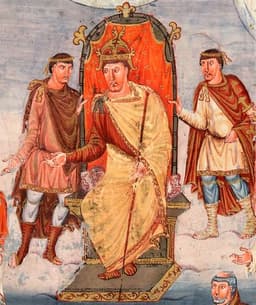
Charles the Bald
Emperor · Medieval
50.7Total
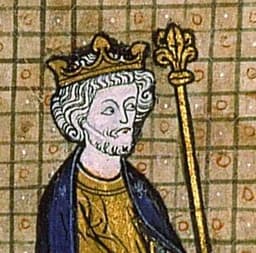
Philip III of France
Emperor · Medieval
56.5Total
Basic Information
Born
823
1245
Died
877
1285
Era
Medieval
Medieval
Nationality
Frankish Empire
France
Occupation
Emperor
Emperor
Civilization
Western
Western
Score Comparison
Military (10%)
10.0
72.5
Political (20%)
68.0
48.0
Influence (20%)
54.9
54.1
Legacy (20%)
46.7
45.8
Leadership (15%)
65.0
74.0
Strategy (15%)
43.3
60.0
TOTAL
50.7
56.5
Charles the Bald — Complete Timeline
843 AD
Treaty of VerdunPolitical Action
Charles the Bald, along with his brothers Lothair and Louis the German, signed the Treaty of Verdun, dividing the Carolingian Empire into three kingdoms. Charles received West Francia, which became the foundation of modern France.
TreatyDivisionWest FranciaFrance
Impact: global
845 AD
Defense against Viking RaidsWar
Charles faced repeated Viking invasions, including the siege of Paris in 845. He paid large tributes (Danegeld) to buy off attackers, a strategy that temporarily secured peace but drained royal resources and exposed military weakness.
VikingsDanegeldSiege of Paris
Impact: national
875 AD
Coronation as Holy Roman EmperorPolitical Action◆ Major
Pope John VIII crowned Charles the Bald as Holy Roman Emperor, following the death of Louis II. This coronation asserted Charles's claim to imperial authority but was contested by other Carolingian rulers.
CoronationHoly Roman EmpirePapacy
Impact: regionalconstructive
Philip III of France — Complete Timeline
1258 AD
Treaty of CorbeilPolitical Action
Philip III's father, Louis IX, signed the Treaty of Corbeil, which renounced French claims to Catalonia and Roussillon in exchange for Aragonese renunciation of claims to Provence and Languedoc. Philip III inherited this settlement.
TreatyDiplomacyCapetian
Impact: regional
1274 AD
Invasion of NavarreWar◆ Major
Philip III invaded Navarre to enforce his claim as regent for his niece, Joan I of Navarre. He secured control of the kingdom, which later passed to his son Philip IV through marriage, expanding French influence in the Pyrenees.
InvasionTerritorial ExpansionCapetian
Impact: regional
1285 AD
Aragonese CrusadeWar◆ Major
Philip III led the Aragonese Crusade, a papal-sanctioned invasion of Aragon to depose King Peter III. The French army was defeated at the Battle of the Col de Panissars and forced to retreat, suffering heavy losses. Philip III died during the retreat.
CrusadeDefeatCapetian
Impact: regionaltragic
Expert Analysis
Origins
Charles the Bald (born 823) was the youngest son of Emperor Louis the Pious and his second wife Judith. As a grandson of Charlemagne, he was born into the Carolingian dynasty at a time when the empire was fracturing. His early life was marked by family conflict: his father's attempts to secure a kingdom for him led to civil wars with his half-brothers. Charles received a solid education from monastic tutors, but his legitimacy was often questioned due to his mother's controversial influence.
Philip III of France (born 1245) was the son of King Louis IX (Saint Louis) and Margaret of Provence. Growing up in the Capetian court, he was groomed for kingship from an early age. His father's reputation for piety and justice set high standards. Philip was known as 'the Bold' (le Hardi), though chroniclers note he was more obedient than daring. He accompanied his father on the Seventh Crusade, which ended in disaster at Tunis, where Louis IX died in 1270.
Rise to Power
Charles the Bald's path to power was through the Treaty of Verdun (843), which divided the Carolingian Empire among his father's three surviving sons. Charles received West Francia, roughly modern France. He spent decades consolidating control over rebellious nobles and fending off Viking raids. His coronation as Holy Roman Emperor in 875, after the death of his nephew Louis II, was a major achievement, but it came at the cost of alienating his East Frankish relatives.
Philip III became king at age 25 upon his father's death in 1270. His accession was smooth due to Capetian stability. He immediately faced the challenge of completing the crusade his father had started, but he quickly negotiated a truce and returned to France. His early reign focused on enforcing royal authority in the south, particularly through the Treaty of Corbeil (1258), which had been negotiated by his father but was implemented under Philip. This treaty renounced French claims to Catalonia in exchange for Aragonese renunciation of claims in Provence.
Leadership & Governance
Charles the Bald governed through a combination of grants and coercion. He issued capitularies to regulate justice and church affairs, but his authority was limited by powerful magnates. He relied heavily on bishops and counts to administer his realm. His military strategy against Vikings was largely defensive: he built fortified bridges and paid Danegeld, which bought temporary peace but drained resources. Politically, he scored 68.0, reflecting his ability to navigate complex family dynamics, but his military score of 10.0 indicates his weakness in combat.
Philip III's leadership style was more autocratic but still constrained by feudal customs. He expanded the royal domain by acquiring the counties of Toulouse and Poitou through marriage and inheritance. His administration relied on bailiffs and seneschals, continuing his father's reforms. However, his most ambitious project, the Aragonese Crusade (1284-1285), was a catastrophe. The French army of 100,000 men was defeated by the Aragonese fleet and disease. Philip himself died from dysentery during the retreat. His leadership score of 74.0 reflects his boldness, but his strategy score of 60.0 shows flawed planning.
Triumph & Tragedy
Charles the Bald's greatest success was securing West Francia as a distinct kingdom, laying the foundation for modern France. He also became Holy Roman Emperor, a title he held from 875 until his death in 877. His greatest failure was his inability to defend against Vikings; Paris was sacked in 845, and he paid enormous tributes. His political maneuvering also led to the fragmentation of the Carolingian Empire, which never reunited.
Philip III's triumph was the expansion of French territory: he added Navarre (through his marriage to Isabella of Aragon) and Toulouse. His tragedy was the Aragonese Crusade, which drained the treasury and ended in humiliating defeat. He also failed to secure the inheritance of his son Philip IV, who had to deal with the consequences of his father's failed policies.
Character & Destiny
Charles the Bald was pragmatic and flexible, willing to compromise to maintain power. He was also learned, patronizing scholars like John Scotus Eriugena. However, his indecisiveness in military matters earned him a reputation for weakness. His destiny was shaped by the Carolingian decline: he could not reverse the fragmentation of the empire.
Philip III was pious and obedient to the Church, which led him to undertake the Aragonese Crusade at the pope's request. He was also stubborn, refusing to retreat until it was too late. His character, marked by loyalty to his father's legacy, drove him to overreach. Historians note that he was overshadowed by his son Philip IV, who proved a more effective ruler.
Legacy
Charles the Bald's legacy is mixed. He is remembered as a king who held West Francia together but failed to stop Viking incursions. His reign contributed to the feudal decentralization that characterized medieval France. His influence score of 54.9 reflects his role in shaping the Carolingian successor states. The Treaty of Verdun remains a defining moment in European history.
Philip III's legacy is largely overshadowed by his father and son. He is known for the Aragonese Crusade's failure, which weakened French prestige. However, his territorial acquisitions strengthened the Capetian domain. His legacy score of 45.8 is the lowest among these two, partly because his reign was short and marked by disaster.
Conclusion
While Philip III scores higher overall (56.5 vs 50.7), Charles the Bald had a greater long-term impact. Charles's division of the empire created the kingdom of France, a political entity that endured for centuries. Philip III's territorial gains were later consolidated by his successors, but his catastrophic crusade set back French ambitions. Charles's political score (68.0) exceeds Philip's (48.0), indicating superior statecraft. However, Philip's military (72.5) and leadership (74.0) scores show he was a more effective commander. In terms of legacy, Charles's role in shaping medieval Europe is more significant. Therefore, Charles the Bald had greater historical impact despite his lower total score.
Rankings
🥇
Philip III of FranceLeader
Mil: 72.5Pol: 48.0Inf: 54.1
56.5
🥈
Charles the Bald
Mil: 10.0Pol: 68.0Inf: 54.9
50.7
+5.8 behind
How This Comparison Works
Algorithm
Each figure is scored on 6 dimensions (0—100 scale) based on structured historical data: Military (10%), Political (20%), Influence (20%), Legacy (20%), Leadership (15%), Strategy (15%). The weighted total produces the final ranking.
Data Sources
Scores are computed from structured sub-indicators in the database. Scale factors adjust for era (Ancient ×0.85, Modern ×1.0) and civilization size (Eastern ×1.05, Other ×0.80) to account for differences in population and military scale.
Maximum 3 Figures
Comparisons are limited to 2—3 figures to ensure readability and statistical meaningfulness.
Error Margins
±5 points per dimension — Sub-scores are derived from historical records with inherent uncertainty. Two figures within 5 points on a dimension should be considered roughly equivalent in that area.
Total Score Accuracy
±3 points overall — The weighted combination of 6 dimensions produces a total score with approximately ±3 points of uncertainty. Differences of less than 3 points are not statistically significant— the figures are effectively tied.
Known Limitations
- Historical records are incomplete and uneven across civilizations
- Figures from oral-tradition societies may be underrepresented
- Occupation labels can misclassify multi-role figures
- Scores measure capability and impact, not moral character
- Quantitative scoring is a comparison tool, not absolute truth
Capability Radar
Military (10%) — Battles & Warfare
Battles
45
55
Win Rate
40
60
Expansion
35
65
Political (20%) — Governance & Reform
Reform
45
40
Diplomacy
55
50
Economy
50
45
Influence (20%) — Cultural & Global Reach
Cultural
40
30
Global
30
25
Legacy (20%) — Historical Impact
Historical
45
40
Longevity
35
35
Leadership (15%) — Power & Stability
Tenure
60
55
Stability
40
50
Strategy (15%) — Tactics & Innovation
Strategy
40
50
Tactics
35
45
Reform
30
30
Similar Comparisons
Comments & Discussion
No comments yet. Be the first to share your thoughts!