Loading...
Charles the Bald vs John II Komnenos
John II Komnenos leads by 14.5 pts · 2 figures compared
…
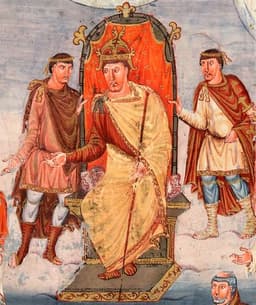
Charles the Bald
Emperor · Medieval
50.7Total

John II Komnenos
Emperor · Medieval
65.2Total
Basic Information
Born
823
1087
Died
877
1143
Era
Medieval
Medieval
Nationality
Frankish Empire
Byzantine Empire
Occupation
Emperor
Emperor
Civilization
Western
Western
Score Comparison
Military (10%)
10.0
81.2
Political (20%)
68.0
70.0
Influence (20%)
54.9
60.0
Legacy (20%)
46.7
52.0
Leadership (15%)
65.0
78.0
Strategy (15%)
43.3
69.1
TOTAL
50.7
65.2
Charles the Bald — Complete Timeline
843 AD
Treaty of VerdunPolitical Action
Charles the Bald, along with his brothers Lothair and Louis the German, signed the Treaty of Verdun, dividing the Carolingian Empire into three kingdoms. Charles received West Francia, which became the foundation of modern France.
TreatyDivisionWest FranciaFrance
Impact: global
845 AD
Defense against Viking RaidsWar
Charles faced repeated Viking invasions, including the siege of Paris in 845. He paid large tributes (Danegeld) to buy off attackers, a strategy that temporarily secured peace but drained royal resources and exposed military weakness.
VikingsDanegeldSiege of Paris
Impact: national
875 AD
Coronation as Holy Roman EmperorPolitical Action◆ Major
Pope John VIII crowned Charles the Bald as Holy Roman Emperor, following the death of Louis II. This coronation asserted Charles's claim to imperial authority but was contested by other Carolingian rulers.
CoronationHoly Roman EmpirePapacy
Impact: regionalconstructive
John II Komnenos — Complete Timeline
1118 AD
Accession as Emperor (1118)Political Action◆ Major
John II Komnenos succeeded his father Alexios I as Byzantine emperor. He was known for his piety, justice, and military skill. His reign marked the height of the Komnenian restoration.
Accession
Impact: regionalconstructive
1119 AD
Campaigns against the Seljuks (1119-1138)War◆ Major
John II led several campaigns against the Seljuk Turks in Anatolia, recapturing key cities such as Laodicea, Sozopolis, and Kastamoni. He also defeated the Danishmendids. These campaigns restored Byzantine control over much of western Anatolia.
Byzantine-Seljuk WarsMilitary Campaign
Impact: regionalconstructive
1137 AD
Campaign against the Crusader States (1137-1138)War◆ Major
John II led a campaign against the Crusader Principality of Antioch, forcing Prince Raymond to swear fealty. He also besieged the city of Aleppo but failed to capture it. This demonstrated Byzantine authority over the Crusader states.
CrusadesDiplomacyMilitary Campaign
Impact: regional
1143 AD
Death from a Hunting Accident (1143)Other◆ Major
John II died from an infected wound sustained while hunting. He was succeeded by his son Manuel I Komnenos. His death was a loss for the empire, as he was considered one of its most capable rulers.
DeathAccident
Impact: regionaltragic
Expert Analysis
Origins
Charles the Bald was born on June 13, 823, in Frankfurt, the son of Emperor Louis the Pious and his second wife Judith of Bavaria. As a younger son, he was initially not destined for a large inheritance, but his mother's influence secured him the kingdom of Aquitaine in 832. His early life was marked by the dynastic struggles of the Carolingian family, where shifting alliances and civil wars were common. He received a typical aristocratic education, focusing on military training and Latin literacy, though his political acumen was honed through constant negotiation and conflict with his half-brothers.
John II Komnenos was born on September 13, 1087, in Constantinople, the eldest son of Emperor Alexios I Komnenos and Irene Doukaina. Raised in the imperial court, he was groomed for leadership from an early age, receiving a comprehensive education in military tactics, theology, and classical literature. His father's reforms and the recent recovery of the Byzantine Empire after the Battle of Manzikert provided a stable foundation. John's upbringing emphasized piety, justice, and duty, earning him later comparisons to the Roman emperor Marcus Aurelius.
Rise to Power
Charles the Bald's rise was shaped by the Treaty of Verdun in 843, which partitioned the Carolingian Empire among the three surviving sons of Louis the Pious. Charles received West Francia, roughly corresponding to modern France. This division was the result of years of civil war, including the Battle of Fontenoy (841) where Charles and Louis the German defeated their brother Lothair. Charles's political maneuvering, including alliances with the Church and nobles, solidified his rule, though he faced constant rebellions from his own nobility and Viking incursions.
John II Komnenos succeeded his father peacefully in 1118, a rare event in Byzantine history. His accession was challenged by his sister Anna Komnene and her husband, who plotted to overthrow him, but John swiftly neutralized the conspiracy, showing clemency by sparing their lives. He then focused on consolidating power, purging corrupt officials and strengthening the military. His reign marked the continuation of the Komnenian restoration, building on his father's achievements.
Leadership & Governance
Charles the Bald's governance was characterized by a reliance on local counts and bishops to administer his fragmented kingdom. He issued capitularies to standardize laws and promoted Carolingian Renaissance learning, patronizing scholars like John Scotus Eriugena. However, his leadership was reactive, often paying Danegeld (tribute) to Viking raiders, such as the 845 siege of Paris where he paid 7,000 pounds of silver. His military score of 10.0 reflects his inability to effectively defend his realm, though his political score of 68.0 indicates skill in negotiation and alliance-building.
John II Komnenos was an active and disciplined leader, personally leading campaigns and enforcing justice. He reformed the Byzantine army, restoring the professional tagmata and improving logistics. His administration emphasized meritocracy, appointing capable officials regardless of birth. He also maintained diplomatic relations with the Holy Roman Empire and the Papacy, securing the empire's western borders. His leadership score of 78.0 and political score of 70.0 reflect his effectiveness in both spheres.
Triumph & Tragedy
Charles the Bald's greatest triumph was his coronation as Holy Roman Emperor by Pope John VIII in 875, fulfilling his ambition to match his grandfather's prestige. He also successfully negotiated the Treaty of Meerssen (870) to expand his territory after Lothair II's death. His tragedies include the constant Viking raids, which drained the treasury and destabilized his kingdom. His death in 877 while crossing the Alps during a campaign against his nephew Carloman left a succession crisis that contributed to the decline of Carolingian power.
John II Komnenos's triumphs were his campaigns against the Seljuks, recapturing key cities like Laodicea (1119) and Kastamoni (1132), and his victory at the Battle of Beroia (1122) against the Pechenegs, which eliminated a major threat. He also forced the Crusader Principality of Antioch to swear fealty in 1137. His tragedy was his sudden death in 1143 from a hunting accident, cutting short his plans to reclaim Syria and his son Manuel's unpreparedness. His military score of 81.2 and strategy score of 69.1 underscore his effectiveness.
Character & Destiny
Charles the Bald was pragmatic and politically astute, but his character was marred by indecisiveness and a tendency to avoid direct confrontation. His reliance on bribery and diplomacy rather than military force shaped his destiny: he preserved his kingdom but failed to secure lasting stability. Historians assess him as a capable administrator overshadowed by the legacy of Charlemagne. His total score of 50.7 reflects this mixed record.
John II Komnenos was known for his piety, justice, and bravery. He was a hands-on emperor, often fighting alongside his troops. His character earned him the epithet "the Good" and comparisons to Marcus Aurelius. His destiny was to restore Byzantine power, but his early death prevented full fruition. His total score of 65.2 indicates a more successful reign.
Legacy
Charles the Bald's legacy is mixed: he founded the West Frankish kingdom that would become France, but his inability to repel Vikings led to the rise of local feudal lords. The Carolingian Renaissance continued under his patronage, but his political fragmentation set the stage for later dynastic struggles. His legacy score of 46.9 reflects his limited long-term impact.
John II Komnenos left a stronger legacy: he restored Byzantine authority in Anatolia and the Balkans, and his military and administrative reforms laid the groundwork for the Komnenian restoration. His son Manuel I continued his policies, but the empire's decline after Manuel's death is partly attributed to John's untimely death. His legacy score of 52.0 is higher, reflecting his enduring impact on Byzantine history.
Conclusion
John II Komnenos had a greater impact than Charles the Bald. With a total score of 65.2 against Charles's 50.7, John's military, leadership, and strategic scores significantly outpace Charles's. While Charles's political skill was comparable (68.0 vs 70.0), John's effective governance and military successes recovered Byzantine territory and stabilized the empire for decades. Charles's reign, though important for the formation of France, was reactive and ultimately weakened the Carolingian dynasty. John's tragedy was his early death; Charles's was his inability to secure his realm. The data supports John II Komnenos as the more successful ruler.
Rankings
🥇
John II KomnenosLeader
Mil: 81.2Pol: 70.0Inf: 60.0
65.2
🥈
Charles the Bald
Mil: 10.0Pol: 68.0Inf: 54.9
50.7
+14.5 behind
How This Comparison Works
Algorithm
Each figure is scored on 6 dimensions (0—100 scale) based on structured historical data: Military (10%), Political (20%), Influence (20%), Legacy (20%), Leadership (15%), Strategy (15%). The weighted total produces the final ranking.
Data Sources
Scores are computed from structured sub-indicators in the database. Scale factors adjust for era (Ancient ×0.85, Modern ×1.0) and civilization size (Eastern ×1.05, Other ×0.80) to account for differences in population and military scale.
Maximum 3 Figures
Comparisons are limited to 2—3 figures to ensure readability and statistical meaningfulness.
Error Margins
±5 points per dimension — Sub-scores are derived from historical records with inherent uncertainty. Two figures within 5 points on a dimension should be considered roughly equivalent in that area.
Total Score Accuracy
±3 points overall — The weighted combination of 6 dimensions produces a total score with approximately ±3 points of uncertainty. Differences of less than 3 points are not statistically significant— the figures are effectively tied.
Known Limitations
- Historical records are incomplete and uneven across civilizations
- Figures from oral-tradition societies may be underrepresented
- Occupation labels can misclassify multi-role figures
- Scores measure capability and impact, not moral character
- Quantitative scoring is a comparison tool, not absolute truth
Capability Radar
Military (10%) — Battles & Warfare
Battles
45
75
Win Rate
40
80
Expansion
35
72
Political (20%) — Governance & Reform
Reform
45
76
Diplomacy
55
80
Economy
50
74
Influence (20%) — Cultural & Global Reach
Cultural
40
55
Global
30
45
Legacy (20%) — Historical Impact
Historical
45
60
Longevity
35
50
Leadership (15%) — Power & Stability
Tenure
60
85
Stability
40
82
Strategy (15%) — Tactics & Innovation
Strategy
40
82
Tactics
35
78
Reform
30
70
Similar Comparisons
Comments & Discussion
No comments yet. Be the first to share your thoughts!