Loading...
Charles II of England vs Napoleon Bonaparte
Napoleon Bonaparte leads by 18.2 pts · 2 figures compared
…
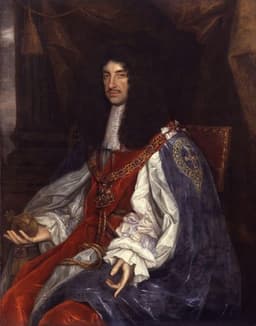
Charles II of England
Emperor · Modern
52.7Total

Napoleon Bonaparte
General · Modern
70.9Total
Basic Information
Born
1630
1769
Died
1685
1821
Era
Modern
Modern
Nationality
England
France
Occupation
Emperor
General
Civilization
Western
Western
Score Comparison
Military (10%)
10.2
94.0
Political (20%)
60.0
72.0
Influence (20%)
62.0
40.0
Legacy (20%)
52.0
80.0
Leadership (15%)
68.0
78.0
Strategy (15%)
39.6
90.0
TOTAL
52.7
70.9
Charles II of England — Complete Timeline
1660 AD
Restoration of the MonarchyPolitical Action
Charles II was invited back to England by Parliament, restoring the monarchy after the death of Oliver Cromwell. The Declaration of Breda promised amnesty and religious tolerance, leading to a peaceful transition and the end of the Commonwealth.
RestorationMonarchyCommonwealth
Impact: nationalconstructive
1666 AD
Great Fire of LondonOther◆ Major
A massive fire destroyed much of London, including St. Paul's Cathedral and thousands of homes. Charles II oversaw the rebuilding efforts, appointing Christopher Wren to redesign the city, which modernized London's architecture.
DisasterRebuildingLondon
Impact: nationaltragic
1670 AD
Secret Treaty of DoverPolitical Action◆ Major
Charles II signed the Secret Treaty of Dover with Louis XIV of France, agreeing to convert to Catholicism and support French wars in exchange for subsidies. This secret pact undermined English Protestant interests and sparked political controversy.
TreatyCatholicismFrance
Impact: regional
1673 AD
Test Act of 1673Reform
Parliament passed the Test Act, requiring all officeholders to receive Anglican communion and renounce transubstantiation. Charles II reluctantly accepted it, which excluded Catholics from public office and deepened religious divisions.
Religious LegislationAnglicanismCatholic Exclusion
Impact: national
1678 AD
Popish PlotPolitical Action◆ Major
Titus Oates fabricated a conspiracy alleging a Catholic plot to assassinate Charles II and install his Catholic brother James. The resulting hysteria led to the execution of innocent Catholics and a political crisis, though Charles remained skeptical.
ConspiracyAnti-CatholicismPolitical Crisis
Impact: nationaldestructive
Napoleon Bonaparte — Complete Timeline
1799 AD
Coup of 18 BrumaireOther◆ Major
Napoleon Bonaparte, with support from his brother Lucien and key political figures, overthrew the Directory in a bloodless coup. He established the Consulate with himself as First Consul, effectively becoming the ruler of France. This event ended the French Revolution's most unstable period.
French RevolutionCoupRise to Power
Impact: regional
1804 AD
Promulgation of the Napoleonic CodeOther◆ Major
Napoleon enacted the Civil Code of the French, known as the Napoleonic Code, a comprehensive set of laws that replaced the fragmented feudal legal systems. The code established legal equality, protected property rights, and secularized law. It became the basis for legal systems in many European and world countries.
Legal ReformNapoleonic CodeCivil Law
Impact: globalconstructive
1805 AD
Battle of AusterlitzWar◆ Major
Napoleon's Grande Arm
Napoleonic WarsBattleDecisive Victory
Impact: global
1812 AD
Invasion of RussiaWar◆ Major
Napoleon led the Grande Arm
Napoleonic WarsInvasionDisaster
Impact: globaldestructive
1815 AD
Battle of WaterlooWar◆ Major
Napoleon's French army was defeated by the combined forces of the Duke of Wellington's Anglo-Allied army and Gebhard Leberecht von Bl
Napoleonic WarsBattleFinal Defeat
Impact: globaldestructive
Expert Analysis
charles-ii-of-england-vs-napoleon-bonaparte
# The Emperor and the Merry Monarch: Two Paths to Power in an Age of Upheaval
In the winter of 1815, as Napoleon Bonaparte shivered in exile on the remote island of Saint Helena, he might have envied the fate of Charles II of England, a king who had lost his throne and then, miraculously, regained it. Both men lived through revolutions that shattered their worlds. Both rose from the ashes of chaos to rule. But one conquered Europe with fire and sword, while the other charmed a nation back to monarchy with wit and compromise. Why did the Corsican corporal become a titan of history, while the Stuart king became remembered chiefly for his mistresses and his dogs? The answer lies not in their times alone, but in the very different men they were.
Origins
Napoleon Bonaparte was born in 1769 on the rugged island of Corsica, a territory only recently annexed by France. His family was minor nobility, proud and impoverished. Young Napoleon spoke Italian before French, and his accent would forever mark him as an outsider. At the military academy of Brienne, he was bullied for his small stature and foreign ways. He read voraciously—history, geography, military tactics—and dreamed of liberating Corsica. The French Revolution, which began when he was twenty, shattered the old order and opened doors that had been locked for centuries. For a brilliant, ambitious outsider, it was an invitation to remake the world.
Charles II was born in 1630 at St. James’s Palace, the second son of King Charles I and Queen Henrietta Maria. He grew up in a court of exquisite refinement and deepening crisis. His father’s conflict with Parliament escalated into civil war when Charles was twelve. At fifteen, he commanded Royalist forces—and lost. At nineteen, after his father’s execution, he became a king without a kingdom, wandering Europe as a penniless exile for eleven years. He learned to read people, to smile when he was furious, to promise what he could not deliver. He learned that survival mattered more than glory.
Rise to Power
Napoleon’s ascent was a masterpiece of speed and audacity. In 1793, at age twenty-four, he drove the British out of Toulon and was promoted to brigadier general. In 1795, he saved the revolutionary government from a royalist mob with a “whiff of grapeshot”—a single, decisive volley of cannon fire. He was given command of the Army of Italy, and in 1796-97, he stunned Europe with a campaign of breathtaking brilliance, defeating larger Austrian armies through speed, deception, and relentless aggression. By 1799, he was First Consul of France. By 1804, he crowned himself Emperor. He had gone from obscure Corsican to master of Europe in fifteen years.
Charles II returned to England on May 29, 1660, his thirtieth birthday. There was no battle, no coup. Parliament invited him back. The republic that had executed his father had collapsed into chaos under Oliver Cromwell’s son. The nation wanted stability, and Charles—charming, forgiving, and unburdened by principle—was the safest option. He entered London on a wave of celebration, the streets lined with cheering crowds. He had done nothing to earn the throne except survive. That was precisely why they wanted him.
Leadership & Governance
Napoleon governed as he fought: with total concentration, relentless energy, and a vision of order imposed from above. He reformed French law into the Napoleonic Code, a rational system that abolished feudal privileges and enshrined equality before the law. He centralized the bureaucracy, created the Bank of France, and built roads and canals that bound the nation together. He was a military genius—his score of 94.0 in military ability and 93.0 in strategy reflects a mind that could maneuver hundreds of thousands of men across a continent. But his political score of 75.0 reveals a fatal flaw: he could not stop. Victory demanded more victory. Conquest required more conquest. He created an empire that depended entirely on his own genius, and genius cannot be everywhere at once.
Charles II governed as he survived: with charm, indirection, and a profound understanding of human weakness. He was lazy by nature and shrewd by experience. He let Parliament believe it ruled while he quietly built a court of loyalists, dispensing patronage with a master’s touch. His leadership score of 86.9 reflects a man who could hold a fractured nation together through sheer personal magnetism. He was no military commander—his score of 18.3 in that domain is almost comically low—but he understood that England did not need a warrior king. It needed a king who would not start another civil war. He signed the Secret Treaty of Dover in 1670, promising Louis XIV he would convert to Catholicism, but he never kept the promise. He watched the Popish Plot of 1678 convulse the nation, but he refused to be drawn into religious war. He survived.
Triumph & Tragedy
Napoleon’s greatest triumph was Austerlitz in 1805, where he destroyed the combined armies of Russia and Austria in a single day of flawless maneuver. His greatest tragedy was the invasion of Russia in 1812, where he lost half a million men to the snow and the Russian winter. He was exiled to Elba in 1814, escaped in 1815, and raised another army—only to be defeated at Waterloo by the Duke of Wellington and the Prussian General Blücher. He died in 1821 on Saint Helena, a prisoner of the British, at age fifty-one.
Charles II’s greatest triumph was the Restoration itself: he brought peace to a nation torn apart by civil war, religious extremism, and republican experiment. His greatest tragedy was the Great Fire of London in 1666, which destroyed much of the city. He oversaw the rebuilding with energy and vision, commissioning Christopher Wren to design St. Paul’s Cathedral. He died in 1685, in his bed, surrounded by his court and his mistresses. He had converted to Catholicism on his deathbed, a secret he had kept for decades.
Character & Destiny
Napoleon was driven by an insatiable hunger for greatness. “Impossible is a word to be found only in the dictionary of fools,” he said. He believed that destiny had chosen him to remake Europe. He was brilliant, ruthless, and utterly convinced of his own rightness. That conviction made him unstoppable—until it made him blind. He could not share power, could not delegate, could not accept defeat. His personality built an empire, and his personality destroyed it.
Charles II was driven by a profound desire to never again be poor, hunted, or powerless. “I have no desire to go on my travels again,” he once remarked. He was cynical, witty, and deeply pragmatic. He knew that kings could be killed, that nations could change, that nothing was permanent. He learned to bend rather than break. His personality did not build an empire; it preserved a kingdom. He gave England what it needed most: a breathing space between the fanaticism of the Puritans and the absolutism of his brother James.
Legacy
Napoleon left behind a transformed Europe. The Napoleonic Code influenced legal systems across the continent. He destroyed the Holy Roman Empire and sparked the nationalism that would reshape the nineteenth century. His memory is a battleground: to some, he was a tyrant who drowned Europe in blood; to others, a genius who spread the ideals of the French Revolution. His legacy score of 78.0 reflects this ambiguity.
Charles II left behind a restored monarchy that would never again challenge Parliament. He made the English throne safe for constitutional rule. He founded the Royal Society, patronized the arts, and gave his name to an age of wit, theater, and scientific inquiry. He is remembered as the Merry Monarch, a king who loved life and let his people live. His legacy score of 68.8 is lower than Napoleon’s, but it is a legacy of peace.
Conclusion
Napoleon and Charles II faced the same question: how to rule in an age of revolution. Napoleon answered with genius and force, building an empire that collapsed under its own weight. Charles answered with patience and charm, building a stability that lasted for centuries. One was a comet, the other a candle. Comets illuminate the sky, but candles warm the room. In the end, which is more valuable depends on whether you are watching from a palace or living in the house.
Rankings
🥇
Napoleon BonaparteLeader
Mil: 94.0Pol: 72.0Inf: 40.0
70.9
🥈
Charles II of England
Mil: 10.2Pol: 60.0Inf: 62.0
52.7
+18.2 behind
How This Comparison Works
Algorithm
Each figure is scored on 6 dimensions (0—100 scale) based on structured historical data: Military (10%), Political (20%), Influence (20%), Legacy (20%), Leadership (15%), Strategy (15%). The weighted total produces the final ranking.
Data Sources
Scores are computed from structured sub-indicators in the database. Scale factors adjust for era (Ancient ×0.85, Modern ×1.0) and civilization size (Eastern ×1.05, Other ×0.80) to account for differences in population and military scale.
Maximum 3 Figures
Comparisons are limited to 2—3 figures to ensure readability and statistical meaningfulness.
Error Margins
±5 points per dimension — Sub-scores are derived from historical records with inherent uncertainty. Two figures within 5 points on a dimension should be considered roughly equivalent in that area.
Total Score Accuracy
±3 points overall — The weighted combination of 6 dimensions produces a total score with approximately ±3 points of uncertainty. Differences of less than 3 points are not statistically significant— the figures are effectively tied.
Known Limitations
- Historical records are incomplete and uneven across civilizations
- Figures from oral-tradition societies may be underrepresented
- Occupation labels can misclassify multi-role figures
- Scores measure capability and impact, not moral character
- Quantitative scoring is a comparison tool, not absolute truth
Capability Radar
Military (10%) — Battles & Warfare
Battles
10
95
Win Rate
10
90
Expansion
5
95
Political (20%) — Governance & Reform
Reform
60
95
Diplomacy
65
80
Economy
55
85
Influence (20%) — Cultural & Global Reach
Cultural
60
85
Global
50
90
Legacy (20%) — Historical Impact
Historical
65
95
Longevity
55
90
Leadership (15%) — Power & Stability
Tenure
55
85
Stability
50
70
Strategy (15%) — Tactics & Innovation
Strategy
5
95
Tactics
5
98
Reform
15
92
Similar Comparisons
Comments & Discussion
TriumphalTitan6/17/2026
Napoleon conquered Europe with strategic genius, but Charles II conquered England with sheer charm—and gave us the Royal Navy. The Merry Monarch founded the Royal Observatory and sponsored the Royal Society, planting seeds of empire while Bonaparte bled France white. Give me a king who knows when to sign a peace treaty over one who builds armies to feed his ego.
数据拆解者6/17/2026
数据不会说谎:拿破仑打了60多场战役,赢了50多,但法国人口在1810-1815年间下降100多万。查理二世在位25年,英格兰人口增长近30万,伦敦成为欧洲金融中心。用伤亡换荣耀,像用全副身家赌一把;靠贸易和宽容积累国力,才是真智慧——历史的天平该重新称称了。
LegionaryScribe6/17/2026
As a classics scholar, I see Napoleon as Caesar’s echo—the Gallic campaigns, the 18 Brumaire coup, even the Egyptian expedition mirrored ancient consolidation. But Charles II? He’s Augustus in wit, not war—restoring order without bloodshed after Cromwell’s ruin. Augustus’s “return to the republic” is Charles’s Protestantism with a wink. One left a code of laws, the other a code of laughter.
血色十字架6/17/2026
克伦威尔的共和梦碎在1660年,查理二世靠的不是剑,是人心——他赦免了大部分圆颅党,只处决了几个倒霉蛋。拿破仑呢?百日王朝回来第一件事就是肃清反对派,把拉法耶特流放。同样是复辟,一个用宽恕建根基,一个用铁腕挖了坟。谁更懂统治?
DiplomaticDissent6/17/2026
The comparison misses class context. Napoleon rose from Corsican poverty to emperor by exploiting revolutionary mobility; Charles II returned to a throne his father lost by embracing religious tolerance with the 1672 Declaration of Indulgence. One was a parvenu who ran out of luck at Waterloo; the other, a Stuart who ran Europe’s first intelligence network. Let’s not flatten power into personality.