Loading...
Cato the Elder vs Zhang Lu
Cato the Elder leads by 17.1 pts · 2 figures compared
…
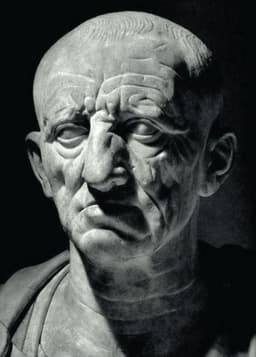
Cato the Elder
Politician · Ancient
63.0Total

Zhang Lu
Politician · Ancient
45.9Total
Basic Information
Born
-234
150
Died
-149
216
Era
Ancient
Ancient
Nationality
Roman Republic
China
Occupation
Politician
Politician
Civilization
Western
Eastern
Score Comparison
Military (10%)
45.0
14.9
Political (20%)
55.0
40.8
Influence (20%)
68.0
54.9
Legacy (20%)
68.0
44.2
Leadership (15%)
72.0
64.0
Strategy (15%)
54.3
39.6
TOTAL
63.0
45.9
Cato the Elder — Complete Timeline
195 BC
Consulship and Campaign in SpainWar
Cato served as consul and led a campaign in Hispania Citerior, suppressing a rebellion. He used harsh tactics, including mass executions, to pacify the region, and later boasted of his victories in his writings.
Military campaignSpanish wars
Impact: regionaldestructive
184 BC
Censorship and Moral ReformsReform◆ Major
Cato the Elder served as censor, implementing strict moral reforms to combat luxury and corruption. He expelled senators for immorality, taxed luxury goods, and promoted traditional Roman values, earning the nickname 'Censorius'.
CensorshipMoral reform
Impact: nationalconstructive
168 BC
Publication of 'Origines'Cultural◆ Major
Cato wrote 'Origines', the first history of Rome in Latin. The work covered the founding of Rome and the early Republic, emphasizing Roman virtues and the importance of agriculture, and influenced later Roman historiography.
LiteratureHistoriography
Impact: nationalconstructive
155 BC
Opposition to HellenizationPolitical Action
Cato opposed the influence of Greek culture on Rome, arguing it undermined Roman values. He led a campaign to expel Greek philosophers from Rome and promoted traditional Roman education and customs.
Cultural conflictConservatism
Impact: national
153 BC
Campaign for the Destruction of CarthagePolitical Action◆ Major
Cato ended every speech in the Senate with 'Carthago delenda est' (Carthage must be destroyed). His persistent advocacy for war against Carthage influenced Roman policy and contributed to the outbreak of the Third Punic War.
Foreign policyImperialism
Impact: globaldestructive
Zhang Lu — Complete Timeline
190 AD
Establishment of the Celestial Master state in HanzhongPolitical Action◆ Major
Zhang Lu, as the third Celestial Master, established a theocratic state in Hanzhong based on Taoist principles. He implemented communal living, charity stations, and a tax system, ruling independently for over two decades.
Three KingdomsTaoismTheocracy
Impact: regionalconstructive
215 AD
Surrender to Cao CaoPolitical Action◆ Major
Zhang Lu surrendered Hanzhong to Cao Cao after a military campaign. Cao Cao accepted his surrender, appointed him as General, and allowed him to retain some autonomy, integrating the Celestial Master state into Cao Wei.
Three KingdomsSurrenderIntegration
Impact: regional
Expert Analysis
Origins
Cato the Elder was born in 234 BCE in Tusculum, a Latin town southeast of Rome, to a plebeian family. His father was a farmer, and Cato grew up working the land, which instilled in him a lifelong disdain for luxury and corruption. He received a traditional Roman education, focusing on law, rhetoric, and military training. His early career was marked by service in the Second Punic War, where he fought under Fabius Maximus and gained military experience. Cato's rise was aided by his oratory skills and his ability to connect with the common people, presenting himself as a man of traditional Roman virtues.
Zhang Lu was born around 190 CE in present-day Jiangsu, China, during the turbulent end of the Han dynasty. He was the grandson of Zhang Daoling, founder of the Way of the Celestial Masters, a Taoist religious movement. His father, Zhang Heng, succeeded as the second Celestial Master. Zhang Lu inherited the leadership after his father's death. The family's religious authority and the chaotic political environment provided Zhang Lu with a base of power. He was educated in Taoist scriptures and governance, but his early life is less documented than Cato's.
Rise to Power
Cato's rise began with his election as military tribune in 214 BCE. His big break came in 204 BCE when he was appointed quaestor to Scipio Africanus, but Cato disapproved of Scipio's lavish spending. He later served as aedile and praetor, gaining popularity through strict enforcement of laws. In 195 BCE, he was elected consul and given command in Hispania Citerior, where he suppressed a rebellion with extreme measures, including mass executions. His censorship in 184 BCE was his peak, where he expelled senators for immorality and taxed luxury goods. Cato's persistent advocacy for the destruction of Carthage, encapsulated in his phrase "Carthago delenda est," became his defining political stance.
Zhang Lu rose to power in the early 190s CE when he was appointed as a military officer by the Han governor of Yizhou (Sichuan). However, he later turned against the Han and established an independent theocratic state in Hanzhong, a strategic mountain basin. He used his religious authority as the third Celestial Master to organize a community based on Taoist principles, including communal living and charity. His state offered refuge to people fleeing the chaos of the collapsing Han. Zhang Lu's rule was legitimized by his religious role, and he maintained power through a combination of spiritual leadership and pragmatic diplomacy.
Leadership & Governance
Cato's leadership style was authoritarian and moralistic. As censor, he enforced sumptuary laws, expelled senators for immorality, and promoted traditional Roman values. He opposed the influx of Greek culture, which he saw as corrupting. His governance focused on discipline and frugality. For example, he taxed luxury items like jewelry and expensive fabrics. Militarily, he was harsh, as seen in Spain where he executed many prisoners. Politically, he scored 55.0, reflecting his effectiveness in the Senate. His strategy score of 54.3 indicates a practical but inflexible approach.
Zhang Lu's leadership was theocratic and communal. He ruled Hanzhong as a Taoist utopia, implementing a system where people contributed grain and goods to a common store. He established charity stations offering food and shelter to travelers. His military score of 14.9 is low, but he avoided major battles by surrendering to Cao Cao when necessary. His political score of 40.8 reflects his ability to maintain a stable state for nearly 30 years. Zhang Lu's strategy score of 39.6 indicates a defensive and conciliatory approach, prioritizing survival over expansion.
Triumph & Tragedy
Cato's greatest success was his moral reform that shaped Roman identity. His censorship set a standard for public morality. His campaign against Carthage succeeded posthumously when the Third Punic War destroyed Carthage in 146 BCE. However, his opposition to Hellenization may have limited Rome's cultural development. His harshness in Spain caused resentment. His greatest failure was his inability to prevent the rise of luxury he opposed; his reforms were temporary.
Zhang Lu's triumph was establishing a stable theocratic state that lasted until 215 CE, when he surrendered to Cao Cao. He successfully integrated religious and political authority. His charity systems were innovative. His tragedy was that his state was absorbed by a secular warlord. His religious movement survived but lost political power. Zhang Lu's legacy score of 44.2 reflects his limited long-term impact compared to Cato's 68.0.
Character & Destiny
Cato was stubborn, self-righteous, and relentless. His character drove his campaign against Carthage, but also made him inflexible. He scored 72.0 in leadership, reflecting his ability to inspire, but his rigidity limited his adaptability. His destiny was to be remembered as a symbol of Roman virtue and pugnacity.
Zhang Lu was pragmatic and religiously devout. He chose surrender over futile resistance, ensuring his followers' safety. His character allowed him to maintain authority without military force. His destiny was to be a footnote in Chinese history, remembered as a Taoist ruler who briefly governed a peaceful state.
Legacy
Cato's legacy is immense. He influenced Roman literature as the first Latin historian. His phrase "Carthago delenda est" became a symbol of persistent advocacy. His moral reforms set a precedent for later emperors. He scored 68.0 in legacy, reflecting his enduring impact on Western civilization.
Zhang Lu's legacy is more niche. The Celestial Masters Taoist movement continued, influencing later Taoist sects. His state model was a brief experiment in theocratic governance. In Chinese history, he is a minor figure compared to Cao Cao or Liu Bei. His legacy score of 44.2 reflects this limited impact.
Conclusion
Cato the Elder had a greater impact than Zhang Lu. With a total score of 63.0 versus Zhang Lu's 45.9, Cato's influence on Roman politics, literature, and the destruction of Carthage shaped the Mediterranean world. Zhang Lu's theocratic state was a localized experiment that did not transform Chinese civilization. Cato's moral reforms and literary works had lasting effects, while Zhang Lu's legacy is confined to religious history. The 17.1-point gap underscores Cato's broader significance.
Rankings
🥇
Cato the ElderLeader
Mil: 45.0Pol: 55.0Inf: 68.0
63.0
🥈
Zhang Lu
Mil: 14.9Pol: 40.8Inf: 54.9
45.9
+17.1 behind
How This Comparison Works
Algorithm
Each figure is scored on 6 dimensions (0—100 scale) based on structured historical data: Military (10%), Political (20%), Influence (20%), Legacy (20%), Leadership (15%), Strategy (15%). The weighted total produces the final ranking.
Data Sources
Scores are computed from structured sub-indicators in the database. Scale factors adjust for era (Ancient ×0.85, Modern ×1.0) and civilization size (Eastern ×1.05, Other ×0.80) to account for differences in population and military scale.
Maximum 3 Figures
Comparisons are limited to 2—3 figures to ensure readability and statistical meaningfulness.
Error Margins
±5 points per dimension — Sub-scores are derived from historical records with inherent uncertainty. Two figures within 5 points on a dimension should be considered roughly equivalent in that area.
Total Score Accuracy
±3 points overall — The weighted combination of 6 dimensions produces a total score with approximately ±3 points of uncertainty. Differences of less than 3 points are not statistically significant— the figures are effectively tied.
Known Limitations
- Historical records are incomplete and uneven across civilizations
- Figures from oral-tradition societies may be underrepresented
- Occupation labels can misclassify multi-role figures
- Scores measure capability and impact, not moral character
- Quantitative scoring is a comparison tool, not absolute truth
Capability Radar
Military (10%) — Battles & Warfare
Battles
10
15
Win Rate
10
15
Expansion
10
20
Political (20%) — Governance & Reform
Reform
70
30
Diplomacy
60
30
Economy
70
35
Influence (20%) — Cultural & Global Reach
Cultural
70
40
Global
60
20
Legacy (20%) — Historical Impact
Historical
70
35
Longevity
70
30
Leadership (15%) — Power & Stability
Tenure
60
35
Stability
60
40
Strategy (15%) — Tactics & Innovation
Strategy
10
25
Tactics
10
20
Reform
10
10
Similar Comparisons
Comments & Discussion
No comments yet. Be the first to share your thoughts!