Loading...
Cato the Elder vs Lykurgos of Sparta
Lykurgos of Sparta leads by 10.0 pts · 2 figures compared
…
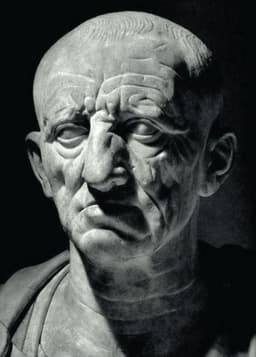
Cato the Elder
Politician · Ancient
63.0Total

Lykurgos of Sparta
Politician · Ancient
73.0Total
Basic Information
Born
-234
-800
Died
-149
-750
Era
Ancient
Ancient
Nationality
Roman Republic
Sparta
Occupation
Politician
Politician
Civilization
Western
Western
Score Comparison
Military (10%)
45.0
30.0
Political (20%)
55.0
70.0
Influence (20%)
68.0
88.0
Legacy (20%)
68.0
87.0
Leadership (15%)
72.0
72.0
Strategy (15%)
54.3
50.0
TOTAL
63.0
73.0
Cato the Elder — Complete Timeline
195 BC
Consulship and Campaign in SpainWar
Cato served as consul and led a campaign in Hispania Citerior, suppressing a rebellion. He used harsh tactics, including mass executions, to pacify the region, and later boasted of his victories in his writings.
Military campaignSpanish wars
Impact: regionaldestructive
184 BC
Censorship and Moral ReformsReform◆ Major
Cato the Elder served as censor, implementing strict moral reforms to combat luxury and corruption. He expelled senators for immorality, taxed luxury goods, and promoted traditional Roman values, earning the nickname 'Censorius'.
CensorshipMoral reform
Impact: nationalconstructive
168 BC
Publication of 'Origines'Cultural◆ Major
Cato wrote 'Origines', the first history of Rome in Latin. The work covered the founding of Rome and the early Republic, emphasizing Roman virtues and the importance of agriculture, and influenced later Roman historiography.
LiteratureHistoriography
Impact: nationalconstructive
155 BC
Opposition to HellenizationPolitical Action
Cato opposed the influence of Greek culture on Rome, arguing it undermined Roman values. He led a campaign to expel Greek philosophers from Rome and promoted traditional Roman education and customs.
Cultural conflictConservatism
Impact: national
153 BC
Campaign for the Destruction of CarthagePolitical Action◆ Major
Cato ended every speech in the Senate with 'Carthago delenda est' (Carthage must be destroyed). His persistent advocacy for war against Carthage influenced Roman policy and contributed to the outbreak of the Third Punic War.
Foreign policyImperialism
Impact: globaldestructive
Lykurgos of Sparta — Complete Timeline
775 BC
Institution of the Great RhetraReform
Lykurgos established the Great Rhetra, a foundational constitution for Sparta. It created the dual kingship, the Gerousia (council of elders), and the Apella (assembly), forming the basis of the Spartan mixed government.
Spartan ConstitutionGreat RhetraGovernment Reform
Impact: nationalconstructive
Introduction of the Agoge SystemReform◆ Major
Lykurgos is credited with creating the agoge, the rigorous state-sponsored education and training system for Spartan boys. This system emphasized discipline, military prowess, and loyalty to the state, defining Spartan society for centuries.
AgogeSpartan EducationMilitary Training
Impact: nationalconstructive
Economic Reforms: Iron Currency and Communal MessesReform◆ Major
Lykurgos replaced gold and silver currency with heavy iron bars to discourage trade and luxury. He also instituted common messes (syssitia), requiring all male citizens to dine together, fostering equality and military bonding.
Economic ReformIron CurrencySyssitia
Impact: nationalconstructive
Expert Analysis
Origins
**Cato the Elder** (234–149 BCE) was born to a plebeian family in Tusculum, an Italian town near Rome. His father, a farmer, instilled in him traditional Roman values of frugality and hard work. Cato gained military experience in the Second Punic War under Quintus Fabius Maximus, which shaped his conservative worldview. Unlike many Roman aristocrats, he did not receive a Greek education, which later fueled his anti-Hellenistic stance.
**Lykurgos of Sparta** is a semi-mythical figure, traditionally dated to the 9th or 8th century BCE. According to ancient sources like Plutarch, he was a member of the Spartan royal house who traveled extensively to study other societies. He is said to have visited Crete, Egypt, and Ionia, absorbing ideas for a new constitution. His reforms aimed to end civil strife and create a stable, militaristic state.
Rise to Power
Cato rose through the *cursus honorum*, the sequential political offices of Rome. He served as quaestor (204 BCE), aedile, praetor, and consul (195 BCE). His reputation for moral integrity and oratory skills propelled him. As consul, he led a campaign in Hispania Citerior, where he suppressed a rebellion with harsh tactics, including mass executions of 600 deserters. His political influence peaked with his censorship in 184 BCE, where he implemented sweeping moral reforms.
Lykurgos’s rise is shrouded in legend. He is said to have been appointed as guardian of the king and then used his authority to enact the Great Rhetra. After securing the support of the Delphic oracle, he forced the kings and people to accept his reforms. He allegedly then left Sparta, binding the citizens by oath to uphold his laws until his return, and never came back, dying in exile.
Leadership & Governance
Cato’s leadership was rooted in traditional Roman conservatism. As censor, he expelled senators for immorality, taxed luxury goods heavily, and promoted public works. He opposed the spread of Greek culture, arguing it corrupted Roman virtues. He famously ended every speech with "Carthago delenda est" (Carthage must be destroyed), advocating for war until Carthage was razed in 146 BCE. His governance style was direct, moralistic, and often harsh; he believed in strict discipline and simplicity.
Lykurgos created a totalitarian system designed for military excellence. The Great Rhetra established a mixed constitution: two kings (military leaders), a Gerousia (council of 28 elders over 60), and an Apella (assembly of citizens). The agoge system trained boys from age 7 in endurance, stealth, and combat. Economic reforms banned gold and silver, replacing them with iron currency to discourage trade, and required all citizens to eat at common messes (syssitia). This created an isolated, egalitarian warrior society.
Triumph & Tragedy
Cato’s greatest triumph was his moral censorship, which temporarily curbed corruption and luxury. His persistent call for Carthage’s destruction succeeded when the Third Punic War ended in 146 BCE, though he died before seeing it. His greatest failure was his inability to stop the Hellenization of Rome; Greek culture continued to spread, and his anti-Greek measures had limited effect. His harshness in Spain also created lasting resentment.
Lykurgos’s triumph was creating a stable, powerful Sparta that dominated Greece for centuries. The agoge produced elite soldiers, and Sparta’s constitution was admired by later thinkers like Plato and Aristotle. However, his system’s tragedy was its rigidity: it created a brittle society that could not adapt. The focus on military training neglected arts, economics, and population growth. Sparta’s population declined, and after its defeat at Leuctra in 371 BCE, it never recovered.
Character & Destiny
Cato was stubborn, frugal, and fiercely patriotic. His personality scores 55.0 in political and 72.0 in leadership, reflecting his effectiveness as a moral crusader but limited flexibility. He was known for his sharp tongue and legal battles; he prosecuted many for corruption. His destiny was to be remembered as the voice of traditional Roman values, even as Rome moved toward empire.
Lykurgos, with a political score of 70.0 and influence of 88.0, is the archetypal lawgiver. He is portrayed as wise, selfless, and visionary. His supposed voluntary exile ensured his laws would be permanent. His character shaped Spartan destiny: the system he created endured for centuries, but its lack of innovation ultimately led to Sparta’s decline.
Legacy
Cato’s legacy is twofold: his writings, especially *Origines* and his agricultural manual *De Agri Cultura*, influenced Roman historiography and farming practices. His political stance against Carthage contributed to Rome’s dominance of the Mediterranean. However, his anti-Hellenism was largely ignored. His legacy score of 68.0 reflects his impact on Roman identity.
Lykurgos’s legacy is immense: he is credited with creating the Spartan system that became a model for military states. His constitution influenced later political thought, from Plato’s *Republic* to modern totalitarian regimes. His legacy score of 87.0 shows his enduring impact. The term "Spartan" remains synonymous with austerity and discipline.
Conclusion
While Cato was a significant moral and political force in Rome, Lykurgos had a greater and more lasting impact on history. Lykurgos scored 73.0 overall compared to Cato’s 63.0. Lykurgos created a complete societal system that defined Sparta for centuries and inspired later thinkers. Cato, despite his influence, was a reactionary figure whose efforts were ultimately overwhelmed by the tide of history. Lykurgos’s foundational role in shaping Western ideas of law, citizenship, and military discipline gives him the edge.
FAQ
1. **Did Cato the Elder really end every speech with "Carthage must be destroyed"?**
Yes, according to ancient sources like Pliny the Elder and Plutarch, Cato concluded all his Senate speeches with "Ceterum censeo Carthaginem esse delendam" (Furthermore, I consider that Carthage must be destroyed). This became a famous example of persistent advocacy.
2. **Is Lykurgos a historical figure or a myth?**
Most historians consider Lykurgos semi-legendary. While ancient writers like Plutarch and Herodotus treat him as real, there is no contemporary evidence. His reforms are dated to the 9th–8th centuries BCE, but the Spartan system likely evolved over time. Nonetheless, he is central to Spartan identity.
3. **How did Cato’s censorship affect Roman society?**
Cato’s censorship (184 BCE) included expelling senators for immorality, taxing luxury items, and repairing public infrastructure. He attempted to curb the influence of Greek culture. While his reforms were popular with conservatives, they were largely temporary and did not reverse the trend toward Hellenization.
Rankings
🥇
Lykurgos of SpartaLeader
Mil: 30.0Pol: 70.0Inf: 88.0
73.0
🥈
Cato the Elder
Mil: 45.0Pol: 55.0Inf: 68.0
63.0
+10.0 behind
How This Comparison Works
Algorithm
Each figure is scored on 6 dimensions (0—100 scale) based on structured historical data: Military (10%), Political (20%), Influence (20%), Legacy (20%), Leadership (15%), Strategy (15%). The weighted total produces the final ranking.
Data Sources
Scores are computed from structured sub-indicators in the database. Scale factors adjust for era (Ancient ×0.85, Modern ×1.0) and civilization size (Eastern ×1.05, Other ×0.80) to account for differences in population and military scale.
Maximum 3 Figures
Comparisons are limited to 2—3 figures to ensure readability and statistical meaningfulness.
Error Margins
±5 points per dimension — Sub-scores are derived from historical records with inherent uncertainty. Two figures within 5 points on a dimension should be considered roughly equivalent in that area.
Total Score Accuracy
±3 points overall — The weighted combination of 6 dimensions produces a total score with approximately ±3 points of uncertainty. Differences of less than 3 points are not statistically significant— the figures are effectively tied.
Known Limitations
- Historical records are incomplete and uneven across civilizations
- Figures from oral-tradition societies may be underrepresented
- Occupation labels can misclassify multi-role figures
- Scores measure capability and impact, not moral character
- Quantitative scoring is a comparison tool, not absolute truth
Capability Radar
Military (10%) — Battles & Warfare
Battles
10
0
Win Rate
10
0
Expansion
10
0
Political (20%) — Governance & Reform
Reform
70
95
Diplomacy
60
50
Economy
70
70
Influence (20%) — Cultural & Global Reach
Cultural
70
90
Global
60
85
Legacy (20%) — Historical Impact
Historical
70
95
Longevity
70
95
Leadership (15%) — Power & Stability
Tenure
60
40
Stability
60
85
Strategy (15%) — Tactics & Innovation
Strategy
10
0
Tactics
10
0
Reform
10
95
Similar Comparisons
Comments & Discussion
No comments yet. Be the first to share your thoughts!