Loading...
Catherine the Great vs Suleiman the Magnificent
Suleiman the Magnificent leads by 6.4 pts · 2 figures compared
…
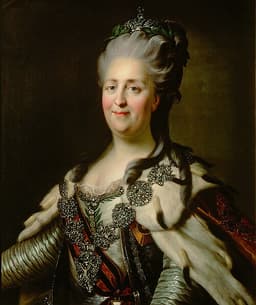
Catherine the Great
Emperor · Modern
66.8Total
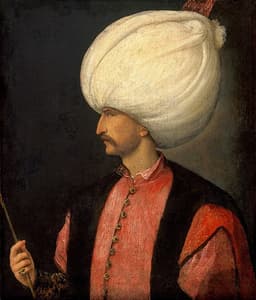
Suleiman the Magnificent
Emperor · Medieval
73.2Total
Basic Information
Born
1729
1494
Died
1796
1566
Era
Modern
Medieval
Nationality
Russia
Ottoman Empire
Occupation
Emperor
Emperor
Civilization
Western
Middle Eastern
Score Comparison
Military (10%)
78.5
85.0
Political (20%)
90.0
78.0
Influence (20%)
65.0
72.0
Legacy (20%)
40.0
68.0
Leadership (15%)
80.0
72.0
Strategy (15%)
72.0
72.0
TOTAL
66.8
73.2
Catherine the Great — Complete Timeline
1762 AD
Coup d'État of 1762Political Action
Catherine II led a coup d'
CoupAccessionPower
Impact: national
1764 AD
Hermitage Museum FoundedCultural◆ Major
Catherine the Great founded the Hermitage Museum in St. Petersburg by purchasing a large collection of paintings from Berlin. The museum grew into one of the world's largest art collections, reflecting her patronage of Enlightenment culture.
ArtMuseumEnlightenment
Impact: globalconstructive
1768 AD
Russo-Turkish War (1768-1774)War◆ Major
Catherine the Great initiated a war against the Ottoman Empire, resulting in Russian victory. The Treaty of K
WarOttoman EmpireExpansion
Impact: regional
1783 AD
Annexation of CrimeaPolitical Action◆ Major
Catherine the Great formally annexed the Crimean Peninsula from the Ottoman Empire. This strategic acquisition gave Russia a dominant position in the Black Sea and a warm-water port, fulfilling a long-standing imperial ambition.
AnnexationCrimeaBlack Sea
Impact: regional
1785 AD
Charter to the Gentry GrantedReform◆ Major
Catherine the Great issued the Charter to the Gentry, which codified the rights and privileges of the Russian nobility. It exempted nobles from taxation and military service, solidifying their social status and support for her rule.
NobilityReformSocial Structure
Impact: nationalconstructive
Suleiman the Magnificent — Complete Timeline
1522 AD
Siege of RhodesWar◆ Major
Suleiman personally led a massive Ottoman campaign against the Knights Hospitaller on Rhodes. After a six-month siege, the knights surrendered and were allowed to leave. This victory secured Ottoman control over the eastern Mediterranean.
SiegeMediterraneanKnights Hospitaller
Impact: regional
1526 AD
Battle of MohácsWar
Suleiman's Ottoman army defeated the Hungarian forces of King Louis II at Moh
BattleHungaryOttoman expansion
Impact: regional
1529 AD
Siege of ViennaWar◆ Major
Suleiman besieged Vienna, the Habsburg capital, with a large army. The siege failed due to supply issues, disease, and strong defenses. This defeat halted Ottoman expansion into central Europe and marked the empire's furthest advance westward.
SiegeViennaDefeat
Impact: regional
1530 AD
Codification of Ottoman lawReform◆ Major
Suleiman oversaw the compilation and standardization of Ottoman legal codes, known as Kanun. These laws regulated criminal justice, land tenure, and taxation, creating a unified legal system that balanced sharia with secular law. He earned the title 'Kanuni' (the Lawgiver).
Legal reformKanunOttoman Empire
Impact: nationalconstructive
1536 AD
Execution of Ibrahim PashaPolitical Action◆ Major
Suleiman ordered the execution of his grand vizier and close friend Ibrahim Pasha, who had served for 13 years. The reasons remain debated, but likely involved Ibrahim's growing power and conflicts with Suleiman's wife, Hurrem Sultan. This event demonstrated the absolute power of the sultan.
ExecutionCourt politicsPower
Impact: nationaltragic
Expert Analysis
Catherine the Great vs Suleiman the Magnificent
# The Magnificent and the Great
On a summer morning in 1529, Suleiman the Magnificent stood before the walls of Vienna, his army stretching to the horizon like a sea of turbans and steel. Two centuries later, in the frozen winter of 1762, a German princess who would become Catherine the Great rode through the snows of St. Petersburg at the head of mutinous guards, her husband’s throne trembling before her. Both were rulers who reshaped empires, yet they navigated vastly different worlds. Why did Suleiman’s golden age end in stagnation, while Catherine’s reforms laid foundations for a Russian century? The answers lie in their origins, their choices, and the currents of history that carried them.
Origins
Suleiman was born in 1494 into the Ottoman dynasty, a son of Sultan Selim I. His childhood was steeped in the traditions of a nomadic warrior state that had grown into an Islamic superpower. He studied law, poetry, and the Quran, but his education was also martial—he learned to command armies before he could grow a beard. The medieval world he inherited was one of faith, conquest, and absolute authority, where the sultan was both caliph and shadow of God on earth.
Catherine, born Sophia Augusta Frederica in 1729, was a minor German princess from the impoverished house of Anhalt-Zerbst. Her world was the fragmented Holy Roman Empire, where petty courts jostled for survival. She devoured French Enlightenment texts—Voltaire, Montesquieu, Diderot—while dreaming of escape from provincial obscurity. When she arrived in Russia at age fifteen to marry the future Peter III, she entered a realm that was half-European, half-Asiatic, still recovering from Peter the Great’s violent modernization. Where Suleiman was born to rule, Catherine had to seize the right.
Rise to Power
Suleiman ascended the throne in 1520 at age twenty-six, following his father’s sudden death. There was no struggle, no coup—just the seamless transfer of power in a dynasty that had learned to avoid civil war by executing rivals. His first act was to release prisoners taken by his father, a gesture of magnanimity that signaled a new era. He inherited an army at its peak, a treasury swollen with conquest, and a bureaucracy that answered only to him.
Catherine’s path was far more treacherous. Her husband, Peter III, was erratic, pro-Prussian, and contemptuous of Russian Orthodox traditions. By 1762, after eighteen years of a miserable marriage, Catherine had cultivated allies among the Imperial Guard and the Orlov brothers. On June 28, 1762, she led a coup that deposed Peter, who was murdered days later—likely with her tacit consent. She justified the act as necessity: “I had to choose between perishing with him or for him,” she later wrote. Her rise was a gamble, not an inheritance.
Leadership & Governance
Suleiman governed as a medieval sultan, combining military command with legal reform. In 1530, he codified Ottoman law—the *Kanun*—standardizing criminal, land, and tax codes across a sprawling empire. He was called “the Lawgiver” by his own people, not “the Magnificent” (a European invention). His military campaigns were relentless: the Siege of Rhodes in 1522 broke the Knights Hospitaller, and the Battle of Mohács in 1526 shattered Hungary, killing King Louis II. Yet his failure at Vienna in 1529 revealed the limits of logistics and disease. He ruled through a grand vizier, Ibrahim Pasha, whom he executed in 1536—a chilling reminder that even a friend could fall to the sultan’s paranoia.
Catherine ruled as an enlightened despot. She corresponded with Voltaire, founded the Hermitage Museum in 1764, and issued the Charter to the Gentry in 1785, granting nobles unprecedented freedoms—exempting them from taxes and military service. She expanded Russia’s borders through the Russo-Turkish War of 1768–1774, annexing Crimea in 1783, giving Russia its first warm-water ports. Yet her reforms were cautious; she never abolished serfdom, fearing noble revolt. Where Suleiman commanded from the saddle, Catherine governed from the salon, blending autocracy with intellectual ambition.
Triumph & Tragedy
Suleiman’s greatest triumph was Mohács, where he destroyed Hungarian independence in a single afternoon. His tragedy was Vienna—the siege that failed, marking the Ottoman Empire’s high-water mark in Europe. Worse, his execution of Ibrahim Pasha, his most capable vizier, was a self-inflicted wound, born of suspicion and the harem’s intrigues. The empire never recovered the same brilliance.
Catherine’s triumph was the annexation of Crimea, a bloodless strategic masterstroke that fulfilled Peter the Great’s dream. Her tragedy was her failure to reform serfdom, which left Russia a powder keg. The Pugachev Rebellion of 1773–1775, a peasant uprising, terrified her into conservatism. She died in 1796, having expanded Russia’s territory by over 200,000 square miles—but leaving a system that would explode in revolution a century later.
Character & Destiny
Suleiman was a poet and a warrior, capable of tenderness and cruelty. He wrote verses to his wife Roxelana while ordering the deaths of his own sons. His personality was shaped by the Ottoman system’s contradictions: absolute power required absolute vigilance. His destiny was to embody the empire’s zenith, then watch it begin its slow decline.
Catherine was pragmatic, ambitious, and voracious—for power, knowledge, and pleasure. She took lovers who served as ministers, and when they failed, she replaced them. Her character was forged in survival: a German outsider who became more Russian than the Russians. Her destiny was to modernize a backward empire without breaking its chains.
Legacy
Suleiman is remembered as the architect of Ottoman greatness. His legal code endured for centuries, and his mosques—designed by Sinan—still dominate Istanbul’s skyline. Yet his legacy is ambiguous: he expanded the empire to unsustainable size, and his successors lacked his vision. The Ottoman decline began within decades of his death.
Catherine’s legacy is more durable. The Hermitage remains one of the world’s great museums. Russia’s southern expansion set the stage for its imperial future. She is remembered as a paradox: a champion of Enlightenment who ruled as an autocrat, a woman who dominated a patriarchal world. “I shall be an autocrat,” she once said, “that is my trade.”
Conclusion
Standing before Vienna, Suleiman saw a world of faith and conquest, where a sultan’s will was law. Riding through St. Petersburg, Catherine saw a world of ideas and power, where a princess could become empress through wit and will. Both were magnificent and great in their own ways, but their differences reveal how history shapes its rulers. Suleiman was the last of the medieval titans; Catherine was the first of the modern despots. Their empires rose and fell, but their stories endure—reminders that leadership is never just about power, but about the world a leader chooses to see.
Rankings
🥇
Suleiman the MagnificentLeader
Mil: 85.0Pol: 78.0Inf: 72.0
73.2
🥈
Catherine the Great
Mil: 78.5Pol: 90.0Inf: 65.0
66.8
+6.4 behind
How This Comparison Works
Algorithm
Each figure is scored on 6 dimensions (0—100 scale) based on structured historical data: Military (10%), Political (20%), Influence (20%), Legacy (20%), Leadership (15%), Strategy (15%). The weighted total produces the final ranking.
Data Sources
Scores are computed from structured sub-indicators in the database. Scale factors adjust for era (Ancient ×0.85, Modern ×1.0) and civilization size (Eastern ×1.05, Other ×0.80) to account for differences in population and military scale.
Maximum 3 Figures
Comparisons are limited to 2—3 figures to ensure readability and statistical meaningfulness.
Error Margins
±5 points per dimension — Sub-scores are derived from historical records with inherent uncertainty. Two figures within 5 points on a dimension should be considered roughly equivalent in that area.
Total Score Accuracy
±3 points overall — The weighted combination of 6 dimensions produces a total score with approximately ±3 points of uncertainty. Differences of less than 3 points are not statistically significant— the figures are effectively tied.
Known Limitations
- Historical records are incomplete and uneven across civilizations
- Figures from oral-tradition societies may be underrepresented
- Occupation labels can misclassify multi-role figures
- Scores measure capability and impact, not moral character
- Quantitative scoring is a comparison tool, not absolute truth
Capability Radar
Military (10%) — Battles & Warfare
Battles
85
95
Win Rate
80
90
Expansion
90
95
Political (20%) — Governance & Reform
Reform
90
90
Diplomacy
85
88
Economy
85
85
Influence (20%) — Cultural & Global Reach
Cultural
85
90
Global
80
88
Legacy (20%) — Historical Impact
Historical
85
92
Longevity
80
85
Leadership (15%) — Power & Stability
Tenure
95
95
Stability
80
85
Strategy (15%) — Tactics & Innovation
Strategy
85
92
Tactics
75
85
Reform
90
80
Similar Comparisons
Comments & Discussion
No comments yet. Be the first to share your thoughts!