Loading...
Catherine the Great vs George Washington
George Washington leads by 10.0 pts · 2 figures compared
…
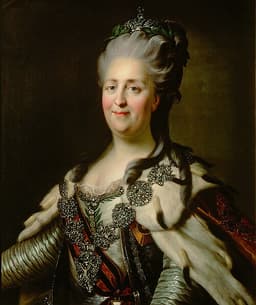
Catherine the Great
Emperor · Modern
66.8Total
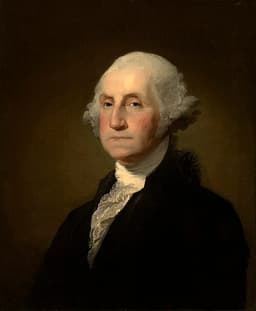
George Washington
Politician · Modern
76.8Total
Basic Information
Born
1729
1732
Died
1796
1799
Era
Modern
Modern
Nationality
Russia
United States
Occupation
Emperor
Politician
Civilization
Western
Western
Score Comparison
Military (10%)
78.5
75.0
Political (20%)
90.0
82.0
Influence (20%)
65.0
75.0
Legacy (20%)
40.0
80.0
Leadership (15%)
80.0
85.0
Strategy (15%)
72.0
55.0
TOTAL
66.8
76.8
Catherine the Great — Complete Timeline
1762 AD
Coup d'État of 1762Political Action
Catherine II led a coup d'
CoupAccessionPower
Impact: national
1764 AD
Hermitage Museum FoundedCultural◆ Major
Catherine the Great founded the Hermitage Museum in St. Petersburg by purchasing a large collection of paintings from Berlin. The museum grew into one of the world's largest art collections, reflecting her patronage of Enlightenment culture.
ArtMuseumEnlightenment
Impact: globalconstructive
1768 AD
Russo-Turkish War (1768-1774)War◆ Major
Catherine the Great initiated a war against the Ottoman Empire, resulting in Russian victory. The Treaty of K
WarOttoman EmpireExpansion
Impact: regional
1783 AD
Annexation of CrimeaPolitical Action◆ Major
Catherine the Great formally annexed the Crimean Peninsula from the Ottoman Empire. This strategic acquisition gave Russia a dominant position in the Black Sea and a warm-water port, fulfilling a long-standing imperial ambition.
AnnexationCrimeaBlack Sea
Impact: regional
1785 AD
Charter to the Gentry GrantedReform◆ Major
Catherine the Great issued the Charter to the Gentry, which codified the rights and privileges of the Russian nobility. It exempted nobles from taxation and military service, solidifying their social status and support for her rule.
NobilityReformSocial Structure
Impact: nationalconstructive
George Washington — Complete Timeline
1775 AD
Appointed Commander-in-Chief of the Continental ArmyOther◆ Major
The Second Continental Congress appointed Washington as commander-in-chief of the Continental Army on June 15, 1775. He accepted the position without pay, taking command of the forces besieging Boston at the start of the American Revolutionary War.
American RevolutionMilitary Leadership
Impact: national
1776 AD
Crossed the Delaware RiverOther◆ Major
On the night of December 25-26, 1776, Washington led 2,400 troops across the ice-choked Delaware River. The surprise attack on Hessian forces at Trenton resulted in a decisive American victory, capturing nearly 1,000 prisoners and reviving Patriot morale after a series of defeats.
American RevolutionBattleTurning Point
Impact: nationalconstructive
1787 AD
Presided over the Constitutional ConventionPolitical Action◆ Major
Washington served as president of the Constitutional Convention in Philadelphia from May to September 1787. His presence lent legitimacy to the proceedings, and he formally signed the final draft of the U.S. Constitution, though he contributed little to the debates.
ConstitutionFounding Father
Impact: national
1789 AD
Inaugurated as First President of the United StatesPolitical Action◆ Major
Washington was unanimously elected by the Electoral College and inaugurated on April 30, 1789, at Federal Hall in New York City. He established numerous executive branch precedents, including the cabinet system, the inaugural address, and the title 'Mr. President'.
PresidencyFounding Father
Impact: national
1793 AD
Issued the Proclamation of NeutralityOther◆ Major
Washington issued the Proclamation of Neutrality on April 22, 1793, declaring the United States neutral in the conflict between France and Great Britain. This decision established the precedent of American isolationism and avoided entanglement in European wars.
Foreign PolicyNeutrality
Impact: national
1796 AD
Delivered the Farewell AddressOther◆ Major
Washington published his Farewell Address on September 19, 1796, announcing his decision not to seek a third term. The address warned against political factionalism, permanent foreign alliances, and the influence of the military in government, shaping American political culture.
PresidencyLegacy
Impact: national
Expert Analysis
George Washington vs Catherine the Great
### The Empress and the General: Catherine the Great and George Washington in an Age of Revolutions
In the winter of 1789, as the snows of St. Petersburg blanketed the Neva River, a German-born empress sat in her Hermitage, reading the dispatches from America. Across the Atlantic, a Virginia planter was traveling by carriage to New York City, about to become the first president of a republic that had no precedent. Catherine the Great and George Washington were contemporaries, born only three years apart, yet they inhabited different worlds. One inherited a throne by coup; the other refused a crown by choice. One expanded an empire through war; the other forged a nation through retreat and patience. How did two figures of the same era, both celebrated as founders, come to represent such opposite poles of leadership?
### Origins
George Washington was born in 1732 into the modest gentry of colonial Virginia. His formal education was sparse—he never attended university—and his early life was marked by the death of his father when he was eleven. He learned surveying, land speculation, and the hard calculus of frontier warfare. His world was one of self-made men, where reputation was earned through discipline and stoic endurance.
Catherine the Great, born Sophie of Anhalt-Zerbst in 1729, was a minor German princess whose only dowry was her intellect. At fifteen, she was summoned to Russia to marry the future Tsar Peter III. She learned Russian, converted to Orthodoxy, and read voraciously—Montesquieu, Voltaire, Diderot. Her childhood had been a lesson in survival: her father was a petty prince, her mother ambitious and cold. She understood from the start that in a court of wolves, charm and calculation were the only shields.
### Rise to Power
Washington’s rise was methodical. He began as a young officer in the Virginia militia during the French and Indian War, where he made mistakes—he once surrendered Fort Necessity—but learned the brutal realities of command. He became a delegate to the Continental Congress, not because he sought power, but because he was seen as incorruptible. When the Revolutionary War began in 1775, he was chosen to lead the Continental Army not for his brilliance, but for his unity: he was a Southerner who could bind the colonies.
Catherine’s rise was a coup d’état. In 1762, just six months after her husband Peter III became tsar, she led the Imperial Guard in a bloodless overthrow. Peter was arrested and soon died under mysterious circumstances—likely murdered. Catherine, then thirty-three, became Empress of All Russia. She had no legal claim, no divine right. She seized power with the Orlov brothers, a lover, and a regiment of soldiers. Where Washington ascended through consensus, Catherine climbed through conspiracy.
### Leadership & Governance
Washington’s leadership was defined by restraint. As commander of the Continental Army, he understood that the revolution was won not by battles but by survival. He kept the army together through the terrible winter at Valley Forge in 1777–78, not by inspiring speeches, but by sheer presence and stubbornness. As president, he set precedents that would shape the office: the two-term limit, the cabinet system, the avoidance of foreign entanglements. His Farewell Address warned against “the baneful effects of the spirit of party.” He governed as a republican—not a king.
Catherine governed as an enlightened autocrat. She corresponded with Voltaire and Diderot, founded the Hermitage Museum in 1764, and reformed education and law. Yet her reforms were always limited by the reality of Russian power: she could not free the serfs because the nobility, who had put her on the throne, would not allow it. In 1785, she issued the Charter to the Gentry, codifying their privileges. Her Russia expanded dramatically: the Russo-Turkish War (1768–1774) gave her the Black Sea coast, and in 1783 she annexed Crimea. She was a conqueror in the tradition of Peter the Great, not a liberator in the style of the American founders.
### Triumph & Tragedy
Washington’s greatest moment was not a victory but a surrender: on December 23, 1783, he resigned his commission as commander-in-chief before the Continental Congress. This act—voluntarily giving up power—stunned Europe. King George III reportedly said that if Washington did that, he would be “the greatest man in the world.” Washington’s tragedy was personal: he never had children of his own, and his marriage to Martha Custis was more a partnership of duty than passion. He died in 1799 after a brief illness, his legacy already secure.
Catherine’s triumph was the expansion of Russia into a European superpower. Her tragedy was the Pugachev Rebellion of 1773–75, a massive peasant uprising that she crushed with brutal force. The rebellion revealed the limits of her Enlightenment ideals: when the serfs rose up, she sent the army. Her later years were marked by scandal—her many lovers, the French Revolution that horrified her, and the growing tyranny of her reign. She died in 1796, leaving a Russia that was larger and more powerful, but still an autocracy.
### Character & Destiny
Washington’s character was his destiny. He was a man of immense self-control, often described as cold or aloof. He did not laugh easily, did not charm crowds, did not seek adulation. But he understood the psychology of power: that in a republic, the leader must appear as a servant. Catherine’s character was her instrument. She was witty, sensual, and endlessly pragmatic. She wrote plays, took lovers, and managed a court of scheming nobles with the skill of a chess master. She loved power openly and used it without apology.
Why the difference? Washington lived in a world where power was suspicious—the American Revolution had been fought against a king. Catherine lived in a world where power was the only reality—Russia had never known a republic. One man became great by giving up power; one woman became great by seizing it.
### Legacy
Washington is remembered as the Father of His Country, his face on the dollar bill, his name on the capital. He is a symbol of republican virtue, of the idea that leadership means service. Catherine is remembered as Catherine the Great, her name synonymous with Russian imperial glory. But her legacy is more ambiguous: she expanded Russia’s borders, but she also entrenched serfdom. She read Voltaire, but she crushed rebellion.
### Conclusion
Standing at the edge of the modern world, Washington and Catherine represent two paths for the modern leader. One path is the leader who steps back, who builds institutions that outlast him. The other is the leader who steps forward, who builds an empire that reflects her will. Both were successful in their own time. But the question they leave us is this: which kind of greatness endures? Washington’s republic still stands. Catherine’s empire is gone. Perhaps that is the final judgment.
Rankings
🥇
George WashingtonLeader
Mil: 75.0Pol: 82.0Inf: 75.0
76.8
🥈
Catherine the Great
Mil: 78.5Pol: 90.0Inf: 65.0
66.8
+10.0 behind
How This Comparison Works
Algorithm
Each figure is scored on 6 dimensions (0—100 scale) based on structured historical data: Military (10%), Political (20%), Influence (20%), Legacy (20%), Leadership (15%), Strategy (15%). The weighted total produces the final ranking.
Data Sources
Scores are computed from structured sub-indicators in the database. Scale factors adjust for era (Ancient ×0.85, Modern ×1.0) and civilization size (Eastern ×1.05, Other ×0.80) to account for differences in population and military scale.
Maximum 3 Figures
Comparisons are limited to 2—3 figures to ensure readability and statistical meaningfulness.
Error Margins
±5 points per dimension — Sub-scores are derived from historical records with inherent uncertainty. Two figures within 5 points on a dimension should be considered roughly equivalent in that area.
Total Score Accuracy
±3 points overall — The weighted combination of 6 dimensions produces a total score with approximately ±3 points of uncertainty. Differences of less than 3 points are not statistically significant— the figures are effectively tied.
Known Limitations
- Historical records are incomplete and uneven across civilizations
- Figures from oral-tradition societies may be underrepresented
- Occupation labels can misclassify multi-role figures
- Scores measure capability and impact, not moral character
- Quantitative scoring is a comparison tool, not absolute truth
Capability Radar
Military (10%) — Battles & Warfare
Battles
85
75
Win Rate
80
70
Expansion
90
60
Political (20%) — Governance & Reform
Reform
90
90
Diplomacy
85
85
Economy
85
65
Influence (20%) — Cultural & Global Reach
Cultural
85
85
Global
80
85
Legacy (20%) — Historical Impact
Historical
85
95
Longevity
80
90
Leadership (15%) — Power & Stability
Tenure
95
70
Stability
80
85
Strategy (15%) — Tactics & Innovation
Strategy
85
80
Tactics
75
65
Reform
90
85
Similar Comparisons
Comments & Discussion
The Frontier Pragmatist6/16/2026
Comparing Washington to Catherine is like comparing a stone wall to a Fabergé egg. Washington never commanded armies of 300,000 or fought the Ottomans for Crimea. His 'genius' was knowing when to retreat—at Long Island, at Brandywine. That's good survival instinct, not strategic brilliance. Catherine conquered territory the size of Poland twice over and modernized Russia's economy. Washington won by outlasting the British. Catherine won by actually fighting.
数据迷6/16/2026
把两人放在一起比较就是典型的“伟大人物偏差”。华盛顿没有留下系统性的经济数据,而凯瑟琳大帝在位34年间,俄国GDP增长约40%,黑海出口从零飙升到每年千万卢布。华盛顿的“成功”很大程度上是法国海军和英国议会内斗的副产品。没有援助和时机,他的大陆军早就解散了。凯瑟琳用数量证明了自己。
The Coup Connoisseur6/16/2026
Catherine engineered a palace coup with the help of her lover and the Imperial Guard. Washington couldn't even get his soldiers paid on time. She centralized power, crushed Pugachev's rebellion, and expanded serfdom. He freed his own slaves in his will—after 40 years of owning them. Neither is morally pristine. But Catherine played the 18th-century power game with ruthless brilliance, while Washington fumbled toward moral enlightenment by accident.
帝王学者6/16/2026
两人真正的差异在于对权力的理解。华盛顿主动辞去军权,把指挥刀交回国会,这个举动在欧洲君主看来近乎疯狂。凯瑟琳则把权力紧紧握在手里:她扩充了贵族特权,把农奴制扩大到乌克兰。一个是为了理想主动放弃权力,一个是为了统治不断扩大奴役。谁更伟大?看你的价值观站在哪一边。
The Hermitage Hermit6/16/2026
People forget Catherine corresponded with Voltaire and Diderot—she bought Diderot's library and paid him to be its librarian. Washington's library mostly had farming manuals and military treatises. Different intellectual universes. Catherine tried to remake Russia on Enlightenment principles while keeping absolute power. Washington embodied Enlightenment by restraining power. Both were products of their impossible contradictions.}}