Loading...
Catherine the Great vs Franklin D. Roosevelt
Franklin D. Roosevelt leads by 4.2 pts · 2 figures compared
…
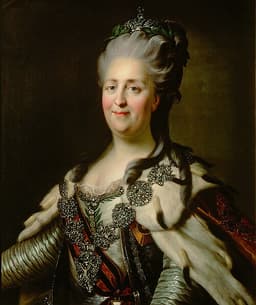
Catherine the Great
Emperor · Modern
66.8Total
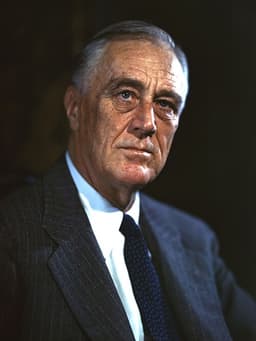
Franklin D. Roosevelt
Politician · Modern
71.0Total
Basic Information
Born
1729
1882
Died
1796
1945
Era
Modern
Modern
Nationality
Russia
United States
Occupation
Emperor
Politician
Civilization
Western
Western
Score Comparison
Military (10%)
78.5
45.0
Political (20%)
90.0
85.0
Influence (20%)
65.0
75.0
Legacy (20%)
40.0
65.0
Leadership (15%)
80.0
85.0
Strategy (15%)
72.0
60.0
TOTAL
66.8
71.0
Catherine the Great — Complete Timeline
1762 AD
Coup d'État of 1762Political Action
Catherine II led a coup d'
CoupAccessionPower
Impact: national
1764 AD
Hermitage Museum FoundedCultural◆ Major
Catherine the Great founded the Hermitage Museum in St. Petersburg by purchasing a large collection of paintings from Berlin. The museum grew into one of the world's largest art collections, reflecting her patronage of Enlightenment culture.
ArtMuseumEnlightenment
Impact: globalconstructive
1768 AD
Russo-Turkish War (1768-1774)War◆ Major
Catherine the Great initiated a war against the Ottoman Empire, resulting in Russian victory. The Treaty of K
WarOttoman EmpireExpansion
Impact: regional
1783 AD
Annexation of CrimeaPolitical Action◆ Major
Catherine the Great formally annexed the Crimean Peninsula from the Ottoman Empire. This strategic acquisition gave Russia a dominant position in the Black Sea and a warm-water port, fulfilling a long-standing imperial ambition.
AnnexationCrimeaBlack Sea
Impact: regional
1785 AD
Charter to the Gentry GrantedReform◆ Major
Catherine the Great issued the Charter to the Gentry, which codified the rights and privileges of the Russian nobility. It exempted nobles from taxation and military service, solidifying their social status and support for her rule.
NobilityReformSocial Structure
Impact: nationalconstructive
Franklin D. Roosevelt — Complete Timeline
1933 AD
Inaugurated as 32nd PresidentOther◆ Major
Franklin D. Roosevelt was inaugurated as President of the United States on March 4, 1933, during the Great Depression. His inaugural address declared 'the only thing we have to fear is fear itself,' and he immediately called Congress into special session to address the banking crisis.
Great DepressionPresidencyInauguration
Impact: national
Enacted the New DealOther◆ Major
Roosevelt launched the New Deal in 1933, a series of federal programs including the Civilian Conservation Corps, the Agricultural Adjustment Act, and the Tennessee Valley Authority. These measures aimed to provide relief, recovery, and reform during the Great Depression, fundamentally expanding the role of the federal government.
Great DepressionEconomic PolicySocial Reform
Impact: nationalconstructive
1935 AD
Signed the Social Security ActOther◆ Major
Roosevelt signed the Social Security Act into law on August 14, 1935, establishing a federal system of old-age pensions, unemployment insurance, and aid for dependent children. This created the modern American welfare state and provided a safety net for millions of citizens.
Social WelfareLegislationNew Deal
Impact: nationalconstructive
1941 AD
Lend-Lease ActOther◆ Major
Roosevelt signed the Lend-Lease Act on March 11, 1941, authorizing the transfer of military equipment and supplies to Allied nations, particularly Britain and the Soviet Union. This program provided critical material support to countries fighting the Axis powers before U.S. entry into World War II.
World War IIForeign PolicyMilitary Aid
Impact: globalconstructive
Declaration of War on JapanPolitical Action◆ Major
Following the Japanese attack on Pearl Harbor on December 7, 1941, Roosevelt delivered his 'Day of Infamy' speech to Congress the next day, requesting a declaration of war. Congress approved the declaration, bringing the United States into World War II.
World War IIPearl HarborDeclaration of War
Impact: globaldestructive
1942 AD
Executive Order 9066Other◆ Major
Roosevelt signed Executive Order 9066 on February 19, 1942, authorizing the forced relocation and internment of Japanese Americans living on the West Coast. Over 110,000 people, mostly U.S. citizens, were incarcerated in camps for the duration of the war, a decision later widely condemned as a violation of civil rights.
World War IICivil RightsInternment
Impact: nationaldestructive
1944 AD
Elected to Fourth TermOther◆ Major
Roosevelt was elected to an unprecedented fourth term as president in November 1944, defeating Republican Thomas E. Dewey. This election occurred during the final stages of World War II, and Roosevelt's continued leadership ensured stability in the war effort and post-war planning.
PresidencyElectionWorld War II
Impact: national
1945 AD
Yalta ConferenceOther◆ Major
Roosevelt met with Winston Churchill and Joseph Stalin at the Yalta Conference in February 1945 to discuss post-war Europe. Agreements included the division of Germany, Soviet entry into the war against Japan, and the creation of the United Nations, shaping the post-war world order.
World War IIDiplomacyPost-War Planning
Impact: global
Expert Analysis
Catherine the Great vs Franklin D. Roosevelt
### The Reformer and the Empress: Two Paths to Modern Power
On a cold March morning in 1933, Franklin D. Roosevelt stood before the U.S. Capitol, his leg braces hidden beneath the podium, and told a nation gripped by fear that “the only thing we have to fear is fear itself.” Across the Atlantic and a century and a half earlier, another leader—a German-born princess who had seized the Russian throne—sat in the Winter Palace, contemplating how to drag a sprawling, feudal empire into the modern age. One man inherited a broken democracy and rebuilt it from within. One woman seized an autocracy and reshaped it by force. Both are remembered as titans of their age, yet their journeys, their tools, and their legacies could not be more different. What drove these two reformers—and why did their paths diverge so sharply?
### Origins
Franklin Delano Roosevelt was born into privilege in 1882, the only child of a wealthy New York family. His upbringing was one of Hudson River estates, private tutors, and a sense of noblesse oblige that came naturally to the landed gentry. He attended Groton, Harvard, and Columbia Law School, absorbing the patrician confidence of America’s East Coast elite. Yet his real education came from his distant cousin, Theodore Roosevelt, whose progressive energy and belief in active government left a deep imprint on young Franklin.
Catherine the Great, born Sophie of Anhalt-Zerbst in 1729, arrived in the world as a minor German princess—a pawn on the chessboard of European dynastic politics. Her childhood was modest, even impoverished, by royal standards. What she lacked in wealth, she made up for in ambition and intellect. At fourteen, she was summoned to Russia to marry the unstable heir to the throne, the future Peter III. She learned Russian obsessively, converted to Orthodoxy, and immersed herself in the works of Voltaire, Montesquieu, and the French Enlightenment. While Roosevelt was taught to manage a stable system, Catherine learned to survive a treacherous one.
### Rise to Power
Roosevelt’s ascent was a model of democratic progression: state senator, Assistant Secretary of the Navy, governor of New York. But his career nearly ended in 1921 when polio struck him down at age thirty-nine. The disease left him paralyzed from the waist down, a fact he concealed from the public with careful staging. That struggle forged something in him—a steely resilience that would define his presidency. He entered the White House in 1933, winning a landslide against Herbert Hoover, and immediately faced a nation where a quarter of the workforce was unemployed.
Catherine’s rise was anything but democratic. In 1762, after enduring a humiliating marriage to the erratic and pro-Prussian Peter III, she orchestrated a coup d’état with the help of the Orlov brothers and the Imperial Guard. She overthrew her husband, who was soon murdered under mysterious circumstances, and crowned herself Empress of All Russia. She was thirty-three, a foreigner on a hostile throne, and she had just killed a tsar. Where Roosevelt’s path was paved by votes, Catherine’s was paved by blood.
### Leadership & Governance
Roosevelt governed through persuasion, radio addresses, and an unprecedented expansion of federal power. His New Deal created Social Security, the Works Progress Administration, and the Tennessee Valley Authority—a safety net for a shattered nation. His military score of 60 reflects that he was no general, but as commander-in-chief during World War II, he made strategic decisions that shaped the war’s outcome, from the lend-lease program to the invasion of Normandy. His political score of 85 captures his mastery of coalition-building, holding together Southern Democrats, urban progressives, and labor unions.
Catherine ruled with a different hand. She corresponded with Voltaire and Diderot, founded the Hermitage Museum in 1764 by purchasing a massive art collection from Berlin, and issued the Charter to the Gentry in 1785, codifying the privileges of the nobility. She expanded Russia’s borders dramatically: the Russo-Turkish War of 1768-1774 brought the Black Sea coast under Russian control, and the annexation of Crimea in 1783 gave Russia its warm-water ports. Yet her reforms were always constrained by the nobility she needed to keep happy. She freed the gentry from state service but tightened serfdom for the peasants. Her political score of 82 reflects a ruler who understood power but could not—or would not—challenge its foundations.
### Triumph & Tragedy
Roosevelt’s greatest triumph was leading the United States through the Great Depression and to victory in World War II. His “Four Freedoms” speech and the creation of the United Nations laid the groundwork for the postwar order. His greatest tragedy was his failure to fully end the Depression before the war—unemployment remained stubbornly high until 1941—and his internment of Japanese Americans, a stain on his legacy that historians still debate.
Catherine’s triumphs were territorial and cultural. She made Russia a European power, a player on the world stage. The Hermitage remains one of the world’s great museums. But her tragedy was the Pugachev Rebellion of 1773-1775, a massive peasant uprising that shook her throne. She crushed it with brutal force, and afterward, any pretense of liberal reform died. The Enlightenment ideals she had professed were abandoned when they threatened her power.
### Character & Destiny
Roosevelt was a master of optimism, a man who radiated calm in crisis. His polio gave him an empathy for suffering that his patrician background might otherwise have denied him. He was also a pragmatist, willing to experiment and fail. “It is common sense to take a method and try it,” he said. “If it fails, admit it frankly and try another.” That flexibility kept democracy alive in its darkest hour.
Catherine was a realist to her core. She understood that Russia could not be ruled like France or England. She was brilliant, ruthless, and deeply lonely—her many lovers, from Grigory Orlov to Grigory Potemkin, were partners in power as much as passion. She once wrote, “I praise loudly, I blame softly.” That discretion kept her on the throne for thirty-four years.
### Legacy
Roosevelt left behind the modern American state—Social Security, the regulatory framework of the New Deal, and the architecture of American global leadership. His four-term presidency prompted the Twenty-Second Amendment, a check on executive power that he himself made necessary. His legacy score of 75 reflects both his immense impact and the controversies that remain.
Catherine left behind a Russia that was larger, more cultured, and more formidable—but still an autocracy. She expanded the empire, built the Hermitage, and patronized the arts, but she also deepened serfdom and crushed dissent. Her legacy score of 72 captures a ruler who modernized the state but not the society.
### Conclusion
One man saved democracy by expanding government. One woman preserved autocracy by embracing reform selectively. Roosevelt’s America became a global superpower because he trusted the people to share the burden. Catherine’s Russia became a great power because she trusted no one but herself. The difference is not just in their scores—Roosevelt’s 85 in leadership against Catherine’s 80—but in the fundamental question each faced. Roosevelt asked: How can we build a more just society? Catherine asked: How can I hold this empire together? Their answers shaped the world we still live in.
Rankings
🥇
Franklin D. RooseveltLeader
Mil: 45.0Pol: 85.0Inf: 75.0
71.0
🥈
Catherine the Great
Mil: 78.5Pol: 90.0Inf: 65.0
66.8
+4.2 behind
How This Comparison Works
Algorithm
Each figure is scored on 6 dimensions (0—100 scale) based on structured historical data: Military (10%), Political (20%), Influence (20%), Legacy (20%), Leadership (15%), Strategy (15%). The weighted total produces the final ranking.
Data Sources
Scores are computed from structured sub-indicators in the database. Scale factors adjust for era (Ancient ×0.85, Modern ×1.0) and civilization size (Eastern ×1.05, Other ×0.80) to account for differences in population and military scale.
Maximum 3 Figures
Comparisons are limited to 2—3 figures to ensure readability and statistical meaningfulness.
Error Margins
±5 points per dimension — Sub-scores are derived from historical records with inherent uncertainty. Two figures within 5 points on a dimension should be considered roughly equivalent in that area.
Total Score Accuracy
±3 points overall — The weighted combination of 6 dimensions produces a total score with approximately ±3 points of uncertainty. Differences of less than 3 points are not statistically significant— the figures are effectively tied.
Known Limitations
- Historical records are incomplete and uneven across civilizations
- Figures from oral-tradition societies may be underrepresented
- Occupation labels can misclassify multi-role figures
- Scores measure capability and impact, not moral character
- Quantitative scoring is a comparison tool, not absolute truth
Capability Radar
Military (10%) — Battles & Warfare
Battles
85
10
Win Rate
80
10
Expansion
90
10
Political (20%) — Governance & Reform
Reform
90
95
Diplomacy
85
90
Economy
85
95
Influence (20%) — Cultural & Global Reach
Cultural
85
80
Global
80
90
Legacy (20%) — Historical Impact
Historical
85
90
Longevity
80
85
Leadership (15%) — Power & Stability
Tenure
95
90
Stability
80
75
Strategy (15%) — Tactics & Innovation
Strategy
85
65
Tactics
75
10
Reform
90
70
Similar Comparisons
Comments & Discussion
No comments yet. Be the first to share your thoughts!