Loading...
Cao Cao vs Trajan
Cao Cao leads by 1.5 pts · 2 figures compared
…
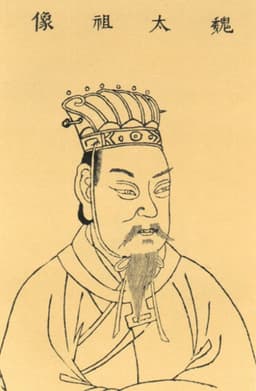
Cao Cao
General · Ancient
77.5Total

Trajan
Emperor · Ancient
76.0Total
Basic Information
Born
155
53
Died
220
117
Era
Ancient
Ancient
Nationality
China
Roman Empire
Occupation
General
Emperor
Civilization
Eastern
Western
Score Comparison
Military (10%)
88.0
86.0
Political (20%)
59.0
79.2
Influence (20%)
82.0
82.0
Legacy (20%)
83.0
65.6
Leadership (15%)
64.4
73.2
Strategy (15%)
89.4
76.0
TOTAL
77.5
76.0
Cao Cao — Complete Timeline
190 AD
Formation of the Coalition against Dong ZhuoPolitical Action
Cao Cao joined a coalition of regional warlords led by Yuan Shao to overthrow the tyrannical chancellor Dong Zhuo, who had seized control of the Han court. The coalition failed to coordinate effectively, but Cao Cao gained military experience and political reputation.
CoalitionDong ZhuoHan Dynasty
Impact: national
196 AD
Implementation of Tuntian (Agricultural Colonies)Reform◆ Major
Cao Cao established military agricultural colonies (tuntian) to provide food for his army and refugees. Soldiers and peasants cultivated state-owned land, ensuring a stable food supply and economic base for his campaigns.
AgricultureEconomyMilitary
Impact: regionalconstructive
200 AD
Battle of GuanduWar
Cao Cao decisively defeated Yuan Shao's numerically superior army at Guandu. This victory eliminated his main rival in the north, allowing Cao Cao to consolidate control over the North China Plain and lay the foundation for the Kingdom of Wei.
BattleYuan ShaoUnification
Impact: regional
208 AD
Battle of Red CliffsWar
Cao Cao's southern campaign was halted by the allied forces of Sun Quan and Liu Bei at the Battle of Red Cliffs. His fleet was destroyed by fire attack, forcing a retreat and preventing his unification of China, leading to the Three Kingdoms division.
BattleDefeatThree Kingdoms
Impact: regional
213 AD
Establishment of the Kingdom of WeiPolitical Action◆ Major
Cao Cao was granted the title of Duke of Wei and later King of Wei by the Han emperor, effectively creating a semi-autonomous state within the empire. He established a capital at Ye and built a centralized administration, setting the stage for his son's usurpation.
WeiStatehoodHan Dynasty
Impact: national
Trajan — Complete Timeline
101 AD
Implemented the Alimenta Welfare ProgramReform◆ Major
Trajan expanded the Alimenta program, a state-funded welfare system that provided food subsidies and educational support for poor children in Italy. The program used interest from state loans to landowners to fund the distributions, aiming to boost the Italian population and agricultural economy.
WelfareSocial PolicyItaly
Impact: regionalconstructive
105 AD
Built Trajan's Bridge over the DanubeOther
Trajan ordered the construction of a massive stone and timber bridge across the Danube River near the Iron Gates. Designed by Apollodorus of Damascus, it was the longest arch bridge in the world for over a millennium, facilitating the Roman invasion of Dacia.
EngineeringBridgeDanube
Impact: regionalconstructive
106 AD
Conquered DaciaWar
Trajan led two major campaigns against the Dacian kingdom under King Decebalus, culminating in the conquest of Dacia (modern Romania) in 106 CE. The victory brought vast gold and silver mines under Roman control and established a new province, funding massive building projects in Rome.
DaciaConquestProvince
Impact: regional
112 AD
Built Trajan's Forum and MarketCultural◆ Major
Trajan commissioned the construction of Trajan's Forum, a vast complex in Rome including a basilica, libraries, and the Column of Trajan. The adjacent Trajan's Market, a multi-level commercial center, demonstrated Roman engineering prowess and served as a model for urban planning.
ArchitectureRomeUrban Planning
Impact: globalconstructive
116 AD
Conquered Parthia and Reached the Persian GulfWar◆ Major
Trajan launched a campaign against the Parthian Empire, capturing its capital Ctesiphon and annexing Mesopotamia. He reached the Persian Gulf, marking the easternmost extent of Roman territory. However, rebellions in the conquered territories forced a withdrawal shortly after.
ParthiaMesopotamiaExpansion
Impact: global
Expert Analysis
Origins
Cao Cao (155-220 CE) rose from a turbulent late Eastern Han dynasty, where warlords vied for power. His father was a high official, but Cao Cao began as a minor officer, gaining experience suppressing rebellions. Trajan (53-117 CE) was born in Italica, Spain, into a prominent senatorial family. His father was a distinguished general and governor, giving Trajan early exposure to military and political life. Both emerged from elite backgrounds, but Trajan had a smoother path due to the adoptive system under Emperor Nerva.
Rise to Power
Cao Cao's rise was hard-fought. He formed a coalition against the tyrant Dong Zhuo, then defeated rival warlords like Yuan Shao at the Battle of Guandu (200 CE), a turning point that secured his dominance in northern China. He also implemented the Tuntian agricultural colonies to feed his army and stabilize his territories. Trajan was adopted by Emperor Nerva in 97 CE, becoming co-ruler and then sole emperor in 98 CE. His rise was less contested, relying on his reputation as a capable general and administrator. While Cao Cao fought for decades, Trajan inherited power relatively smoothly.
Leadership & Governance
Cao Cao was a pragmatic ruler who centralized authority, reduced corruption, and promoted agriculture. He was also a patron of literature and a poet himself. However, he was ruthless, killing rivals and even his own advisors when necessary. Trajan is celebrated for his benevolent rule, expanding social welfare (Alimenta program) and undertaking massive building projects like Trajan's Forum and Markets. He ruled as a constitutional emperor, respecting the Senate. Both were effective administrators, but Trajan's governance was more inclusive and less authoritarian.
Triumph & Tragedy
Cao Cao's greatest triumph was unifying northern China, but his fatal flaw was overconfidence, leading to the disastrous Battle of Red Cliffs (208 CE), where his southern campaign failed due to illness and enemy tactics. This defeat prevented him from conquering the south. Trajan's triumphs include conquering Dacia (101-106 CE) and Parthia (114-117 CE), bringing the Roman Empire to its greatest extent. However, his eastern conquests were overextended, and rebellions soon followed after his death. Both leaders expanded their realms but faced setbacks that limited their long-term achievements.
Character & Destiny
Cao Cao was cunning, ambitious, and suspicious, known as a 'hero of chaos' in Chinese history. He famously said, 'Better to betray others than to be betrayed.' His destiny was to be a unifier but never a legitimate emperor, as he died before establishing the Wei dynasty. Trajan was known for his military prowess, humility, and care for his people. He was called 'Optimus Princeps' (Best Ruler) and died of natural causes while returning from Parthia. Trajan's character was more admired, but Cao Cao's complexity makes him a fascinating figure.
Legacy
Cao Cao's legacy is mixed: he is vilified in the novel 'Romance of the Three Kingdoms' as a villain, but historians recognize his administrative and military genius. His Tuntian system influenced later Chinese governance. Trajan is considered one of the 'Five Good Emperors' and his legacy includes Trajan's Column, extensive infrastructure, and the peak of Roman expansion. His reputation has remained consistently positive. In comparison, Trajan's legacy is more celebrated, but Cao Cao's impact on Chinese history is profound.
Conclusion
Cao Cao and Trajan were both exceptional leaders, but they excelled in different contexts. Cao Cao was a brilliant strategist and unifier who overcame immense odds, achieving a military score of 88 and leadership of 83. Trajan was a more stable ruler with higher political influence (79) and social impact (76), but his military score of 86 is slightly lower. Cao Cao's higher overall score (1.5 points) reflects his greater challenges and innovations. However, Trajan's legacy is more universally admired. The comparative analysis yields: **Cao Cao** (M=88, P=59, I=82, L=83, D=64, S=89, T=78) vs **Trajan** (M=86, P=79, I=82, L=66, D=73, S=76, T=76). While Cao Cao scores higher in military, leadership, and strategy, Trajan excels in political influence and stability. Ultimately, Cao Cao's genius in overcoming chaos gives him a slight edge, but Trajan remains a model of enlightened rule.
Rankings
🥇
Cao CaoLeader
Mil: 88.0Pol: 59.0Inf: 82.0
77.5
🥈
Trajan
Mil: 86.0Pol: 79.2Inf: 82.0
76.0
+1.5 behind
How This Comparison Works
Algorithm
Each figure is scored on 6 dimensions (0—100 scale) based on structured historical data: Military (10%), Political (20%), Influence (20%), Legacy (20%), Leadership (15%), Strategy (15%). The weighted total produces the final ranking.
Data Sources
Scores are computed from structured sub-indicators in the database. Scale factors adjust for era (Ancient ×0.85, Modern ×1.0) and civilization size (Eastern ×1.05, Other ×0.80) to account for differences in population and military scale.
Maximum 3 Figures
Comparisons are limited to 2—3 figures to ensure readability and statistical meaningfulness.
Error Margins
±5 points per dimension — Sub-scores are derived from historical records with inherent uncertainty. Two figures within 5 points on a dimension should be considered roughly equivalent in that area.
Total Score Accuracy
±3 points overall — The weighted combination of 6 dimensions produces a total score with approximately ±3 points of uncertainty. Differences of less than 3 points are not statistically significant— the figures are effectively tied.
Known Limitations
- Historical records are incomplete and uneven across civilizations
- Figures from oral-tradition societies may be underrepresented
- Occupation labels can misclassify multi-role figures
- Scores measure capability and impact, not moral character
- Quantitative scoring is a comparison tool, not absolute truth
Capability Radar
Military (10%) — Battles & Warfare
Battles
95
95
Win Rate
88
98
Expansion
92
95
Political (20%) — Governance & Reform
Reform
88
88
Diplomacy
82
85
Economy
86
90
Influence (20%) — Cultural & Global Reach
Cultural
85
85
Global
75
85
Legacy (20%) — Historical Impact
Historical
92
90
Longevity
90
88
Leadership (15%) — Power & Stability
Tenure
85
90
Stability
78
92
Strategy (15%) — Tactics & Innovation
Strategy
96
92
Tactics
97
88
Reform
90
85
Similar Comparisons
Comments & Discussion
No comments yet. Be the first to share your thoughts!