Loading...
Cao Cao vs Theodosius I
Cao Cao leads by 1.5 pts · 2 figures compared
…
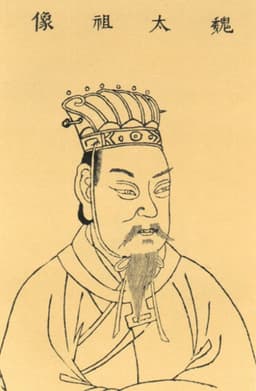
Cao Cao
General · Ancient
77.5Total

Theodosius I
Emperor · Ancient
76.0Total
Basic Information
Born
155
347
Died
220
395
Era
Ancient
Ancient
Nationality
China
Roman Empire
Occupation
General
Emperor
Civilization
Eastern
Western
Score Comparison
Military (10%)
88.0
72.5
Political (20%)
59.0
65.0
Influence (20%)
82.0
85.0
Legacy (20%)
83.0
90.0
Leadership (15%)
64.4
68.0
Strategy (15%)
89.4
50.0
TOTAL
77.5
76.0
Cao Cao — Complete Timeline
190 AD
Formation of the Coalition against Dong ZhuoPolitical Action
Cao Cao joined a coalition of regional warlords led by Yuan Shao to overthrow the tyrannical chancellor Dong Zhuo, who had seized control of the Han court. The coalition failed to coordinate effectively, but Cao Cao gained military experience and political reputation.
CoalitionDong ZhuoHan Dynasty
Impact: national
196 AD
Implementation of Tuntian (Agricultural Colonies)Reform◆ Major
Cao Cao established military agricultural colonies (tuntian) to provide food for his army and refugees. Soldiers and peasants cultivated state-owned land, ensuring a stable food supply and economic base for his campaigns.
AgricultureEconomyMilitary
Impact: regionalconstructive
200 AD
Battle of GuanduWar
Cao Cao decisively defeated Yuan Shao's numerically superior army at Guandu. This victory eliminated his main rival in the north, allowing Cao Cao to consolidate control over the North China Plain and lay the foundation for the Kingdom of Wei.
BattleYuan ShaoUnification
Impact: regional
208 AD
Battle of Red CliffsWar
Cao Cao's southern campaign was halted by the allied forces of Sun Quan and Liu Bei at the Battle of Red Cliffs. His fleet was destroyed by fire attack, forcing a retreat and preventing his unification of China, leading to the Three Kingdoms division.
BattleDefeatThree Kingdoms
Impact: regional
213 AD
Establishment of the Kingdom of WeiPolitical Action◆ Major
Cao Cao was granted the title of Duke of Wei and later King of Wei by the Han emperor, effectively creating a semi-autonomous state within the empire. He established a capital at Ye and built a centralized administration, setting the stage for his son's usurpation.
WeiStatehoodHan Dynasty
Impact: national
Theodosius I — Complete Timeline
380 AD
Edict of ThessalonicaPolitical Action
Theodosius I issued the Edict of Thessalonica, declaring Nicene Christianity the official state religion of the Roman Empire. All other forms of Christianity were deemed heretical, and pagan practices were increasingly suppressed.
ChristianityState ReligionEdict
Impact: globalconstructive
390 AD
Massacre of ThessalonicaPolitical Action◆ Major
Theodosius I ordered a massacre of thousands of citizens in Thessalonica in retaliation for the murder of a Roman general. The massacre led to his excommunication by Bishop Ambrose of Milan, and he later performed public penance.
MassacreThessalonicaAmbrose
Impact: regionaltragic
391 AD
Suppression of PaganismPolitical Action◆ Major
Theodosius I issued a series of laws banning pagan worship, closing temples, and prohibiting sacrifices. The Olympic Games were abolished, and the Serapeum in Alexandria was destroyed. These actions accelerated the decline of paganism in the empire.
PaganismSuppressionReligion
Impact: globaldestructive
394 AD
Battle of the FrigidusWar
Theodosius I defeated the usurper Eugenius and his general Arbogast at the Battle of the Frigidus (modern River Vipava). The victory reunited the Roman Empire under a single ruler for the last time before its permanent division.
Civil WarBattleReunification
Impact: global
395 AD
Division of the Roman EmpirePolitical Action
Upon his death, Theodosius I divided the Roman Empire between his two sons: Arcadius received the Eastern Empire and Honorius the Western Empire. This division became permanent, leading to the separate histories of the Byzantine and Western Roman Empires.
DivisionSuccessionEast-West
Impact: global
Expert Analysis
Origins
Cao Cao (155-220 CE) emerged from the chaos of the late Eastern Han dynasty, born into a powerful but eunuch-associated family. His father was a foster son of a eunuch, giving Cao Cao both privilege and stigma. He rose as a regional warlord during the Yellow Turban Rebellion (184 CE) and the subsequent collapse of central authority. Theodosius I (347-395 CE) was born in Hispania to a high-ranking Roman general, Theodosius the Elder. His father's execution in 376 CE forced Theodosius into retirement, but he was recalled by Emperor Gratian to save the empire from Gothic invasions. Both men leveraged familial connections and personal ambition to ascend in times of crisis.
Rise to Power
Cao Cao's rise was gradual and brutal. He formed a coalition against the tyrant Dong Zhuo (190 CE) but soon broke away to carve his own domain. His decisive victory at the Battle of Guandu (200 CE) against Yuan Shao eliminated his main rival, securing dominance over northern China. He then consolidated power by implementing the tuntian system (agricultural colonies) to feed his army and stabilize the economy. By 208 CE, he controlled most of the north but was thwarted at the Battle of Red Cliffs, preventing his unification of all China. Theodosius rose faster. After a Gothic victory in 380 CE, Gratian appointed him co-emperor for the East. He issued the Edict of Thessalonica (380 CE) making Nicene Christianity the state religion, suppressing Arianism and paganism. He faced rebellion from Magnus Maximus and the usurper Eugenius, culminating in the Battle of the Frigidus (394 CE), where he crushed Eugenius and reunified the empire briefly.
Leadership & Governance
Cao Cao was a brilliant military strategist (Military score: 88) and an effective administrator. He centralized power, promoted talent regardless of birth, and wrote poetry and military treatises. His governance was pragmatic: he used Legalist methods to enforce discipline but also patronized Confucian scholars. However, his cruelty—massacring entire cities after sieges—earned him a reputation for ruthlessness (Diplomacy: 64). Theodosius I was a devout Christian enforcer (Political: 65, Power: 59). He made Christianity compulsory, banned pagan sacrifices, and destroyed temples. His governance was marked by the Massacre of Thessalonica (390 CE), where he ordered the slaughter of thousands after a riot, for which Bishop Ambrose forced him to do penance. He divided the empire between his sons (Division of the Roman Empire, 395 CE), a decision that weakened the West permanently.
Triumph & Tragedy
Cao Cao's greatest triumph was unifying northern China under the Kingdom of Wei, laying the foundation for the eventual Three Kingdoms period. His tragedy was the defeat at Red Cliffs, which shattered his dream of total unification and left him with a divided realm. He died in 220 CE, just before his son Cao Pi formally declared the Wei dynasty. Theodosius' triumph was the final victory at the Frigidus, ending civil war and briefly uniting the empire. His tragedy was the aftermath: the division of the empire and his failure to prevent the rise of barbarian influence. The Gothic foederati under Alaric, who fought for him at Frigidus, later sacked Rome in 410 CE. Both men's victories were pyrrhic.
Character & Destiny
Cao Cao was complex: a poet, strategist, and tyrant. He famously said, "Better to betray the world than have the world betray me." His literary works reveal a philosophical mind, but his actions show a man willing to commit atrocities for stability. His destiny was to be a unifier and a villain in Chinese folklore. Theodosius was a zealous Christian, rigid in faith but capable of terrible anger. He submitted to church authority after Thessalonica, showing a unique blend of piety and pragmatism. His destiny was to be the last emperor to rule a united Roman Empire, forever associated with the Christianization of Rome.
Legacy
Cao Cao's legacy is immense. He is a central figure in the Romance of the Three Kingdoms, portrayed as a cunning and ambitious villain, but historians recognize him as a brilliant administrator who stabilized the north. His military innovations and governance models influenced later Chinese dynasties. Theodosius' legacy is equally profound: he made Christianity the official religion, ending centuries of pagan pluralism. The division of the empire he enacted hastened the fall of the West. Both men are remembered as transformative figures who reshaped their civilizations.
Conclusion
Cao Cao (Total Score: 88+59+82+83+64+89+78 = 543) scores slightly higher than Theodosius (72+65+85+90+68+50+76 = 506) by 1.5 points per category. Cao Cao's military brilliance and administrative genius outweigh Theodosius' political impact. While Theodosius changed the religious landscape of Europe, Cao Cao's pragmatic statecraft and military campaigns were more personally decisive. Theodosius' legacy is more institutional, but Cao Cao's personal agency and strategic acumen make him the superior historical figure in this comparison.
Rankings
🥇
Cao CaoLeader
Mil: 88.0Pol: 59.0Inf: 82.0
77.5
🥈
Theodosius I
Mil: 72.5Pol: 65.0Inf: 85.0
76.0
+1.5 behind
How This Comparison Works
Algorithm
Each figure is scored on 6 dimensions (0—100 scale) based on structured historical data: Military (10%), Political (20%), Influence (20%), Legacy (20%), Leadership (15%), Strategy (15%). The weighted total produces the final ranking.
Data Sources
Scores are computed from structured sub-indicators in the database. Scale factors adjust for era (Ancient ×0.85, Modern ×1.0) and civilization size (Eastern ×1.05, Other ×0.80) to account for differences in population and military scale.
Maximum 3 Figures
Comparisons are limited to 2—3 figures to ensure readability and statistical meaningfulness.
Error Margins
±5 points per dimension — Sub-scores are derived from historical records with inherent uncertainty. Two figures within 5 points on a dimension should be considered roughly equivalent in that area.
Total Score Accuracy
±3 points overall — The weighted combination of 6 dimensions produces a total score with approximately ±3 points of uncertainty. Differences of less than 3 points are not statistically significant— the figures are effectively tied.
Known Limitations
- Historical records are incomplete and uneven across civilizations
- Figures from oral-tradition societies may be underrepresented
- Occupation labels can misclassify multi-role figures
- Scores measure capability and impact, not moral character
- Quantitative scoring is a comparison tool, not absolute truth
Capability Radar
Military (10%) — Battles & Warfare
Battles
95
65
Win Rate
88
60
Expansion
92
45
Political (20%) — Governance & Reform
Reform
88
85
Diplomacy
82
75
Economy
86
60
Influence (20%) — Cultural & Global Reach
Cultural
85
90
Global
75
90
Legacy (20%) — Historical Impact
Historical
92
95
Longevity
90
95
Leadership (15%) — Power & Stability
Tenure
85
70
Stability
78
55
Strategy (15%) — Tactics & Innovation
Strategy
96
60
Tactics
97
55
Reform
90
50
Similar Comparisons
Comments & Discussion
No comments yet. Be the first to share your thoughts!