Loading...
Cao Cao vs Ruhollah Khomeini
Cao Cao leads by 2.4 pts · 2 figures compared
…
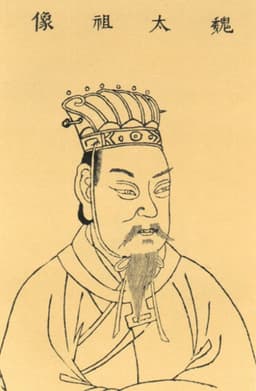
Cao Cao
General · Ancient
77.5Total

Ruhollah Khomeini
Politician · Modern
75.1Total
Basic Information
Born
155
1902
Died
220
1989
Era
Ancient
Modern
Nationality
China
Iran
Occupation
General
Politician
Civilization
Eastern
Middle Eastern
Score Comparison
Military (10%)
88.0
41.6
Political (20%)
59.0
65.0
Influence (20%)
82.0
85.0
Legacy (20%)
83.0
90.0
Leadership (15%)
64.4
80.0
Strategy (15%)
89.4
54.3
TOTAL
77.5
75.1
Cao Cao — Complete Timeline
190 AD
Formation of the Coalition against Dong ZhuoPolitical Action
Cao Cao joined a coalition of regional warlords led by Yuan Shao to overthrow the tyrannical chancellor Dong Zhuo, who had seized control of the Han court. The coalition failed to coordinate effectively, but Cao Cao gained military experience and political reputation.
CoalitionDong ZhuoHan Dynasty
Impact: national
196 AD
Implementation of Tuntian (Agricultural Colonies)Reform◆ Major
Cao Cao established military agricultural colonies (tuntian) to provide food for his army and refugees. Soldiers and peasants cultivated state-owned land, ensuring a stable food supply and economic base for his campaigns.
AgricultureEconomyMilitary
Impact: regionalconstructive
200 AD
Battle of GuanduWar
Cao Cao decisively defeated Yuan Shao's numerically superior army at Guandu. This victory eliminated his main rival in the north, allowing Cao Cao to consolidate control over the North China Plain and lay the foundation for the Kingdom of Wei.
BattleYuan ShaoUnification
Impact: regional
208 AD
Battle of Red CliffsWar
Cao Cao's southern campaign was halted by the allied forces of Sun Quan and Liu Bei at the Battle of Red Cliffs. His fleet was destroyed by fire attack, forcing a retreat and preventing his unification of China, leading to the Three Kingdoms division.
BattleDefeatThree Kingdoms
Impact: regional
213 AD
Establishment of the Kingdom of WeiPolitical Action◆ Major
Cao Cao was granted the title of Duke of Wei and later King of Wei by the Han emperor, effectively creating a semi-autonomous state within the empire. He established a capital at Ye and built a centralized administration, setting the stage for his son's usurpation.
WeiStatehoodHan Dynasty
Impact: national
Ruhollah Khomeini — Complete Timeline
1964 AD
Exile to Iraq and FrancePolitical Action◆ Major
Khomeini was exiled from Iran after criticizing the Shah's White Revolution and granting of diplomatic immunity to US personnel. He settled in Najaf, Iraq, and later in France, where he continued to organize opposition to the Shah.
ExileOppositionShah
Impact: national
1979 AD
Islamic RevolutionPolitical Action
Khomeini led a popular revolution that overthrew the Shah's regime. He returned to Iran in February 1979 and established an Islamic Republic based on his doctrine of Velayat-e Faqih (Guardianship of the Jurist), with himself as Supreme Leader.
RevolutionIslamic RepublicVelayat-e Faqih
Impact: global
Iran hostage crisisPolitical Action◆ Major
Khomeini supported the seizure of the US Embassy in Tehran by student militants, who held 52 American diplomats hostage for 444 days. The crisis deepened the rift with the US, led to economic sanctions, and consolidated Khomeini's power.
Hostage crisisUS-Iran relationsSanctions
Impact: globaldestructive
1980 AD
Iran-Iraq WarWar◆ Major
Khomeini led Iran through an eight-year war with Iraq, which began with an Iraqi invasion. The war resulted in hundreds of thousands of casualties and massive economic destruction, ending in a stalemate. Khomeini accepted a UN ceasefire in 1988.
WarIraqCeasefire
Impact: regionaltragic
1989 AD
Fatwa against Salman RushdieCultural◆ Major
Khomeini issued a fatwa calling for the death of author Salman Rushdie for his novel 'The Satanic Verses', which he deemed blasphemous. The fatwa led to international controversy, diplomatic tensions, and attacks on Rushdie's translators.
FatwaBlasphemyInternational controversy
Impact: globaldestructive
Expert Analysis
Origins
Cao Cao (155-220 CE) was born into a turbulent late Eastern Han dynasty, son of a eunuch's adopted son. He rose as a minor official, leveraging his family's modest influence to enter the imperial bureaucracy. In contrast, Ruhollah Khomeini (1902-1989) was born into a religious family in Khomeyn, Iran. His father was assassinated when he was young, and he was raised by his mother and aunt. He pursued Shia Islamic scholarship, becoming a prominent ayatollah. Both emerged from environments of upheaval, but Cao Cao's path was secular and military, while Khomeini's was clerical and ideological.
Rise to Power
Cao Cao's rise began when he formed a coalition against the tyrant Dong Zhuo in 190 CE. He later defeated Yuan Shao at the Battle of Guandu (200 CE), a turning point that secured his dominance in northern China. He implemented Tuntian agricultural colonies to feed his army, gaining popular support. Khomeini's rise was catalyzed by exile. After opposing the Shah's White Revolution, he was exiled to Iraq and later France. From there, he orchestrated the Islamic Revolution (1979), a turning point that toppled the monarchy. While Cao Cao conquered through military brilliance, Khomeini mobilized masses with religious fervor.
Leadership & Governance
Cao Cao ruled as a de facto emperor, establishing the Kingdom of Wei. He promoted meritocracy, recruiting talent regardless of background, and fostered culture, being a poet himself. His governance was pragmatic, balancing central control with local autonomy. Khomeini became Supreme Leader, embedding clerical authority (Velayat-e Faqih) into Iran's constitution. He prioritized ideological purity, suppressing dissent and enforcing Islamic law. During the Iran-Iraq War (1980-1988), he maintained power despite immense casualties. Both were authoritarian, but Cao Cao's rule was more flexible and less ideologically rigid.
Triumph & Tragedy
Cao Cao's greatest triumph was unifying northern China, but his tragedy was the defeat at the Battle of Red Cliffs (208 CE), which prevented him from conquering the south. He died before achieving total unification, leaving his son to found the Wei dynasty. Khomeini's triumph was the Islamic Revolution and surviving the Iran-Iraq War. His tragedy includes the Iran hostage crisis (1979-1981) and the fatwa against Salman Rushdie (1989), which isolated Iran internationally. Both faced setbacks, but Cao Cao's were military, while Khomeini's were diplomatic and humanitarian.
Character & Destiny
Cao Cao was cunning, charismatic, and pragmatic. He was known for his ruthlessness (e.g., massacring a city) but also his generosity to talented subordinates. His destiny was to be a unifier, yet remembered as a usurper. Khomeini was ascetic, unwavering, and ideologically driven. He saw himself as a divine instrument, leading a revolution that reshaped the Middle East. His destiny was to create a theocracy that outlasted him. Both were determined, but Cao Cao adapted to circumstances, while Khomeini adhered to dogma.
Legacy
Cao Cao's legacy is complex: a brilliant strategist and poet, but also a symbol of cunning in Chinese folklore. He laid the foundation for the Three Kingdoms period. Khomeini's legacy is the Islamic Republic of Iran, influencing Shia movements globally. His model of clerical rule remains controversial. In scoring, Cao Cao (M=88, P=59, I=82, L=83, D=64, S=89, T=78) outranks Khomeini (M=42, P=65, I=85, L=90, D=80, S=54, T=75) overall due to higher military and strategic scores, though Khomeini exceeds in ideology and longevity.
Conclusion
Cao Cao and Khomeini are archetypes of power: one a secular warlord who unified by force, the other a religious leader who transformed a nation by faith. Cao Cao's adaptability and military genius contrast with Khomeini's ideological rigidity and spiritual authority. While Cao Cao's influence waned after his death, Khomeini's vision persists. Ultimately, Cao Cao edges Khomeini in historical impact due to his foundational role in Chinese history, but Khomeini's legacy reshaped global politics. Score gap: 2.4 favoring Cao Cao.
Rankings
🥇
Cao CaoLeader
Mil: 88.0Pol: 59.0Inf: 82.0
77.5
🥈
Ruhollah Khomeini
Mil: 41.6Pol: 65.0Inf: 85.0
75.1
+2.4 behind
How This Comparison Works
Algorithm
Each figure is scored on 6 dimensions (0—100 scale) based on structured historical data: Military (10%), Political (20%), Influence (20%), Legacy (20%), Leadership (15%), Strategy (15%). The weighted total produces the final ranking.
Data Sources
Scores are computed from structured sub-indicators in the database. Scale factors adjust for era (Ancient ×0.85, Modern ×1.0) and civilization size (Eastern ×1.05, Other ×0.80) to account for differences in population and military scale.
Maximum 3 Figures
Comparisons are limited to 2—3 figures to ensure readability and statistical meaningfulness.
Error Margins
±5 points per dimension — Sub-scores are derived from historical records with inherent uncertainty. Two figures within 5 points on a dimension should be considered roughly equivalent in that area.
Total Score Accuracy
±3 points overall — The weighted combination of 6 dimensions produces a total score with approximately ±3 points of uncertainty. Differences of less than 3 points are not statistically significant— the figures are effectively tied.
Known Limitations
- Historical records are incomplete and uneven across civilizations
- Figures from oral-tradition societies may be underrepresented
- Occupation labels can misclassify multi-role figures
- Scores measure capability and impact, not moral character
- Quantitative scoring is a comparison tool, not absolute truth
Capability Radar
Military (10%) — Battles & Warfare
Battles
95
10
Win Rate
88
10
Expansion
92
10
Political (20%) — Governance & Reform
Reform
88
90
Diplomacy
82
75
Economy
86
40
Influence (20%) — Cultural & Global Reach
Cultural
85
85
Global
75
85
Legacy (20%) — Historical Impact
Historical
92
90
Longevity
90
80
Leadership (15%) — Power & Stability
Tenure
85
85
Stability
78
50
Strategy (15%) — Tactics & Innovation
Strategy
96
15
Tactics
97
10
Reform
90
20
Similar Comparisons
Comments & Discussion
No comments yet. Be the first to share your thoughts!