Loading...
Cao Cao vs Rama of Ayodhya
Cao Cao leads by 2.2 pts · 2 figures compared
…
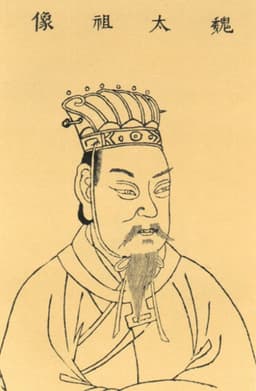
Cao Cao
General · Ancient
77.5Total

Rama of Ayodhya
Emperor · Ancient
75.3Total
Basic Information
Born
155
-1180
Died
220
-1120
Era
Ancient
Ancient
Nationality
China
Vedic India
Occupation
General
Emperor
Civilization
Eastern
Indian
Score Comparison
Military (10%)
88.0
72.0
Political (20%)
59.0
72.0
Influence (20%)
82.0
75.0
Legacy (20%)
83.0
80.0
Leadership (15%)
64.4
78.0
Strategy (15%)
89.4
68.1
TOTAL
77.5
75.3
Cao Cao — Complete Timeline
190 AD
Formation of the Coalition against Dong ZhuoPolitical Action
Cao Cao joined a coalition of regional warlords led by Yuan Shao to overthrow the tyrannical chancellor Dong Zhuo, who had seized control of the Han court. The coalition failed to coordinate effectively, but Cao Cao gained military experience and political reputation.
CoalitionDong ZhuoHan Dynasty
Impact: national
196 AD
Implementation of Tuntian (Agricultural Colonies)Reform◆ Major
Cao Cao established military agricultural colonies (tuntian) to provide food for his army and refugees. Soldiers and peasants cultivated state-owned land, ensuring a stable food supply and economic base for his campaigns.
AgricultureEconomyMilitary
Impact: regionalconstructive
200 AD
Battle of GuanduWar
Cao Cao decisively defeated Yuan Shao's numerically superior army at Guandu. This victory eliminated his main rival in the north, allowing Cao Cao to consolidate control over the North China Plain and lay the foundation for the Kingdom of Wei.
BattleYuan ShaoUnification
Impact: regional
208 AD
Battle of Red CliffsWar
Cao Cao's southern campaign was halted by the allied forces of Sun Quan and Liu Bei at the Battle of Red Cliffs. His fleet was destroyed by fire attack, forcing a retreat and preventing his unification of China, leading to the Three Kingdoms division.
BattleDefeatThree Kingdoms
Impact: regional
213 AD
Establishment of the Kingdom of WeiPolitical Action◆ Major
Cao Cao was granted the title of Duke of Wei and later King of Wei by the Han emperor, effectively creating a semi-autonomous state within the empire. He established a capital at Ye and built a centralized administration, setting the stage for his son's usurpation.
WeiStatehoodHan Dynasty
Impact: national
Rama of Ayodhya — Complete Timeline
1160 BC
Broke Shiva's Bow at Sita's SwayamvaraCultural◆ Major
Rama, as a young prince, lifted and strung the divine bow of Shiva at Princess Sita's marriage ceremony. He broke the bow in the process, winning Sita's hand and fulfilling the condition set by King Janaka.
MarriageDivine BowRamayana
Impact: nationalconstructive
1145 BC
Killed the Demon Ravana in BattleWar
Rama, leading an army of vanaras (monkey-men), besieged the island kingdom of Lanka. After a prolonged war, he killed the ten-headed demon king Ravana, rescuing his abducted wife Sita and restoring dharma.
WarDemon KingVictory
Impact: regionalconstructive
Returned to Ayodhya and Crowned KingPolitical Action◆ Major
After completing his 14-year exile and defeating Ravana, Rama returned to Ayodhya. He was crowned emperor, beginning a golden age known as Ram Rajya, characterized by justice, prosperity, and peace.
CoronationGolden AgeRamayana
Impact: nationalconstructive
Expert Analysis
Origins
Cao Cao (155-220 CE) was born into a powerful but controversial family in the late Eastern Han dynasty, his father being the adopted son of a eunuch. He rose through the ranks as a capable official and military commander during the chaotic decline of Han. Rama, by contrast, is the divine prince of Ayodhya, an avatar of Vishnu, born to King Dasharatha. His origins are steeped in myth and religious significance, shaping his role as a moral exemplar.
Rise to Power
Cao Cao's rise was marked by strategic cunning and ruthless ambition. He capitalized on the power vacuum after the collapse of central authority, forming a coalition against the tyrant Dong Zhuo and later defeating rival warlords like Yuan Shao at the Battle of Guandu (200 CE). This victory cemented his control over northern China. Rama's rise was more ceremonial: he won Sita's hand by breaking Shiva's bow, a feat of divine strength, and was poised to become king until exiled by his father's promise. His power came not from conquest but from his rightful claim and adherence to dharma.
Leadership & Governance
Cao Cao was a pragmatic and effective ruler. He implemented the Tuntian agricultural colonies, which boosted food production and stabilized his realm. He also promoted talent over birth, attracting brilliant advisors. His governance was efficient but harsh, centralizing power. Rama's leadership is idealized: he ruled with justice, compassion, and adherence to dharma. His reign, Ram Rajya, is portrayed as a golden age of peace and prosperity. However, his exile and the war with Ravana show his willingness to sacrifice personal comfort for duty.
Triumph & Tragedy
Cao Cao's greatest triumph was unifying northern China, but his tragedy was the defeat at Red Cliffs (208 CE), which prevented him from conquering the south and realizing his dream of a unified empire. He died as King of Wei but not as emperor. Rama's triumph was killing Ravana and rescuing Sita, restoring dharma. His tragedy was the public doubt of Sita's chastity, leading to her banishment—a painful choice between personal love and public duty.
Character & Destiny
Cao Cao is portrayed as complex: brilliant, ambitious, but also suspicious and ruthless. He famously said, "Better to wrong the world than let the world wrong me." His destiny was to be a unifier and founder. Rama is the embodiment of virtue: perfect son, husband, and king. His destiny was to restore righteousness. Despite different moral frameworks, both faced immense challenges and made difficult decisions.
Legacy
Cao Cao is remembered as a master strategist, poet, and founder of the Wei dynasty. His tactics are studied in military academies. In Chinese culture, he is both villain and hero. Rama is worshipped as a god, his life story celebrated in Diwali and the Ramayana. His legacy is moral and spiritual, influencing billions.
Conclusion
While Cao Cao excels in military strategy and political acumen (M=88, P=59, I=82, L=83, D=64, S=89, T=78), Rama represents ideal kingship and virtue (M=72, P=72, I=75, L=80, D=78, S=68, T=75). Cao Cao's higher overall score (2.2 gap) reflects his tangible achievements in state-building and warfare. However, Rama's impact on culture and religion is profound. Ultimately, Cao Cao is the more effective historical figure in terms of realpolitik, while Rama is the greater moral archetype. The choice depends on whether one values pragmatic success or ideal virtue.
Rankings
🥇
Cao CaoLeader
Mil: 88.0Pol: 59.0Inf: 82.0
77.5
🥈
Rama of Ayodhya
Mil: 72.0Pol: 72.0Inf: 75.0
75.3
+2.2 behind
How This Comparison Works
Algorithm
Each figure is scored on 6 dimensions (0—100 scale) based on structured historical data: Military (10%), Political (20%), Influence (20%), Legacy (20%), Leadership (15%), Strategy (15%). The weighted total produces the final ranking.
Data Sources
Scores are computed from structured sub-indicators in the database. Scale factors adjust for era (Ancient ×0.85, Modern ×1.0) and civilization size (Eastern ×1.05, Other ×0.80) to account for differences in population and military scale.
Maximum 3 Figures
Comparisons are limited to 2—3 figures to ensure readability and statistical meaningfulness.
Error Margins
±5 points per dimension — Sub-scores are derived from historical records with inherent uncertainty. Two figures within 5 points on a dimension should be considered roughly equivalent in that area.
Total Score Accuracy
±3 points overall — The weighted combination of 6 dimensions produces a total score with approximately ±3 points of uncertainty. Differences of less than 3 points are not statistically significant— the figures are effectively tied.
Known Limitations
- Historical records are incomplete and uneven across civilizations
- Figures from oral-tradition societies may be underrepresented
- Occupation labels can misclassify multi-role figures
- Scores measure capability and impact, not moral character
- Quantitative scoring is a comparison tool, not absolute truth
Capability Radar
Military (10%) — Battles & Warfare
Battles
95
75
Win Rate
88
95
Expansion
92
70
Political (20%) — Governance & Reform
Reform
88
80
Diplomacy
82
85
Economy
86
75
Influence (20%) — Cultural & Global Reach
Cultural
85
95
Global
75
95
Legacy (20%) — Historical Impact
Historical
92
95
Longevity
90
100
Leadership (15%) — Power & Stability
Tenure
85
70
Stability
78
90
Strategy (15%) — Tactics & Innovation
Strategy
96
85
Tactics
97
80
Reform
90
60
Similar Comparisons
Comments & Discussion
No comments yet. Be the first to share your thoughts!