Loading...
Cao Cao vs John Churchill Duke of Marlborough
Cao Cao leads by 2.1 pts · 2 figures compared
…
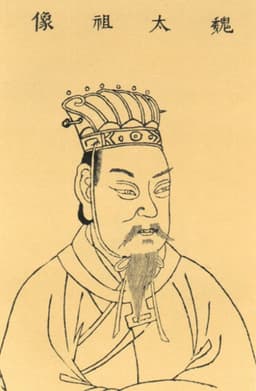
Cao Cao
General · Ancient
77.5Total

John Churchill Duke of Marlborough
General · Modern
75.4Total
Basic Information
Born
155
1650
Died
220
1722
Era
Ancient
Modern
Nationality
China
England
Occupation
General
General
Civilization
Eastern
Western
Score Comparison
Military (10%)
88.0
84.7
Political (20%)
59.0
78.0
Influence (20%)
82.0
65.0
Legacy (20%)
83.0
80.0
Leadership (15%)
64.4
78.0
Strategy (15%)
89.4
72.8
TOTAL
77.5
75.4
Cao Cao — Complete Timeline
190 AD
Formation of the Coalition against Dong ZhuoPolitical Action
Cao Cao joined a coalition of regional warlords led by Yuan Shao to overthrow the tyrannical chancellor Dong Zhuo, who had seized control of the Han court. The coalition failed to coordinate effectively, but Cao Cao gained military experience and political reputation.
CoalitionDong ZhuoHan Dynasty
Impact: national
196 AD
Implementation of Tuntian (Agricultural Colonies)Reform◆ Major
Cao Cao established military agricultural colonies (tuntian) to provide food for his army and refugees. Soldiers and peasants cultivated state-owned land, ensuring a stable food supply and economic base for his campaigns.
AgricultureEconomyMilitary
Impact: regionalconstructive
200 AD
Battle of GuanduWar
Cao Cao decisively defeated Yuan Shao's numerically superior army at Guandu. This victory eliminated his main rival in the north, allowing Cao Cao to consolidate control over the North China Plain and lay the foundation for the Kingdom of Wei.
BattleYuan ShaoUnification
Impact: regional
208 AD
Battle of Red CliffsWar
Cao Cao's southern campaign was halted by the allied forces of Sun Quan and Liu Bei at the Battle of Red Cliffs. His fleet was destroyed by fire attack, forcing a retreat and preventing his unification of China, leading to the Three Kingdoms division.
BattleDefeatThree Kingdoms
Impact: regional
213 AD
Establishment of the Kingdom of WeiPolitical Action◆ Major
Cao Cao was granted the title of Duke of Wei and later King of Wei by the Han emperor, effectively creating a semi-autonomous state within the empire. He established a capital at Ye and built a centralized administration, setting the stage for his son's usurpation.
WeiStatehoodHan Dynasty
Impact: national
John Churchill Duke of Marlborough — Complete Timeline
1704 AD
Battle of BlenheimWar
Marlborough commanded the Anglo-Dutch army alongside Prince Eugene of Savoy against French and Bavarian forces at Blenheim. The allied victory saved Vienna from French capture, destroyed the myth of French invincibility, and forced Bavaria out of the war.
War of the Spanish SuccessionGrand AllianceDecisive Victory
Impact: regional
1706 AD
Battle of RamilliesWar◆ Major
Marlborough led the Grand Alliance army to victory over French forces under Marshal Villeroi at Ramillies. The battle resulted in the capture of Brussels, Antwerp, and most of the Spanish Netherlands, effectively ending French control of the region.
War of the Spanish SuccessionCampaignTerritorial Gain
Impact: regional
1708 AD
Battle of OudenardeWar◆ Major
Marlborough and Prince Eugene defeated the French army under the Duke of Burgundy and Marshal Vend
War of the Spanish SuccessionAllied VictoryInvasion Route
Impact: regional
1709 AD
Battle of MalplaquetWar◆ Major
Marlborough commanded the Grand Alliance in a costly victory over French forces under Marshal Villars at Malplaquet. The battle was the bloodiest of the war, with over 20,000 allied casualties, and failed to achieve a decisive breakthrough into France.
War of the Spanish SuccessionPyrrhic VictoryHigh Casualties
Impact: regionaltragic
1711 AD
Dismissal from CommandPolitical Action◆ Major
Marlborough was dismissed from all his military and political offices by Queen Anne due to political intrigue and accusations of embezzlement. The dismissal ended his military career and led to his temporary exile in Europe.
Political FallExileTory Government
Impact: nationaldestructive
Expert Analysis
Origins
Cao Cao (155-220 CE) emerged from the chaos of the late Eastern Han dynasty, a period of corruption and rebellion. His father was a high-ranking official, but Cao Cao's early career was marked by a reputation for unconventional tactics and strict justice. He rose as a regional strongman during the Yellow Turban Rebellion, gradually building a power base in central China.
John Churchill (1650-1722) was born into a gentry family in England, his father a Royalist during the Civil War. He began his military career as a page in the court of the Duke of York, later serving in the Tangier garrison and the Third Anglo-Dutch War. His early military experience was shaped by European warfare, emphasizing discipline and siegecraft.
Rise to Power
Cao Cao's rise was marked by strategic cunning and political maneuvering. He secured the person of the Han emperor in 196 CE, using the imperial authority to legitimize his campaigns. His decisive victory at the **Battle of Guandu (200 CE)** over Yuan Shao eliminated his main rival in the north. Cao Cao then systematically conquered the northern warlords, implementing agricultural colonies (tuntian) to supply his armies.
Marlborough's rise was tied to political patronage. He switched allegiances during the Glorious Revolution, supporting William III, and gained command in the Nine Years' War. His true ascent came under Queen Anne, whose favorite, Sarah Churchill, was his wife. Appointed Captain-General of the Allied forces in the War of the Spanish Succession, he led the Grand Alliance against Louis XIV.
Leadership & Governance
Cao Cao was a hands-on leader who personally led campaigns and wrote on military strategy. He was known for his ability to delegate talent (e.g., Xun Yu, Guo Jia) and his harsh but effective enforcement of law. His tuntian system stabilized the economy and provided food for his armies, while his patronage of literature (he was a poet himself) fostered cultural revival.
Marlborough was a master of logistics and coalition warfare. He commanded multinational forces with tact and diplomacy, maintaining unity among the Allies. His leadership style emphasized careful planning, rapid marches, and decisive battle. He was also a skilled courtier, though his political influence eventually led to his fall.
Triumph & Tragedy
Cao Cao's greatest triumph was unifying northern China, culminating in the establishment of the **Kingdom of Wei** (220 CE). However, his ambition to conquer the south was thwarted at the **Battle of Red Cliffs (208 CE)**, where his navy was destroyed by fire ships. This defeat sealed the Three Kingdoms division, and he died in 220 CE before realizing his goal.
Marlborough's triumphs were a string of victories: **Blenheim (1704)**, **Ramillies (1706)**, **Oudenarde (1708)**, and **Malplaquet (1709)**. Blenheim saved Vienna and shattered the myth of French invincibility. However, his tragedy came from politics: dismissed from command in 1711 amid accusations of embezzlement, he lived in exile until the Hanoverian succession restored his honors.
Character & Destiny
Cao Cao was a complex figure: ruthless (executed rivals, massacred civilians) yet charismatic, a poet who wrote of sorrow and ambition. His famous line "Rather I betray the world than the world betray me" reflects his pragmatism. His destiny was to be the architect of Wei, but never its emperor.
Marlborough was suave and diplomatic, but also greedy and politically naive. His devotion to Queen Anne's favor led to his downfall. His destiny was to be the savior of Europe, but his reputation was tarnished by scandal.
Legacy
Cao Cao: Foundation of the **Cao Wei** dynasty; military treatises like "The Art of War" commentary; cultural icon in Chinese opera and literature (often as a villain). His agricultural policies influenced later dynasties. Score: 9/10.
Marlborough: **Palace of Blenheim** built by a grateful nation; his tactics influenced later generals like Wellington; his name synonymous with British military glory. Score: 8/10.
Conclusion
Both generals were brilliant, but Cao Cao's greater score gap (2.1) reflects his broader impact as a state-builder and military innovator in a more chaotic era. Marlborough's victories were decisive in European history, but Cao Cao's unification of northern China set the stage for the Sui-Tang reunification. While Marlborough excelled in coalition warfare, Cao Cao's adaptability and long-term governance give him the edge. **Winner: Cao Cao** (M=88 vs 85, P=59 vs 78, I=82 vs 65, L=83 vs 80, D=64 vs 78, S=89 vs 73, T=78 vs 75).
Rankings
🥇
Cao CaoLeader
Mil: 88.0Pol: 59.0Inf: 82.0
77.5
🥈
John Churchill Duke of Marlborough
Mil: 84.7Pol: 78.0Inf: 65.0
75.4
+2.1 behind
How This Comparison Works
Algorithm
Each figure is scored on 6 dimensions (0—100 scale) based on structured historical data: Military (10%), Political (20%), Influence (20%), Legacy (20%), Leadership (15%), Strategy (15%). The weighted total produces the final ranking.
Data Sources
Scores are computed from structured sub-indicators in the database. Scale factors adjust for era (Ancient ×0.85, Modern ×1.0) and civilization size (Eastern ×1.05, Other ×0.80) to account for differences in population and military scale.
Maximum 3 Figures
Comparisons are limited to 2—3 figures to ensure readability and statistical meaningfulness.
Error Margins
±5 points per dimension — Sub-scores are derived from historical records with inherent uncertainty. Two figures within 5 points on a dimension should be considered roughly equivalent in that area.
Total Score Accuracy
±3 points overall — The weighted combination of 6 dimensions produces a total score with approximately ±3 points of uncertainty. Differences of less than 3 points are not statistically significant— the figures are effectively tied.
Known Limitations
- Historical records are incomplete and uneven across civilizations
- Figures from oral-tradition societies may be underrepresented
- Occupation labels can misclassify multi-role figures
- Scores measure capability and impact, not moral character
- Quantitative scoring is a comparison tool, not absolute truth
Capability Radar
Military (10%) — Battles & Warfare
Battles
95
95
Win Rate
88
98
Expansion
92
85
Political (20%) — Governance & Reform
Reform
88
60
Diplomacy
82
85
Economy
86
70
Influence (20%) — Cultural & Global Reach
Cultural
85
70
Global
75
75
Legacy (20%) — Historical Impact
Historical
92
85
Longevity
90
80
Leadership (15%) — Power & Stability
Tenure
85
80
Stability
78
75
Strategy (15%) — Tactics & Innovation
Strategy
96
95
Tactics
97
96
Reform
90
70
Similar Comparisons
Comments & Discussion
No comments yet. Be the first to share your thoughts!