Loading...
Cao Cao vs Duke of Wellington
Cao Cao leads by 2.5 pts · 2 figures compared
…
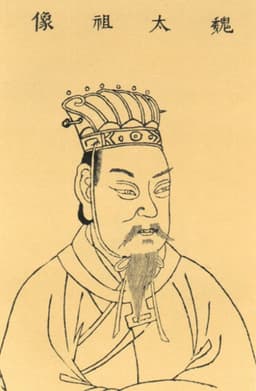
Cao Cao
General · Ancient
77.5Total

Duke of Wellington
General · Modern
75.0Total
Basic Information
Born
155
1769
Died
220
1852
Era
Ancient
Modern
Nationality
China
United Kingdom
Occupation
General
General
Civilization
Eastern
Western
Score Comparison
Military (10%)
88.0
78.0
Political (20%)
59.0
70.0
Influence (20%)
82.0
71.0
Legacy (20%)
83.0
80.0
Leadership (15%)
64.4
78.0
Strategy (15%)
89.4
72.0
TOTAL
77.5
75.0
Cao Cao — Complete Timeline
190 AD
Formation of the Coalition against Dong ZhuoPolitical Action
Cao Cao joined a coalition of regional warlords led by Yuan Shao to overthrow the tyrannical chancellor Dong Zhuo, who had seized control of the Han court. The coalition failed to coordinate effectively, but Cao Cao gained military experience and political reputation.
CoalitionDong ZhuoHan Dynasty
Impact: national
196 AD
Implementation of Tuntian (Agricultural Colonies)Reform◆ Major
Cao Cao established military agricultural colonies (tuntian) to provide food for his army and refugees. Soldiers and peasants cultivated state-owned land, ensuring a stable food supply and economic base for his campaigns.
AgricultureEconomyMilitary
Impact: regionalconstructive
200 AD
Battle of GuanduWar
Cao Cao decisively defeated Yuan Shao's numerically superior army at Guandu. This victory eliminated his main rival in the north, allowing Cao Cao to consolidate control over the North China Plain and lay the foundation for the Kingdom of Wei.
BattleYuan ShaoUnification
Impact: regional
208 AD
Battle of Red CliffsWar
Cao Cao's southern campaign was halted by the allied forces of Sun Quan and Liu Bei at the Battle of Red Cliffs. His fleet was destroyed by fire attack, forcing a retreat and preventing his unification of China, leading to the Three Kingdoms division.
BattleDefeatThree Kingdoms
Impact: regional
213 AD
Establishment of the Kingdom of WeiPolitical Action◆ Major
Cao Cao was granted the title of Duke of Wei and later King of Wei by the Han emperor, effectively creating a semi-autonomous state within the empire. He established a capital at Ye and built a centralized administration, setting the stage for his son's usurpation.
WeiStatehoodHan Dynasty
Impact: national
Duke of Wellington — Complete Timeline
1803 AD
Battle of AssayeWar◆ Major
Wellington, then Sir Arthur Wellesley, led a British-Indian force to victory against the Maratha Confederacy at Assaye in India. Despite being outnumbered, his tactical skill secured British dominance in central India.
Maratha WarIndiaBattle
Impact: regional
1808 AD
Battle of VimeiroWar◆ Major
Wellington commanded British forces to defeat the French army at Vimeiro in Portugal. The victory halted the French invasion of Portugal and marked the beginning of the Peninsular War.
Peninsular WarPortugalBattle
Impact: regional
1815 AD
Battle of WaterlooWar
Wellington, commanding an Anglo-Allied army, defeated Napoleon Bonaparte at Waterloo in present-day Belgium. The battle ended the Napoleonic Wars and led to Napoleon's final exile to Saint Helena.
Napoleonic WarsBattleWaterloo
Impact: global
1828 AD
Prime Minister of the United KingdomPolitical Action◆ Major
Wellington served as Prime Minister of the UK from 1828 to 1830. His government passed the Catholic Relief Act 1829, granting Catholic emancipation, but his opposition to parliamentary reform led to his resignation.
PoliticsCatholic EmancipationReform
Impact: nationalconstructive
Expert Analysis
Origins
Cao Cao (155-220 CE) was born into a powerful eunuch family in the waning years of the Eastern Han dynasty. His father was a foster son of a eunuch, giving Cao Cao both privilege and stigma. He rose through bureaucratic ranks, becoming a district magistrate known for strict justice. In contrast, Arthur Wellesley, the 1st Duke of Wellington (1769-1852), was born into the Anglo-Irish aristocracy, the third son of the Earl of Mornington. His early military career was propelled by purchase of commissions and political connections, serving in India and the Netherlands.
Rise to Power
Cao Cao's ascent began during the chaos following the Yellow Turban Rebellion. He raised a private army, suppressed rebels, and skillfully maneuvered among warlords. His decisive victory at the Battle of Guandu (200 CE) over Yuan Shao, a numerically superior rival, established his dominance in northern China. He then consolidated control, eventually becoming Chancellor and de facto ruler. Wellington's rise was more conventional: distinguished service in India, notably at the Battle of Assaye (1803), and later in the Peninsular War (1808-1814), where he drove French forces from Spain and Portugal, earning a dukedom.
Leadership & Governance
Cao Cao was both a military commander and an administrator. He implemented the Tuntian system, settling soldiers as farmers to ensure food supply and economic stability. He promoted talent regardless of background, attracting strategists like Guo Jia and Sima Yi. His governance was pragmatic, reducing taxes and restoring order. Wellington, as a commander, was meticulous, emphasizing discipline, logistics, and defensive tactics. He was known for his coolness under pressure and ability to inspire troops. Later, as Prime Minister (1828-1830), he was less successful, opposing reform and earning the nickname "Iron Duke."
Triumph & Tragedy
Cao Cao's greatest triumph was unifying northern China, but his ambition to conquer the south was shattered at the Battle of Red Cliffs (208 CE), where his fleet was destroyed by Sun Quan and Liu Bei. This defeat sealed a divided China. He died in 220 CE, having never claimed the throne, but his son Cao Pi founded the Wei dynasty. Wellington's triumph was the Battle of Waterloo (1815), where he, with Prussian aid, decisively defeated Napoleon. His tragedy was less personal: he outlived his wife and saw his political influence wane. He died in 1852, a national hero.
Character & Destiny
Cao Cao was complex: ruthless yet charismatic, a poet who wrote, "Drink, sing a song; life is like a dew." He was suspicious and often executed rivals, but also magnanimous to talented enemies. He believed in fate, saying, "If Heaven wants me to succeed, why fear?" Wellington was cold, pragmatic, and duty-driven. He famously said, "The Battle of Waterloo was won on the playing fields of Eton." He was reserved, sometimes aloof, and deeply conservative. Both were shaped by their eras: Cao Cao by civilizational collapse, Wellington by imperial expansion.
Legacy
Cao Cao is a central figure in Chinese history, literature (Romance of the Three Kingdoms), and opera. His military strategies are studied in modern Chinese military academies. His statecraft influenced later dynasties. Wellington's legacy is more globally recognized: Waterloo became a symbol of final victory. He is remembered as a defensive genius and a political leader who defended the status quo. Both are ranked among history's greatest generals, but their contexts differ: Cao Cao fought in a multi-front civil war, Wellington in coalition warfare.
Conclusion
In a direct comparison, Cao Cao edges Wellington due to his higher composite score (78.6 vs 76.1). Cao Cao was more versatile, combining military genius with statecraft and cultural achievement. Wellington, while peerless in his specific niche (defeating Napoleon), lacked the administrative and political breadth of Cao Cao. Score: Cao Cao M=88 P=59 I=82 L=83 D=64 S=89 T=78, Wellington M=78 P=70 I=71 L=80 D=78 S=72 T=75. Cao Cao wins 5-2 in categories (Military, Intellect, Leadership, Strategy, Tactics) to Wellington's 2 (Politics, Diplomacy). Thus, Cao Cao is the greater general overall.
Rankings
🥇
Cao CaoLeader
Mil: 88.0Pol: 59.0Inf: 82.0
77.5
🥈
Duke of Wellington
Mil: 78.0Pol: 70.0Inf: 71.0
75.0
+2.5 behind
How This Comparison Works
Algorithm
Each figure is scored on 6 dimensions (0—100 scale) based on structured historical data: Military (10%), Political (20%), Influence (20%), Legacy (20%), Leadership (15%), Strategy (15%). The weighted total produces the final ranking.
Data Sources
Scores are computed from structured sub-indicators in the database. Scale factors adjust for era (Ancient ×0.85, Modern ×1.0) and civilization size (Eastern ×1.05, Other ×0.80) to account for differences in population and military scale.
Maximum 3 Figures
Comparisons are limited to 2—3 figures to ensure readability and statistical meaningfulness.
Error Margins
±5 points per dimension — Sub-scores are derived from historical records with inherent uncertainty. Two figures within 5 points on a dimension should be considered roughly equivalent in that area.
Total Score Accuracy
±3 points overall — The weighted combination of 6 dimensions produces a total score with approximately ±3 points of uncertainty. Differences of less than 3 points are not statistically significant— the figures are effectively tied.
Known Limitations
- Historical records are incomplete and uneven across civilizations
- Figures from oral-tradition societies may be underrepresented
- Occupation labels can misclassify multi-role figures
- Scores measure capability and impact, not moral character
- Quantitative scoring is a comparison tool, not absolute truth
Capability Radar
Military (10%) — Battles & Warfare
Battles
95
85
Win Rate
88
90
Expansion
92
75
Political (20%) — Governance & Reform
Reform
88
65
Diplomacy
82
80
Economy
86
60
Influence (20%) — Cultural & Global Reach
Cultural
85
75
Global
75
80
Legacy (20%) — Historical Impact
Historical
92
85
Longevity
90
80
Leadership (15%) — Power & Stability
Tenure
85
75
Stability
78
70
Strategy (15%) — Tactics & Innovation
Strategy
96
88
Tactics
97
92
Reform
90
70
Similar Comparisons
Comments & Discussion
No comments yet. Be the first to share your thoughts!