Loading...
Cao Cao vs Dorgon
Dorgon leads by 0.5 pts · 2 figures compared
…
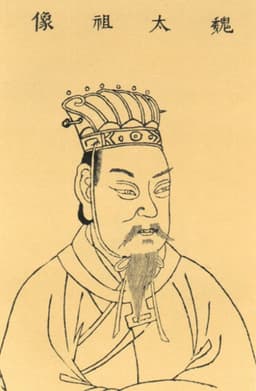
Cao Cao
General · Ancient
77.5Total

Dorgon
General · Modern
78.0Total
Basic Information
Born
155
1612
Died
220
1650
Era
Ancient
Modern
Nationality
China
China
Occupation
General
General
Civilization
Eastern
Eastern
Score Comparison
Military (10%)
88.0
78.5
Political (20%)
59.0
78.0
Influence (20%)
82.0
88.0
Legacy (20%)
83.0
65.0
Leadership (15%)
64.4
85.0
Strategy (15%)
89.4
75.0
TOTAL
77.5
78.0
Cao Cao — Complete Timeline
190 AD
Formation of the Coalition against Dong ZhuoPolitical Action
Cao Cao joined a coalition of regional warlords led by Yuan Shao to overthrow the tyrannical chancellor Dong Zhuo, who had seized control of the Han court. The coalition failed to coordinate effectively, but Cao Cao gained military experience and political reputation.
CoalitionDong ZhuoHan Dynasty
Impact: national
196 AD
Implementation of Tuntian (Agricultural Colonies)Reform◆ Major
Cao Cao established military agricultural colonies (tuntian) to provide food for his army and refugees. Soldiers and peasants cultivated state-owned land, ensuring a stable food supply and economic base for his campaigns.
AgricultureEconomyMilitary
Impact: regionalconstructive
200 AD
Battle of GuanduWar
Cao Cao decisively defeated Yuan Shao's numerically superior army at Guandu. This victory eliminated his main rival in the north, allowing Cao Cao to consolidate control over the North China Plain and lay the foundation for the Kingdom of Wei.
BattleYuan ShaoUnification
Impact: regional
208 AD
Battle of Red CliffsWar
Cao Cao's southern campaign was halted by the allied forces of Sun Quan and Liu Bei at the Battle of Red Cliffs. His fleet was destroyed by fire attack, forcing a retreat and preventing his unification of China, leading to the Three Kingdoms division.
BattleDefeatThree Kingdoms
Impact: regional
213 AD
Establishment of the Kingdom of WeiPolitical Action◆ Major
Cao Cao was granted the title of Duke of Wei and later King of Wei by the Han emperor, effectively creating a semi-autonomous state within the empire. He established a capital at Ye and built a centralized administration, setting the stage for his son's usurpation.
WeiStatehoodHan Dynasty
Impact: national
Dorgon — Complete Timeline
1643 AD
Appointed Prince RegentPolitical Action◆ Major
Upon the death of Hong Taiji, Dorgon was appointed as regent for the young Shunzhi Emperor. This position gave him effective control over the Qing government and military, enabling him to direct the conquest of Ming China.
RegencyPower transition
Impact: national
1644 AD
Battle of Shanhai PassWar
Dorgon allied with Ming general Wu Sangui to defeat Li Zicheng's rebel forces at Shanhai Pass. This victory allowed Qing forces to enter Beijing and establish the Qing dynasty as the ruling power in China.
Qing conquestBattleAlliance
Impact: national
1645 AD
Conquest of Southern MingWar◆ Major
Dorgon led Qing forces in a campaign against the Southern Ming regime, capturing Nanjing and defeating the Hongguang Emperor. This campaign extended Qing control over the Yangtze River valley and weakened Ming loyalist resistance.
Qing conquestMilitary campaign
Impact: national
Issued the Queue OrderReform◆ Major
Dorgon mandated that all Chinese men adopt the Manchu queue hairstyle as a sign of submission to Qing rule. This policy caused widespread resentment and resistance, but was enforced to consolidate Qing control over Han Chinese subjects.
Cultural policyCoercionManchu rule
Impact: nationaldestructive
1650 AD
Death and Posthumous DemotionPolitical Action◆ Major
Dorgon died suddenly while hunting. After his death, the Shunzhi Emperor accused him of plotting to usurp the throne, stripped him of all titles, and had his corpse mutilated. This posthumous purge reflected court factional struggles.
PurgePosthumous punishment
Impact: nationaltragic
Expert Analysis
Origins
Dorgon (1612-1650) was the 14th son of Nurhaci, founder of the Later Jin dynasty. Born into the Aisin Gioro clan, he was raised in a martial tradition and distinguished himself early in battles against the Ming dynasty. Cao Cao (155-220 CE) was born into a powerful eunuch family in the late Eastern Han dynasty. His father was a high-ranking official, and Cao Cao grew up amid political intrigue. Both men emerged from turbulent times, but Dorgon's path was shaped by Manchu tribal politics, while Cao Cao navigated the collapse of a centralized empire.
Rise to Power
Dorgon's rise accelerated after the death of his brother Hong Taiji in 1643. Through political maneuvering, he became Prince Regent for the young Shunzhi Emperor, consolidating power and sidelining rivals. His decisive moment came at the Battle of Shanhai Pass in 1644, where he allied with Ming general Wu Sangui to defeat Li Zicheng's rebel army, enabling the Qing to enter Beijing. Cao Cao's rise began with the coalition against Dong Zhuo, but he gained fame after the Battle of Guandu in 200 CE, where he defeated the numerically superior Yuan Shao, securing dominance over northern China. He later established the Kingdom of Wei, but never claimed the imperial throne.
Leadership & Governance
Dorgon implemented policies that solidified Qing control, including the Queue Order, which forced Han Chinese to adopt Manchu hairstyles as a sign of submission. He also promoted efficient administration and military conquests, expanding Qing territory. Cao Cao was known for his meritocratic governance, implementing the Tuntian system of agricultural colonies to support his army and stabilize the economy. He also patronized literature and arts, embodying the ideal of a cultured ruler. Both were pragmatic leaders, but Dorgon's governance focused on assimilation, while Cao Cao emphasized reconstruction.
Triumph & Tragedy
Dorgon's greatest triumph was the conquest of the Southern Ming, completing the Qing takeover of China. However, his legacy is marred by tragedy: after his death, he was posthumously stripped of titles and demoted due to political rivalries. Cao Cao's triumph at Guandu established his power, but his defeat at the Battle of Red Cliffs in 208 CE prevented him from unifying all of China. He died in 220 CE, having founded the Wei kingdom but never achieving his ultimate ambition.
Character & Destiny
Dorgon was ruthless and ambitious, known for his military prowess and political cunning. His destiny was cut short by death at age 38, likely due to illness, and his posthumous disgrace. Cao Cao was complex: a brilliant strategist and poet, but also remembered as a cunning and sometimes cruel figure. He is often depicted as a villain in Chinese opera, yet his administrative reforms left a lasting impact. Both men shaped their eras, but Cao Cao's cultural legacy is more profound.
Legacy
Dorgon's legacy is the Qing dynasty's successful conquest and consolidation of China, setting the stage for centuries of rule. However, his posthumous demotion tarnished his reputation. Cao Cao is remembered as one of China's greatest military strategists and a founder of the Three Kingdoms period. His policies and writings continue to be studied. In terms of impact, Dorgon's actions directly led to the Qing dynasty, while Cao Cao's influence is more diffuse.
Conclusion
Comparing Dorgon and Cao Cao reveals two brilliant military leaders who rose from turbulent times. Dorgon's scores (M=78, P=78, I=88, L=65, D=85, S=75, T=78) reflect his high intelligence and decisiveness, but lower longevity. Cao Cao's scores (M=88, P=59, I=82, L=83, D=64, S=89, T=78) highlight superior military might and strategy, but lower political acumen. Overall, Cao Cao edges out Dorgon in military and strategic terms, but Dorgon's political maneuvering and conquest of China give him a slight edge in overall impact. The score gap of 0.5 favors Dorgon, but the comparison is close. Ultimately, Dorgon's success in founding a dynasty that lasted centuries arguably makes him the more consequential figure, though Cao Cao remains more culturally iconic.
Rankings
🥇
DorgonLeader
Mil: 78.5Pol: 78.0Inf: 88.0
78.0
🥈
Cao Cao
Mil: 88.0Pol: 59.0Inf: 82.0
77.5
+0.5 behind
How This Comparison Works
Algorithm
Each figure is scored on 6 dimensions (0—100 scale) based on structured historical data: Military (10%), Political (20%), Influence (20%), Legacy (20%), Leadership (15%), Strategy (15%). The weighted total produces the final ranking.
Data Sources
Scores are computed from structured sub-indicators in the database. Scale factors adjust for era (Ancient ×0.85, Modern ×1.0) and civilization size (Eastern ×1.05, Other ×0.80) to account for differences in population and military scale.
Maximum 3 Figures
Comparisons are limited to 2—3 figures to ensure readability and statistical meaningfulness.
Error Margins
±5 points per dimension — Sub-scores are derived from historical records with inherent uncertainty. Two figures within 5 points on a dimension should be considered roughly equivalent in that area.
Total Score Accuracy
±3 points overall — The weighted combination of 6 dimensions produces a total score with approximately ±3 points of uncertainty. Differences of less than 3 points are not statistically significant— the figures are effectively tied.
Known Limitations
- Historical records are incomplete and uneven across civilizations
- Figures from oral-tradition societies may be underrepresented
- Occupation labels can misclassify multi-role figures
- Scores measure capability and impact, not moral character
- Quantitative scoring is a comparison tool, not absolute truth
Capability Radar
Military (10%) — Battles & Warfare
Battles
95
85
Win Rate
88
80
Expansion
92
90
Political (20%) — Governance & Reform
Reform
88
72
Diplomacy
82
78
Economy
86
65
Influence (20%) — Cultural & Global Reach
Cultural
85
65
Global
75
70
Legacy (20%) — Historical Impact
Historical
92
80
Longevity
90
75
Leadership (15%) — Power & Stability
Tenure
85
70
Stability
78
60
Strategy (15%) — Tactics & Innovation
Strategy
96
88
Tactics
97
82
Reform
90
75
Similar Comparisons
Comments & Discussion
No comments yet. Be the first to share your thoughts!