Loading...
Canaan Banana vs Julius Caesar
Julius Caesar leads by 44.4 pts · 2 figures compared
…
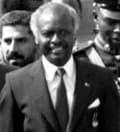
Canaan Banana
Politician · Modern
38.4Total

Julius Caesar
General · Ancient
82.8Total
Basic Information
Born
1936
-100
Died
—
-44
Era
Modern
Ancient
Nationality
Zimbabwe
Roman Republic
Occupation
Politician
General
Civilization
Other
Western
Score Comparison
Military (10%)
48.1
88.0
Political (20%)
30.7
78.0
Influence (20%)
45.5
85.0
Legacy (20%)
35.0
82.0
Leadership (15%)
31.2
80.0
Strategy (15%)
42.2
85.0
TOTAL
38.4
82.8
Canaan Banana — Complete Timeline
1980 AD
Elected President of ZimbabwePolitical Action◆ Major
Canaan Banana was elected as the first President of independent Zimbabwe, a largely ceremonial role. He served as head of state while Robert Mugabe was Prime Minister.
PresidencyIndependence
Impact: national
1999 AD
Convicted of Sodomy and Sexual AssaultOther◆ Major
Banana was convicted on 11 counts of sodomy and sexual assault, committed against his male bodyguards and employees. He was sentenced to 10 years in prison, though he served only 18 months.
ConvictionSexual AssaultScandal
Impact: nationaldestructive
Julius Caesar — Complete Timeline
58 BC
Gallic WarsWar◆ Major
Caesar, as proconsul of Gaul, launched a series of campaigns that conquered all of Gaul (modern France, Belgium, and parts of Switzerland). He fought numerous battles, including against the Helvetii, the Belgae, and the Gallic chieftain Vercingetorix. The wars brought immense wealth and a loyal army to Caesar.
Gallic WarsConquestRoman Expansion
Impact: regional
49 BC
Crossing the RubiconPolitical Action◆ Major
Caesar led Legio XIII across the Rubicon River into Italy, defying the Roman Senate's order to disband his army. This act triggered a civil war against Pompey and the Optimates, ultimately leading to Caesar's dictatorship and the end of the Roman Republic.
Roman Civil WarEnd of RepublicPower Struggle
Impact: global
48 BC
Battle of PharsalusWar◆ Major
Caesar's outnumbered army defeated the larger forces of Pompey the Great at Pharsalus in Greece. Caesar's tactical use of a reserve line to counter Pompey's cavalry charge proved decisive. Pompey fled to Egypt, where he was assassinated, leaving Caesar as the undisputed master of the Roman world.
Roman Civil WarBattleDecisive Victory
Impact: regional
44 BC
Appointment as Dictator for LifePolitical Action◆ Major
The Roman Senate appointed Caesar dictator perpetuo (dictator for life), granting him unprecedented personal power. This move concentrated military, legislative, and judicial authority in one person, effectively ending the Roman Republic's traditional system of checks and balances and alarming many senators.
DictatorshipEnd of RepublicPower Consolidation
Impact: regionaldestructive
Assassination on the Ides of MarchPolitical Action◆ Major
A group of Roman senators, led by Marcus Junius Brutus and Gaius Cassius Longinus, stabbed Caesar to death at a meeting of the Senate in the Theatre of Pompey. The assassination was intended to restore the Republic, but instead triggered another civil war that led to the rise of the Roman Empire.
AssassinationRoman PoliticsEnd of Republic
Impact: globaldestructive
Expert Analysis
canaan-banana-vs-julius-caesar
# The Dictator and the Pastor
On the Ides of March, 44 BCE, a Roman dictator lay bleeding on the floor of the Senate, stabbed twenty-three times by men he had once called friends. On a March day in 1999, a former president of Zimbabwe stood in a Harare courtroom, convicted of sodomy and sexual assault, his reputation in ruins. Two men, two falls from power, separated by two millennia. Yet the question that haunts both their stories is the same: what drives a man who holds history in his hands to lose his grip on everything?
Origins
Julius Caesar was born into the chaos of the late Roman Republic, a world of civil wars, crumbling traditions, and ambitious men who would stop at nothing. His family, the Julii, claimed descent from the goddess Venus, but they were not the wealthiest or most powerful. Young Caesar learned early that in Rome, glory was won through the sword, and influence through careful alliances. He studied rhetoric in Rhodes, served in the military, and watched his uncle Marius wage war against Sulla. The lesson was brutal: power belonged to the man who could seize it.
Canaan Banana was born in 1936 in rural Southern Rhodesia, a British colony where a white minority ruled over a black majority. His father was a migrant laborer, his mother a domestic worker. The young Banana trained as a Methodist minister, a path of patience and moral persuasion. His world was one of hymns, sermons, and quiet resistance against a system that denied him basic rights. While Caesar learned to command legions, Banana learned to lead congregations.
Rise to Power
Caesar’s ascent was a masterclass in strategic ambition. He climbed the political ladder of the Republic—quaestor, aedile, praetor, consul—each step a calculated gamble. In 60 BCE, he formed the First Triumvirate with Pompey and Crassus, an alliance that gave him command of Gaul. Over the next eight years, he conquered a territory larger than Italy, earning loyalty from his soldiers and fear from his enemies. When the Senate ordered him to disband his army, he crossed the Rubicon River in 49 BCE, a line that meant civil war. Within four years, he was dictator for life.
Banana’s rise was quieter. He joined the liberation movement against white rule in Rhodesia, but his role was political, not military. When Zimbabwe gained independence in 1980, the new prime minister, Robert Mugabe, needed a president—a ceremonial figurehead who would not threaten his power. Banana was elected, serving from 1980 to 1987. His office had no real authority. He was a pastor in a palace, a symbol of unity in a nation already fracturing.
Leadership & Governance
Caesar governed with the ruthlessness of a general and the vision of a reformer. He centralized the Roman state, reformed the calendar, granted citizenship to provincials, and launched massive building projects. His military genius was legendary—the siege of Alesia, the lightning campaigns in Gaul, the decisive victory at Pharsalus. But his political wisdom was flawed. He pardoned his enemies, only to be killed by them. He centralized power, only to make himself a target. He did not understand that the Republic’s traditions, however corrupt, were more resilient than any single man.
Banana governed as a figurehead. He had no army, no policy power, no real decision-making. His presidency was defined by what he did not do. He did not stop Mugabe’s consolidation of power. He did not challenge the corruption that would later destroy Zimbabwe. His was a leadership of absence—a man who held a title but not its substance.
Triumph & Tragedy
Caesar’s greatest moment came in 52 BCE at the Battle of Alesia, where he surrounded a Gallic fortress and then surrounded the army that came to relieve it. It was a double siege, a feat of military engineering and tactical brilliance that had no equal in the ancient world. His greatest failure was his refusal to see the daggers in the Senate. On the Ides of March, 44 BCE, he fell, and with him fell the Republic.
Banana’s triumph was the day Zimbabwe became independent. He stood as the nation’s first president, a symbol of hope. His tragedy came twelve years after leaving office, when he was convicted on eleven counts of sodomy and sexual assault, committed against his male bodyguards and employees. The man who had preached morality was condemned for its opposite. He died in 2003, largely forgotten, his name a punchline.
Character & Destiny
Caesar was driven by an insatiable hunger for glory. He wrote his own commentaries, controlled his own narrative, and believed that his fate was written in the stars. His personality—arrogant, calculating, charismatic—shaped every decision. He pardoned enemies because he believed they could not match him. He crossed the Rubicon because he could not imagine losing. His destiny was to be the man who broke the Republic and built the Empire, even if he did not live to see it.
Banana was driven by something else: the desire to be respected. He was a minister in a nation that denied him dignity, a politician in a system that gave him no power. His character was passive, his decisions reactive. He did not seize history; he was carried by it. His conviction was not just a personal failure but a reflection of the moral vacuum that had filled his soul.
Legacy
Caesar’s legacy is the Roman Empire. His name became a title—Caesar, Kaiser, Tsar. His military tactics are still studied at war colleges. His writings are still read. He is remembered as a genius and a tyrant, a man who changed the world forever.
Banana’s legacy is a footnote. He is remembered, if at all, as the first president of a country that would later collapse into dictatorship and poverty. His name appears in lists of African leaders, but his influence was zero. He left no reforms, no monuments, no lasting impact. He was a man who held a position but never held power.
Conclusion
Two men, two worlds. Caesar rose to absolute power and lost it because he could not imagine his own death. Banana rose to ceremonial power and lost his dignity because he could not imagine his own accountability. One changed the world; the other was changed by it. Their stories remind us that history does not judge by intention but by outcome. The man who crosses the Rubicon will be remembered. The man who sits quietly in a palace will be forgotten—unless his shame survives him.
Rankings
🥇
Julius CaesarLeader
Mil: 88.0Pol: 78.0Inf: 85.0
82.8
🥈
Canaan Banana
Mil: 48.1Pol: 30.7Inf: 45.5
38.4
+44.4 behind
How This Comparison Works
Algorithm
Each figure is scored on 6 dimensions (0—100 scale) based on structured historical data: Military (10%), Political (20%), Influence (20%), Legacy (20%), Leadership (15%), Strategy (15%). The weighted total produces the final ranking.
Data Sources
Scores are computed from structured sub-indicators in the database. Scale factors adjust for era (Ancient ×0.85, Modern ×1.0) and civilization size (Eastern ×1.05, Other ×0.80) to account for differences in population and military scale.
Maximum 3 Figures
Comparisons are limited to 2—3 figures to ensure readability and statistical meaningfulness.
Error Margins
±5 points per dimension — Sub-scores are derived from historical records with inherent uncertainty. Two figures within 5 points on a dimension should be considered roughly equivalent in that area.
Total Score Accuracy
±3 points overall — The weighted combination of 6 dimensions produces a total score with approximately ±3 points of uncertainty. Differences of less than 3 points are not statistically significant— the figures are effectively tied.
Known Limitations
- Historical records are incomplete and uneven across civilizations
- Figures from oral-tradition societies may be underrepresented
- Occupation labels can misclassify multi-role figures
- Scores measure capability and impact, not moral character
- Quantitative scoring is a comparison tool, not absolute truth
Capability Radar
Military (10%) — Battles & Warfare
Battles
24
95
Win Rate
23
92
Expansion
28
97
Political (20%) — Governance & Reform
Reform
5
90
Diplomacy
10
85
Economy
5
82
Influence (20%) — Cultural & Global Reach
Cultural
5
88
Global
5
94
Legacy (20%) — Historical Impact
Historical
5
95
Longevity
5
96
Leadership (15%) — Power & Stability
Tenure
10
75
Stability
5
60
Strategy (15%) — Tactics & Innovation
Strategy
31
94
Tactics
33
96
Reform
37
88
Similar Comparisons
Comments & Discussion
CenturionCrit6/17/2026
Caesar’s assassination was a political reset, not a fall from grace—he saw himself as Rome’s savior, crucifying pirates and conquering Gaul. Banana’s conviction, by contrast, marks a moral collapse: a pastor-turned-president who exploited faith for cover. History doesn’t pair them as peers in downfall; one was betrayed for ambition, the other for hypocrisy.
数据疑云6/17/2026
拿屋大维的养父跟津巴布韦牧师比?别扯了。恺撒死时掌控罗马,死后封神,遗嘱养子成元首;Banana下台后才被起诉,案子靠服刑特赦才平息,数据上零政治效应。这对比是修辞绑架实质——一个改变地中海格局,一个只是地方丑闻。
Sulla'sGhost6/17/2026
Banana’s rise from mission boy to president outpaces Caesar’s patrician start—fewer resources, greater odds. Yet his end lacks tragedy; it’s a sordid footnote. Caesar’s stabbing is epic, his killers’ motives debated for millennia. Banana’s sodomy conviction? A whisper in Harare’s corridors. The question isn’t about losing grip—it’s about who gets a dramatic death scene.
经典学究6/17/2026
恺撒的陨落是悲剧,Banana的是闹剧。前者在元老院遭23刀,布鲁图斯那句“还有你吗”已成永恒隐喻;后者是1999年法庭上的猥亵案,连非洲宪章学者都羞于提起。比较深层?恺撒背叛了共和理想,Banana背叛了牧师誓言——但一个塑造了罗马帝国,一个只留下监狱档案。
Pastor'sPunch6/17/2026
Calling this a comparison of "falls" cheapens the divine right of Caesar’s ambition. Banana’s downfall is human, messy, and self-inflicted—not a state crisis. Caesar’s death birthed an empire; Banana’s conviction ended a sorry episode. History isn’t a level playing field: one man’s bloodline claimed Venus, the other’s legacy is a cautionary tale about power without vision.