Loading...
Camille Chamoun vs Julius Caesar
Julius Caesar leads by 31.4 pts · 2 figures compared
…
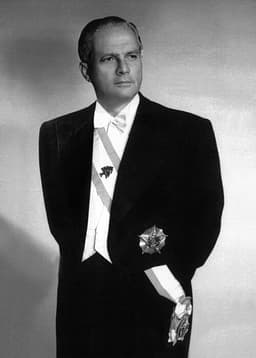
Camille Chamoun
Politician · Modern
51.4Total

Julius Caesar
General · Ancient
82.8Total
Basic Information
Born
1900
-100
Died
1987
-44
Era
Modern
Ancient
Nationality
Lebanon
Roman Republic
Occupation
Politician
General
Civilization
Middle Eastern
Western
Score Comparison
Military (10%)
39.4
88.0
Political (20%)
61.3
78.0
Influence (20%)
53.3
85.0
Legacy (20%)
45.0
82.0
Leadership (15%)
65.0
80.0
Strategy (15%)
39.6
85.0
TOTAL
51.4
82.8
Camille Chamoun — Complete Timeline
1952 AD
Elected President of LebanonPolitical Action◆ Major
Camille Chamoun was elected President of Lebanon on September 23, 1952, succeeding Bechara El Khoury. His election marked a shift in Lebanese politics, and he served a six-year term until 1958.
PresidencyElectionLebanon
Impact: national
1958 AD
1958 Lebanon crisis and U.S. interventionWar◆ Major
President Chamoun faced a major political crisis when Muslim factions rebelled against his pro-Western policies and alleged attempts to amend the constitution for a second term. The U.S. intervened by landing Marines in Beirut to stabilize the government.
Civil WarU.S. InterventionPolitical Crisis
Impact: regionaldestructive
Refused to resign during the 1958 crisisPolitical Action
Chamoun refused to resign despite widespread opposition and the formation of a rebel government in Tripoli. He remained in power until the end of his term in September 1958, when he handed over to Fuad Chehab.
ResistancePolitical StalemateTransition
Impact: national
Founded the National Liberal PartyPolitical Action
After leaving the presidency, Chamoun founded the National Liberal Party (NLP) in 1958. The party became a major political force representing Maronite Christian interests and played a role in the Lebanese Civil War.
Political PartyMaronitePost-presidency
Impact: national
1975 AD
Role in the Lebanese Civil WarWar◆ Major
Chamoun's National Liberal Party and its militia, the Tigers, fought in the Lebanese Civil War as part of the Christian Lebanese Front. He opposed the Taif Agreement and remained a polarizing figure until his death in 1987.
Civil WarMilitiaChristian Faction
Impact: nationaldestructive
Julius Caesar — Complete Timeline
58 BC
Gallic WarsWar◆ Major
Caesar, as proconsul of Gaul, launched a series of campaigns that conquered all of Gaul (modern France, Belgium, and parts of Switzerland). He fought numerous battles, including against the Helvetii, the Belgae, and the Gallic chieftain Vercingetorix. The wars brought immense wealth and a loyal army to Caesar.
Gallic WarsConquestRoman Expansion
Impact: regional
49 BC
Crossing the RubiconPolitical Action◆ Major
Caesar led Legio XIII across the Rubicon River into Italy, defying the Roman Senate's order to disband his army. This act triggered a civil war against Pompey and the Optimates, ultimately leading to Caesar's dictatorship and the end of the Roman Republic.
Roman Civil WarEnd of RepublicPower Struggle
Impact: global
48 BC
Battle of PharsalusWar◆ Major
Caesar's outnumbered army defeated the larger forces of Pompey the Great at Pharsalus in Greece. Caesar's tactical use of a reserve line to counter Pompey's cavalry charge proved decisive. Pompey fled to Egypt, where he was assassinated, leaving Caesar as the undisputed master of the Roman world.
Roman Civil WarBattleDecisive Victory
Impact: regional
44 BC
Appointment as Dictator for LifePolitical Action◆ Major
The Roman Senate appointed Caesar dictator perpetuo (dictator for life), granting him unprecedented personal power. This move concentrated military, legislative, and judicial authority in one person, effectively ending the Roman Republic's traditional system of checks and balances and alarming many senators.
DictatorshipEnd of RepublicPower Consolidation
Impact: regionaldestructive
Assassination on the Ides of MarchPolitical Action◆ Major
A group of Roman senators, led by Marcus Junius Brutus and Gaius Cassius Longinus, stabbed Caesar to death at a meeting of the Senate in the Theatre of Pompey. The assassination was intended to restore the Republic, but instead triggered another civil war that led to the rise of the Roman Empire.
AssassinationRoman PoliticsEnd of Republic
Impact: globaldestructive
Expert Analysis
camille-chamoun-vs-julius-caesar
# The Rubicon and the Cedar: Two Leaders, Two Worlds
On a January morning in 49 BCE, Julius Caesar stood on the banks of a small Italian river, the Rubicon, and made a decision that would shatter the Roman Republic. He crossed, and the world changed forever. On a summer day in 1958, Camille Chamoun sat in the presidential palace in Beirut, refusing to resign as Muslim factions rebelled against his rule. He stayed, and Lebanon began its long descent into chaos. Both men faced moments that defined them. But Caesar crossed into immortality; Chamoun crossed into tragedy. Why? The answer lies not just in their choices, but in the worlds they inhabited.
Origins
Caesar was born into the chaos of the late Roman Republic, a world of civil wars, senatorial corruption, and crumbling traditions. His family, the Julii, claimed descent from the goddess Venus, but they were not wealthy. Caesar learned early that in Rome, glory was currency. He served in the military, studied rhetoric in Rhodes, and was captured by pirates—whom he later crucified, laughing as he did. His world was one of ambition without limits, where a man could rise by his wits and his sword.
Chamoun was born in 1900 in Deir el-Qamar, a mountain village in Ottoman Lebanon. His family were Maronite Christians, a minority in a multi-sect empire. He studied law in Paris and returned to a Lebanon under French mandate. His world was one of fragile balances: Christians, Muslims, Druze, and others living together under a system that parceled power by religion. Chamoun learned that survival meant navigating sectarian currents, not crossing them.
Rise to Power
Caesar’s path was forged in war. He conquered Gaul in eight brutal campaigns, writing his own commentary to shape his legend. He invaded Britain, crossed the Rhine, and amassed a loyal army that called him *imperator*. When the Senate ordered him to disband his forces, he refused. The Rubicon was not a gamble; it was the logical end of a life spent accumulating power. By 44 BCE, he was dictator for life, the undisputed master of Rome.
Chamoun rose through politics, not battle. He served as a diplomat, minister, and finally president in 1952, succeeding Bechara El Khoury after a corruption scandal. His election was a triumph of negotiation, not conquest. He inherited a Lebanon that was prosperous but divided, a "Switzerland of the Middle East" built on a fragile sectarian pact. His power came from the Maronite presidency, not from legions.
Leadership & Governance
Caesar ruled with breathtaking speed. He reformed the calendar, granted citizenship to Gauls, redistributed land to veterans, and began massive building projects. He was a military genius—his siege of Alesia and his victory at Pharsalus are still studied—but his political wisdom faltered. He pardoned his enemies, but he also centralized power, mocked the Senate, and accepted divine honors. He governed like a conqueror, not a politician.
Chamoun governed like a diplomat, but in a crisis, he became a stubborn survivor. His pro-Western policies—aligning with the United States and Britain—alienated Muslim factions who saw him as a tool of imperialism. When the 1958 crisis erupted, he refused to resign, even as rebels seized Tripoli and the army fractured. He called in U.S. Marines, who landed on Beirut’s beaches and stabilized his rule. But the intervention poisoned Lebanese politics. Chamoun won the battle but lost the trust that held Lebanon together.
Triumph & Tragedy
Caesar’s greatest triumph was his conquest of Gaul, which brought Rome wealth and prestige. His greatest tragedy was his assassination on the Ides of March, 44 BCE. He was stabbed 23 times by senators he had pardoned, including his friend Brutus. His death did not save the Republic; it unleashed a civil war that ended with his adopted son, Octavian, becoming the first emperor. Caesar’s tragedy was that he could not see that his ambition had destroyed the very system he sought to lead.
Chamoun’s greatest triumph was surviving the 1958 crisis. He left office peacefully in 1958, a rare feat in the Middle East. His greatest tragedy was the Lebanese Civil War, which began in 1975 and lasted 15 years. Chamoun’s National Liberal Party and its militia, the Tigers, fought in the war, and his son Dany was later assassinated. Chamoun died in 1987, an old man watching his country burn. His tragedy was that his refusal to compromise in 1958 set a precedent for sectarian intransigence that would destroy Lebanon.
Character & Destiny
Caesar was audacious, calculating, and ruthless. He believed in his own star. “Veni, vidi, vici,” he wrote—I came, I saw, I conquered. His personality drove him to seize power, but it also blinded him to the hatred he inspired. He thought his clemency would win loyalty; instead, it bred contempt. His destiny was to be a god or a corpse—and he became both.
Chamoun was polished, resilient, and stubborn. He believed in Lebanon as a Christian refuge in a Muslim sea. “I will not be the one who gives up Lebanon,” he said. His personality drove him to resist pressure, but it also made him inflexible. He thought his Western allies would save him; instead, they deepened the divisions. His destiny was to be a symbol of a lost Lebanon, a cedar that stood alone as the forest burned.
Legacy
Caesar’s legacy is the Roman Empire. His name became a title—*Kaiser* in German, *Tsar* in Russian. His writings are still read. His reforms shaped Western civilization. He is remembered as a genius and a tyrant, a man who destroyed a republic and built an empire. His score of 83.3 reflects this: a colossus whose shadow stretches across millennia.
Chamoun’s legacy is more ambiguous. He is remembered as a founding father of modern Lebanon, but also as a polarizing figure who helped trigger its collapse. His score of 64.6 reflects a man of talent caught in impossible circumstances. He is not a household name outside Lebanon, but his story is a cautionary tale about the limits of power in a divided society.
Conclusion
Caesar and Chamoun never met. One ruled the ancient world’s greatest empire; the other led a small, fragile nation. Yet both faced the same question: when the system breaks, do you break with it, or do you try to hold it together? Caesar broke the Republic to remake it. Chamoun tried to hold Lebanon together, but his grip was too tight. In the end, Caesar’s crossing of the Rubicon became a metaphor for irreversible decisions. Chamoun’s refusal to cross—to compromise, to step aside—became a metaphor for the tragedy of a leader who could not see that sometimes, the greatest courage is not to stand firm, but to let go. Both men changed their worlds. But one changed the world.
Rankings
🥇
Julius CaesarLeader
Mil: 88.0Pol: 78.0Inf: 85.0
82.8
🥈
Camille Chamoun
Mil: 39.4Pol: 61.3Inf: 53.3
51.4
+31.4 behind
How This Comparison Works
Algorithm
Each figure is scored on 6 dimensions (0—100 scale) based on structured historical data: Military (10%), Political (20%), Influence (20%), Legacy (20%), Leadership (15%), Strategy (15%). The weighted total produces the final ranking.
Data Sources
Scores are computed from structured sub-indicators in the database. Scale factors adjust for era (Ancient ×0.85, Modern ×1.0) and civilization size (Eastern ×1.05, Other ×0.80) to account for differences in population and military scale.
Maximum 3 Figures
Comparisons are limited to 2—3 figures to ensure readability and statistical meaningfulness.
Error Margins
±5 points per dimension — Sub-scores are derived from historical records with inherent uncertainty. Two figures within 5 points on a dimension should be considered roughly equivalent in that area.
Total Score Accuracy
±3 points overall — The weighted combination of 6 dimensions produces a total score with approximately ±3 points of uncertainty. Differences of less than 3 points are not statistically significant— the figures are effectively tied.
Known Limitations
- Historical records are incomplete and uneven across civilizations
- Figures from oral-tradition societies may be underrepresented
- Occupation labels can misclassify multi-role figures
- Scores measure capability and impact, not moral character
- Quantitative scoring is a comparison tool, not absolute truth
Capability Radar
Military (10%) — Battles & Warfare
Battles
23
95
Win Rate
25
92
Expansion
25
97
Political (20%) — Governance & Reform
Reform
40
90
Diplomacy
55
85
Economy
35
82
Influence (20%) — Cultural & Global Reach
Cultural
30
88
Global
30
94
Legacy (20%) — Historical Impact
Historical
40
95
Longevity
30
96
Leadership (15%) — Power & Stability
Tenure
60
75
Stability
20
60
Strategy (15%) — Tactics & Innovation
Strategy
31
94
Tactics
35
96
Reform
38
88
Similar Comparisons
Comments & Discussion
No comments yet. Be the first to share your thoughts!