Loading...
This comparison has not been analyzed yet.
One-time AI generation (~1 minute). Scores and timeline are already available below.
Bulent Ecevit vs H. V. R. Iyengar
Bulent Ecevit leads by 1.7 pts · 2 figures compared
…
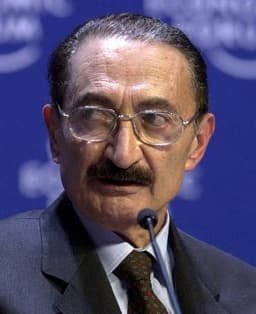
Bulent Ecevit
Politician · Modern
54.3Total

H. V. R. Iyengar
Politician · Modern
52.6Total
Basic Information
Born
1925
1902
Died
—
1978
Era
Modern
Modern
Nationality
Turkey
India
Occupation
Politician
Politician
Civilization
Middle Eastern
Indian
Score Comparison
Military (10%)
47.5
32.0
Political (20%)
68.0
62.7
Influence (20%)
60.0
50.2
Legacy (20%)
50.0
42.5
Leadership (15%)
53.2
72.0
Strategy (15%)
38.3
60.0
TOTAL
54.3
52.6
Bulent Ecevit — Complete Timeline
1974 AD
Ordered the Cyprus InvasionWar
Ecevit ordered the Turkish military invasion of Cyprus following a Greek-backed coup on the island. The invasion led to the partition of Cyprus and the establishment of the Turkish Republic of Northern Cyprus.
Cyprus InvasionMilitary ActionPartition
Impact: regionaldestructive
First Term as Prime Minister of TurkeyPolitical Action◆ Major
Bulent Ecevit became Prime Minister of Turkey for the first time, leading a coalition government of the Republican People's Party (CHP). He served as prime minister four times between 1974 and 1999.
Prime MinisterRepublican People's PartyCoalition
Impact: nationalconstructive
1980 AD
Ousted by the 1980 Military CoupPolitical Action◆ Major
The Turkish military coup overthrew Ecevit's government. He was arrested and banned from politics for a decade, along with other party leaders.
Military CoupArrestPolitical Ban
Impact: nationaldestructive
1999 AD
Return to Politics and Fourth Term as Prime MinisterPolitical Action◆ Major
Ecevit returned as prime minister after the 1999 elections, leading a coalition government. His term was marked by economic crisis and the capture of PKK leader Abdullah Ocalan.
Return to PoliticsCoalitionEconomic Crisis
Impact: national
Capture of Abdullah OcalanPolitical Action◆ Major
Under Ecevit's government, Turkish authorities captured Abdullah Ocalan, leader of the Kurdistan Workers' Party (PKK), in Kenya. Ocalan's capture led to a ceasefire and reduced violence.
PKKAbdullah OcalanCounterterrorism
Impact: nationalconstructive
H. V. R. Iyengar — Complete Timeline
1957 AD
Tenure as Governor of the Reserve Bank of IndiaPolitical Action◆ Major
H. V. R. Iyengar served as the Governor of the Reserve Bank of India from 1957 to 1962. During his tenure, he oversaw monetary policy and banking regulation in post-independence India, managing the economy during a period of planned development.
RBIMonetary PolicyBanking
Impact: national
This comparison has not been analyzed yet.
One-time AI generation (~1 minute). Scores and timeline are already available below.
Rankings
🥇
Bulent EcevitLeader
Mil: 47.5Pol: 68.0Inf: 60.0
54.3
🥈
H. V. R. Iyengar
Mil: 32.0Pol: 62.7Inf: 50.2
52.6
+1.7 behind
How This Comparison Works
Algorithm
Each figure is scored on 6 dimensions (0—100 scale) based on structured historical data: Military (10%), Political (20%), Influence (20%), Legacy (20%), Leadership (15%), Strategy (15%). The weighted total produces the final ranking.
Data Sources
Scores are computed from structured sub-indicators in the database. Scale factors adjust for era (Ancient ×0.85, Modern ×1.0) and civilization size (Eastern ×1.05, Other ×0.80) to account for differences in population and military scale.
Maximum 3 Figures
Comparisons are limited to 2—3 figures to ensure readability and statistical meaningfulness.
Error Margins
±5 points per dimension — Sub-scores are derived from historical records with inherent uncertainty. Two figures within 5 points on a dimension should be considered roughly equivalent in that area.
Total Score Accuracy
±3 points overall — The weighted combination of 6 dimensions produces a total score with approximately ±3 points of uncertainty. Differences of less than 3 points are not statistically significant— the figures are effectively tied.
Known Limitations
- Historical records are incomplete and uneven across civilizations
- Figures from oral-tradition societies may be underrepresented
- Occupation labels can misclassify multi-role figures
- Scores measure capability and impact, not moral character
- Quantitative scoring is a comparison tool, not absolute truth
Capability Radar
Military (10%) — Battles & Warfare
Battles
30
41
Win Rate
40
46
Expansion
30
47
Political (20%) — Governance & Reform
Reform
55
55
Diplomacy
50
50
Economy
45
65
Influence (20%) — Cultural & Global Reach
Cultural
40
20
Global
50
20
Legacy (20%) — Historical Impact
Historical
55
30
Longevity
40
25
Leadership (15%) — Power & Stability
Tenure
60
60
Stability
40
60
Strategy (15%) — Tactics & Innovation
Strategy
40
52
Tactics
35
53
Reform
20
56
Similar Comparisons
Comments & Discussion
No comments yet. Be the first to share your thoughts!