Loading...
Abdoulaye Wade vs Bulent Ecevit
Bulent Ecevit leads by 2.5 pts · 2 figures compared
…

Abdoulaye Wade
Politician · Modern
51.8Total
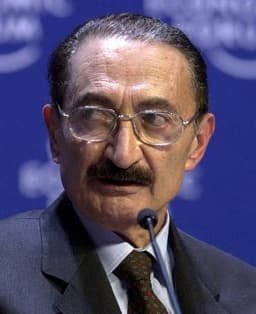
Bulent Ecevit
Politician · Modern
54.3Total
Basic Information
Born
1926
1925
Died
—
—
Era
Modern
Modern
Nationality
Senegal
Turkey
Occupation
Politician
Politician
Civilization
Other
Middle Eastern
Score Comparison
Military (10%)
19.6
47.5
Political (20%)
68.0
68.0
Influence (20%)
56.4
60.0
Legacy (20%)
43.3
50.0
Leadership (15%)
68.0
53.2
Strategy (15%)
44.8
38.3
TOTAL
51.8
54.3
Abdoulaye Wade — Complete Timeline
2000 AD
Elected President of SenegalPolitical Action
Abdoulaye Wade won the presidential election, defeating incumbent Abdou Diouf. His victory marked the first peaceful transfer of power in Senegal's history and was hailed as a democratic milestone.
ElectionDemocracy
Impact: nationalconstructive
2007 AD
Re-elected for a Second TermPolitical Action◆ Major
Wade was re-elected in the first round with 55.9% of the vote. The election was criticized by opposition for irregularities, but Wade's victory was confirmed by the Constitutional Council.
Re-electionControversy
Impact: national
2011 AD
Attempted to Change Constitution for Third TermPolitical Action◆ Major
Wade proposed a constitutional amendment to allow a third term, sparking massive protests. The move was seen as a power grab and led to violent clashes, damaging his democratic legacy.
Constitutional CrisisProtests
Impact: nationaldestructive
2012 AD
Defeated in Presidential ElectionPolitical Action◆ Major
Wade lost the presidential election to Macky Sall in a runoff. He conceded defeat, marking a peaceful transition of power despite the earlier tensions over his third-term bid.
Election DefeatTransition
Impact: national
Bulent Ecevit — Complete Timeline
1974 AD
Ordered the Cyprus InvasionWar
Ecevit ordered the Turkish military invasion of Cyprus following a Greek-backed coup on the island. The invasion led to the partition of Cyprus and the establishment of the Turkish Republic of Northern Cyprus.
Cyprus InvasionMilitary ActionPartition
Impact: regionaldestructive
First Term as Prime Minister of TurkeyPolitical Action◆ Major
Bulent Ecevit became Prime Minister of Turkey for the first time, leading a coalition government of the Republican People's Party (CHP). He served as prime minister four times between 1974 and 1999.
Prime MinisterRepublican People's PartyCoalition
Impact: nationalconstructive
1980 AD
Ousted by the 1980 Military CoupPolitical Action◆ Major
The Turkish military coup overthrew Ecevit's government. He was arrested and banned from politics for a decade, along with other party leaders.
Military CoupArrestPolitical Ban
Impact: nationaldestructive
1999 AD
Return to Politics and Fourth Term as Prime MinisterPolitical Action◆ Major
Ecevit returned as prime minister after the 1999 elections, leading a coalition government. His term was marked by economic crisis and the capture of PKK leader Abdullah Ocalan.
Return to PoliticsCoalitionEconomic Crisis
Impact: national
Capture of Abdullah OcalanPolitical Action◆ Major
Under Ecevit's government, Turkish authorities captured Abdullah Ocalan, leader of the Kurdistan Workers' Party (PKK), in Kenya. Ocalan's capture led to a ceasefire and reduced violence.
PKKAbdullah OcalanCounterterrorism
Impact: nationalconstructive
Expert Analysis
Origins
Abdoulaye Wade was born on May 29, 1926, in Kébémer, Senegal, into a Muslim family. He studied law and economics in France, earning a doctorate from the University of Paris. Wade worked as a lawyer and professor before entering politics. His early career was marked by opposition to the socialist regime of Léopold Sédar Senghor.
Bülent Ecevit was born on May 28, 1925, in Istanbul, Turkey, into a literary family. His father was a professor and his mother a painter. Ecevit studied English literature at Robert College and later worked as a journalist. He entered politics as a member of the Republican People's Party (CHP), influenced by his father's political activism.
Rise to Power
Wade founded the Senegalese Democratic Party (PDS) in 1974, positioning himself as a liberal alternative to the dominant Socialist Party. He ran for president multiple times, losing in 1978, 1983, and 1988. His persistence and ability to mobilize urban youth and intellectuals kept him relevant. In 2000, he won the presidency against incumbent Abdou Diouf, marking Senegal's first peaceful transfer of power since independence. Wade's victory was celebrated as a triumph for democracy in Africa.
Ecevit rose through the CHP ranks, becoming party secretary-general in 1966. He was appointed prime minister in 1974 after leading the CHP to a plurality in elections. His rise was fueled by his image as a man of the people and his nationalist stance. The key turning point came in July 1974 when he ordered the Turkish invasion of Cyprus following a Greek-backed coup. The operation, named 'Operation Attila', led to the partition of the island and solidified Ecevit's popularity among Turkish nationalists.
Leadership & Governance
Wade's governance style was characterized by liberal economic reforms and infrastructure projects. He pursued policies to attract foreign investment and privatize state enterprises. However, his later years were marked by authoritarian tendencies, including attempts to amend the constitution for a third term. Wade's leadership score is 68.0, reflecting his effectiveness in maintaining political stability but also his controversial power-grabbing.
Ecevit's governance was defined by his handling of the Cyprus issue and economic crises. He adopted a populist approach, emphasizing social welfare and state intervention. His first term saw the establishment of the Turkish Land Forces Command in Cyprus. Later, as prime minister in the 1990s, he faced a severe economic crisis, with inflation soaring. Ecevit's political score also stands at 68.0, but his strategy score is only 38.3, reflecting poor economic management and inability to prevent the 1980 coup.
Triumph & Tragedy
Wade's greatest triumph was his peaceful electoral victory in 2000, ending 40 years of Socialist rule. He also oversaw economic growth and improved infrastructure, including the construction of the new international airport. His tragedy was his failed attempt to change the constitution for a third term, which sparked violent protests and tarnished his democratic legacy. He lost the 2012 election and conceded, but the damage was done.
Ecevit's triumph was the Cyprus invasion, which secured Turkish Cypriots' autonomy and boosted his popularity. He also oversaw the capture of PKK leader Abdullah Öcalan in 1999, a major blow to Kurdish separatists. His tragedy was the 1980 military coup that ousted his government, leading to his arrest and a decade-long political ban. Additionally, his later term ended with a deep economic crisis that eroded public trust.
Character & Destiny
Wade was a tenacious and charismatic leader, but his long tenure in opposition made him resistant to compromise. His decision to seek a third term was seen as a hubristic overreach, leading to his downfall. Historians note that his legacy is mixed: he is credited with strengthening democracy but criticized for authoritarian drift.
Ecevit was an intellectual and poet, known for his integrity and nationalist fervor. He was decisive in foreign policy but indecisive in economics. His character led him to prioritize national sovereignty over economic reform, contributing to Turkey's instability. The 1980 coup was a direct result of political polarization and economic chaos under his watch.
Legacy
Wade's legacy is the consolidation of multiparty democracy in Senegal. His peaceful transfer of power in 2000 set a precedent for Africa. However, his attempt to extend his rule weakened democratic institutions. Today, Senegal remains a stable democracy, partly due to Wade's earlier contributions.
Ecevit's legacy is deeply tied to the Cyprus issue. The invasion created a divided island that remains a source of tension. He is remembered as a nationalist hero by some and as a divisive figure by others. His economic mismanagement contributed to Turkey's recurring crises. Ecevit's total score of 54.3 slightly edges out Wade's 51.8, but his impact is more controversial.
Conclusion
While both leaders scored similarly overall, Ecevit's influence on geopolitics through the Cyprus invasion gives him a broader historical footprint. Wade's peaceful transition was significant but localized. Ecevit's actions reshaped the Eastern Mediterranean, even if his domestic record was flawed. Therefore, Ecevit had a greater impact, despite Wade's higher leadership score (68.0 vs 53.2). However, Wade's legacy in democratic governance is more positive.
Rankings
🥇
Bulent EcevitLeader
Mil: 47.5Pol: 68.0Inf: 60.0
54.3
🥈
Abdoulaye Wade
Mil: 19.6Pol: 68.0Inf: 56.4
51.8
+2.5 behind
How This Comparison Works
Algorithm
Each figure is scored on 6 dimensions (0—100 scale) based on structured historical data: Military (10%), Political (20%), Influence (20%), Legacy (20%), Leadership (15%), Strategy (15%). The weighted total produces the final ranking.
Data Sources
Scores are computed from structured sub-indicators in the database. Scale factors adjust for era (Ancient ×0.85, Modern ×1.0) and civilization size (Eastern ×1.05, Other ×0.80) to account for differences in population and military scale.
Maximum 3 Figures
Comparisons are limited to 2—3 figures to ensure readability and statistical meaningfulness.
Error Margins
±5 points per dimension — Sub-scores are derived from historical records with inherent uncertainty. Two figures within 5 points on a dimension should be considered roughly equivalent in that area.
Total Score Accuracy
±3 points overall — The weighted combination of 6 dimensions produces a total score with approximately ±3 points of uncertainty. Differences of less than 3 points are not statistically significant— the figures are effectively tied.
Known Limitations
- Historical records are incomplete and uneven across civilizations
- Figures from oral-tradition societies may be underrepresented
- Occupation labels can misclassify multi-role figures
- Scores measure capability and impact, not moral character
- Quantitative scoring is a comparison tool, not absolute truth
Capability Radar
Military (10%) — Battles & Warfare
Battles
25
30
Win Rate
29
40
Expansion
32
30
Political (20%) — Governance & Reform
Reform
55
55
Diplomacy
60
50
Economy
50
45
Influence (20%) — Cultural & Global Reach
Cultural
40
40
Global
40
50
Legacy (20%) — Historical Impact
Historical
40
55
Longevity
30
40
Leadership (15%) — Power & Stability
Tenure
60
60
Stability
45
40
Strategy (15%) — Tactics & Innovation
Strategy
35
40
Tactics
37
35
Reform
41
20
Similar Comparisons
Comments & Discussion
No comments yet. Be the first to share your thoughts!