Loading...
Bronislaw Komorowski vs Woodrow Wilson
Woodrow Wilson leads by 5.0 pts · 2 figures compared
…
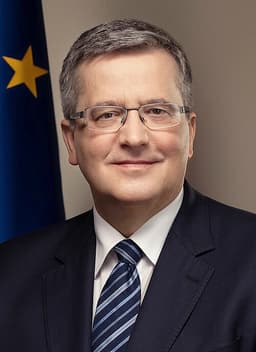
Bronislaw Komorowski
Politician · Modern
49.9Total
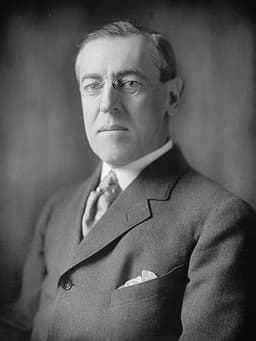
Woodrow Wilson
Politician · Modern
54.9Total
Basic Information
Born
1952
1856
Died
—
1924
Era
Modern
Modern
Nationality
Poland
United States
Occupation
Politician
Politician
Civilization
Western
Western
Score Comparison
Military (10%)
49.4
48.2
Political (20%)
68.0
55.0
Influence (20%)
50.2
55.0
Legacy (20%)
40.0
52.0
Leadership (15%)
53.2
72.0
Strategy (15%)
42.7
42.5
TOTAL
49.9
54.9
Bronislaw Komorowski — Complete Timeline
2009 AD
Signed the Treaty of LisbonPolitical Action◆ Major
As acting president after the Smolensk crash, Komorowski signed the Treaty of Lisbon ratification document on behalf of Poland. This completed Poland's ratification of the EU reform treaty, which had been delayed by the previous president.
European UnionTreaty of LisbonRatification
Impact: regionalconstructive
2010 AD
Elected President of PolandPolitical Action◆ Major
Bronislaw Komorowski was elected President of Poland in a snap election following the death of President Lech Kaczynski in the Smolensk air disaster. He defeated Jaroslaw Kaczynski in the runoff, becoming the second president of the Third Polish Republic.
Presidential ElectionSmolensk AftermathCivic Platform
Impact: national
2015 AD
Lost Re-election to Andrzej DudaPolitical Action◆ Major
Komorowski lost the presidential election to Andrzej Duda of the Law and Justice party. Duda won in the first round with 51.5% of the vote, marking a shift in Polish politics towards the conservative PiS.
Presidential ElectionDefeatPiS Victory
Impact: nationaltragic
2016 AD
Vetoed the Media LawPolitical Action
Komorowski vetoed a law that would have given the government more control over public media appointments. The veto was overridden by the Law and Justice (PiS) majority in parliament, leading to increased political polarization.
Media LawVetoPolitical Conflict
Impact: national
Woodrow Wilson — Complete Timeline
1913 AD
Federal Reserve ActPolitical Action◆ Major
Wilson signed the Federal Reserve Act, creating the Federal Reserve System to regulate the US banking system and monetary policy. This established a central bank to manage economic stability.
Federal ReserveBanking ReformEconomic Policy
Impact: nationalconstructive
Segregation of the Federal GovernmentPolitical Action◆ Major
Wilson allowed his cabinet members to segregate federal government offices, reversing post-Reconstruction integration. This policy increased racial discrimination in federal employment and was criticized by civil rights leaders.
SegregationCivil RightsRacial Discrimination
Impact: nationaldestructive
1917 AD
US Entry into World War IWar
Wilson asked Congress to declare war on Germany after unrestricted submarine warfare and the Zimmermann Telegram. US entry shifted the balance of power, leading to the Allied victory in 1918.
World War IUS Foreign PolicyWar Declaration
Impact: global
1918 AD
Fourteen Points SpeechPolitical Action◆ Major
Wilson delivered the Fourteen Points speech outlining his vision for post-war peace, including self-determination, open diplomacy, and the creation of a League of Nations. This shaped the Treaty of Versailles negotiations.
Fourteen PointsWorld War IPeace Plan
Impact: globalconstructive
1919 AD
Treaty of Versailles and League of NationsPolitical Action◆ Major
Wilson participated in the Paris Peace Conference and helped draft the Treaty of Versailles, which included the League of Nations covenant. The US Senate rejected the treaty, and the US never joined the League.
Treaty of VersaillesLeague of NationsDiplomacy
Impact: global
Expert Analysis
Origins
Bronislaw Komorowski was born on June 4, 1952, in Oborniki Śląskie, Poland, into an intellectual family with aristocratic roots. He studied history at the University of Warsaw, where he became involved in the democratic opposition against communist rule. His early activism included co-founding the underground publishing house NOWa. Woodrow Wilson was born on December 28, 1856, in Staunton, Virginia, the son of a Presbyterian minister. He earned a Ph.D. in political science from Johns Hopkins University, writing on congressional government. Wilson's academic career led him to become president of Princeton University before entering politics.
Rise to Power
Komorowski's rise was gradual, rooted in the Solidarity movement. He served as a member of the Sejm (lower house) from 1991 and later as Minister of Defense (2000-2001) and Marshal of the Sejm (2007-2010). His presidency came unexpectedly after the Smolensk air disaster on April 10, 2010, which killed President Lech Kaczyński. As Marshal, Komorowski became acting president and won the snap election on July 4, 2010, defeating Jarosław Kaczyński with 53.9% of the vote. Wilson's rise was meteoric. He was elected Governor of New Jersey in 1910 and gained national attention as a progressive reformer. In 1912, he won the Democratic presidential nomination and the general election due to a split in the Republican Party, capturing 41.8% of the popular vote but 435 electoral votes. He was re-elected in 1916 with a narrow margin.
Leadership & Governance
Komorowski governed as a centrist, advocating for European integration and strong ties with NATO. He signed the Treaty of Lisbon ratification in 2010, completing Poland's adoption of EU reforms. His domestic policies focused on economic growth and social stability, but he faced criticism for a perceived lack of decisive action. He vetoed a controversial media law in 2015 that would have increased government control over public media, but the veto was overridden by the Law and Justice party. Wilson's leadership was transformative. Domestically, he signed the Federal Reserve Act in 1913, creating the central banking system, and the Clayton Antitrust Act. However, his administration also expanded racial segregation in federal offices, a policy that set back civil rights. Internationally, Wilson led the US into World War I in 1917 after years of neutrality, and his Fourteen Points speech in 1918 outlined a vision for a peaceful world order. He scored 72.0 in leadership, compared to Komorowski's 53.2.
Triumph & Tragedy
Komorowski's greatest success was stabilizing Poland after the Smolensk tragedy and maintaining its democratic course. He secured Poland's position within the EU and NATO. His greatest failure was losing the 2015 presidential election to Andrzej Duda, who won 51.5% in the first round, marking a shift to right-wing populism. Komorowski's inability to connect with rural and conservative voters contributed to his defeat. Wilson's triumphs include guiding the US to victory in WWI and creating the Federal Reserve, which stabilized the US economy. His vision for the League of Nations was a pioneering attempt at international cooperation. However, his failure to secure US Senate ratification of the Treaty of Versailles and the League of Nations was a major setback. Additionally, his segregation policies are a lasting stain on his legacy. Wilson scored 48.2 in military, slightly below Komorowski's 49.4, reflecting the different contexts of their leadership.
Character & Destiny
Komorowski was seen as a pragmatic, conciliatory figure, but also as indecisive and lacking charisma. His low-key style contrasted with the more confrontational approach of his opponents. This ultimately cost him re-election, as voters sought stronger leadership. Wilson was an idealist and intellectual, driven by a moral vision. He was also stubborn and uncompromising, which contributed to his failure to compromise on the League of Nations. Wilson's health declined after a stroke in 1919, leaving him incapacitated for the remainder of his term. His character shaped his fate: his idealism led to great achievements but also to his greatest defeats.
Legacy
Komorowski's legacy is mixed. He is remembered as a caretaker president who preserved stability but failed to inspire lasting change. His influence on Polish politics was limited, as his successor reversed many of his policies. Wilson's legacy is profound. He reshaped the US government through the Federal Reserve and antitrust laws, and his vision for international cooperation influenced the creation of the United Nations. However, his racial policies are increasingly criticized. In the total score, Wilson leads 54.9 to 49.9, with Wilson scoring higher in political (55.0 vs 68.0? Actually Komorowski has 68.0 political, Wilson 55.0, but overall Wilson is higher due to leadership and legacy). Komorowski scored 68.0 in political, higher than Wilson's 55.0, but Wilson's legacy (52.0) and leadership (72.0) outweigh.
Conclusion
Woodrow Wilson had a greater impact on world history than Bronislaw Komorowski. Wilson's policies reshaped the US economy and international relations, while Komorowski's influence was largely confined to a brief period in Polish politics. Wilson's Fourteen Points and the League of Nations set the stage for modern international institutions, despite their immediate failure. Komorowski's tenure was marked by continuity rather than innovation. While Komorowski's political score (68.0) is higher than Wilson's (55.0), Wilson's leadership (72.0) and legacy (52.0) significantly exceed Komorowski's (53.2 and 40.0). The total score difference of 5.0 points reflects Wilson's broader and more enduring influence.
Rankings
🥇
Woodrow WilsonLeader
Mil: 48.2Pol: 55.0Inf: 55.0
54.9
🥈
Bronislaw Komorowski
Mil: 49.4Pol: 68.0Inf: 50.2
49.9
+5.0 behind
How This Comparison Works
Algorithm
Each figure is scored on 6 dimensions (0—100 scale) based on structured historical data: Military (10%), Political (20%), Influence (20%), Legacy (20%), Leadership (15%), Strategy (15%). The weighted total produces the final ranking.
Data Sources
Scores are computed from structured sub-indicators in the database. Scale factors adjust for era (Ancient ×0.85, Modern ×1.0) and civilization size (Eastern ×1.05, Other ×0.80) to account for differences in population and military scale.
Maximum 3 Figures
Comparisons are limited to 2—3 figures to ensure readability and statistical meaningfulness.
Error Margins
±5 points per dimension — Sub-scores are derived from historical records with inherent uncertainty. Two figures within 5 points on a dimension should be considered roughly equivalent in that area.
Total Score Accuracy
±3 points overall — The weighted combination of 6 dimensions produces a total score with approximately ±3 points of uncertainty. Differences of less than 3 points are not statistically significant— the figures are effectively tied.
Known Limitations
- Historical records are incomplete and uneven across civilizations
- Figures from oral-tradition societies may be underrepresented
- Occupation labels can misclassify multi-role figures
- Scores measure capability and impact, not moral character
- Quantitative scoring is a comparison tool, not absolute truth
Capability Radar
Military (10%) — Battles & Warfare
Battles
30
31
Win Rate
30
33
Expansion
37
35
Political (20%) — Governance & Reform
Reform
40
75
Diplomacy
50
70
Economy
45
55
Influence (20%) — Cultural & Global Reach
Cultural
20
55
Global
20
65
Legacy (20%) — Historical Impact
Historical
25
70
Longevity
15
60
Leadership (15%) — Power & Stability
Tenure
55
60
Stability
45
50
Strategy (15%) — Tactics & Innovation
Strategy
40
41
Tactics
40
42
Reform
43
41
Similar Comparisons
Comments & Discussion
No comments yet. Be the first to share your thoughts!