Loading...
This comparison has not been analyzed yet.
One-time AI generation (~1 minute). Scores and timeline are already available below.
Boris I of Bulgaria vs Recceswinth
Boris I of Bulgaria leads by 15.5 pts · 2 figures compared
…
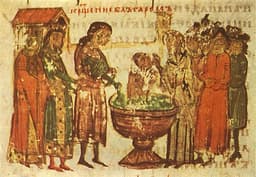
Boris I of Bulgaria
Emperor · Medieval
67.7Total

Recceswinth
Emperor · Medieval
52.2Total
Basic Information
Born
828
620
Died
907
672
Era
Medieval
Medieval
Nationality
Bulgaria
Visigothic Kingdom
Occupation
Emperor
Emperor
Civilization
Western
Western
Score Comparison
Military (10%)
40.0
21.2
Political (20%)
70.3
68.0
Influence (20%)
65.0
56.4
Legacy (20%)
80.0
50.0
Leadership (15%)
78.0
68.0
Strategy (15%)
52.5
30.3
TOTAL
67.7
52.2
Boris I of Bulgaria — Complete Timeline
864 AD
Adoption of Christianity as state religionReform
Boris I accepted Christianity from the Byzantine Empire, baptizing himself and his court. This act aligned Bulgaria with Christian Europe, reduced Byzantine cultural pressure, and laid the foundation for the Bulgarian Orthodox Church.
ChristianizationState ReligionByzantine Influence
Impact: regionalconstructive
889 AD
Abdication and entry into monasteryPolitical Action◆ Major
Boris I abdicated the throne to become a monk. He later returned from the monastery in 893 to depose his son Vladimir-Rasate, who had reverted to paganism, and installed his younger son Simeon I as ruler.
AbdicationMonasticismDynastic Crisis
Impact: national
893 AD
Council of PreslavPolitical Action◆ Major
Boris I convened a council that replaced Greek with Old Church Slavonic as the official liturgical and literary language. This decision promoted Slavic culture and literacy, strengthening Bulgarian national identity.
Language ReformSlavic LiteracyCultural Policy
Impact: regionalconstructive
Recceswinth — Complete Timeline
649 AD
Accession as Visigothic KingPolitical Action◆ Major
Recceswinth became king of the Visigoths, succeeding his father Chindaswinth. He co-ruled with his father for a period before assuming sole rule. His reign focused on legal unification and strengthening the monarchy against the nobility.
Visigothic KingdomSuccessionCo-rule
Impact: regional
650 AD
Suppression of Noble RebellionsPolitical Action◆ Major
Recceswinth faced several revolts from Visigothic nobles who opposed his centralizing policies and the new legal code. He suppressed these rebellions, executing or exiling many aristocrats. This strengthened royal authority but also created lasting tensions between the crown and nobility.
Visigothic KingdomRevoltCentralization
Impact: regionaldestructive
653 AD
Council of Toledo (Eighth Council)Cultural◆ Major
Recceswinth convened the Eighth Council of Toledo, which approved the new legal code and reaffirmed the Catholic faith. The council also addressed issues of royal succession and church-state relations, further integrating the church into the Visigothic state.
Visigothic KingdomCouncil of ToledoChurch-State Relations
Impact: regionalconstructive
654 AD
Issuance of the Visigothic Code (Liber Iudiciorum)Reform
Recceswinth promulgated the Liber Iudiciorum, a comprehensive legal code that replaced all previous Visigothic and Roman laws. It applied equally to all subjects, ending legal distinctions between Visigoths and Romans. This code became the foundation of Visigothic law and influenced later Spanish law.
Visigothic KingdomLaw CodeLegal Unification
Impact: regionalconstructive
This comparison has not been analyzed yet.
One-time AI generation (~1 minute). Scores and timeline are already available below.
Rankings
🥇
Boris I of BulgariaLeader
Mil: 40.0Pol: 70.3Inf: 65.0
67.7
🥈
Recceswinth
Mil: 21.2Pol: 68.0Inf: 56.4
52.2
+15.5 behind
How This Comparison Works
Algorithm
Each figure is scored on 6 dimensions (0—100 scale) based on structured historical data: Military (10%), Political (20%), Influence (20%), Legacy (20%), Leadership (15%), Strategy (15%). The weighted total produces the final ranking.
Data Sources
Scores are computed from structured sub-indicators in the database. Scale factors adjust for era (Ancient ×0.85, Modern ×1.0) and civilization size (Eastern ×1.05, Other ×0.80) to account for differences in population and military scale.
Maximum 3 Figures
Comparisons are limited to 2—3 figures to ensure readability and statistical meaningfulness.
Error Margins
±5 points per dimension — Sub-scores are derived from historical records with inherent uncertainty. Two figures within 5 points on a dimension should be considered roughly equivalent in that area.
Total Score Accuracy
±3 points overall — The weighted combination of 6 dimensions produces a total score with approximately ±3 points of uncertainty. Differences of less than 3 points are not statistically significant— the figures are effectively tied.
Known Limitations
- Historical records are incomplete and uneven across civilizations
- Figures from oral-tradition societies may be underrepresented
- Occupation labels can misclassify multi-role figures
- Scores measure capability and impact, not moral character
- Quantitative scoring is a comparison tool, not absolute truth
Capability Radar
Military (10%) — Battles & Warfare
Battles
45
10
Win Rate
50
10
Expansion
40
10
Political (20%) — Governance & Reform
Reform
95
75
Diplomacy
90
50
Economy
70
55
Influence (20%) — Cultural & Global Reach
Cultural
85
50
Global
70
30
Legacy (20%) — Historical Impact
Historical
90
55
Longevity
85
50
Leadership (15%) — Power & Stability
Tenure
85
60
Stability
80
65
Strategy (15%) — Tactics & Innovation
Strategy
55
10
Tactics
40
10
Reform
60
20
Similar Comparisons
Comments & Discussion
No comments yet. Be the first to share your thoughts!