Loading...
Boris I of Bulgaria vs Dmitry Donskoy
Boris I of Bulgaria leads by 12.2 pts · 2 figures compared
…
Boris I of Bulgaria
Emperor · Medieval
67.7Total

Dmitry Donskoy
Emperor · Medieval
55.5Total
Basic Information
Born
828
1350
Died
907
1389
Era
Medieval
Medieval
Nationality
Bulgaria
Muscovy
Occupation
Emperor
Emperor
Civilization
Western
Western
Score Comparison
Military (10%)
40.0
70.0
Political (20%)
70.3
68.0
Influence (20%)
65.0
55.0
Legacy (20%)
80.0
52.0
Leadership (15%)
78.0
40.0
Strategy (15%)
52.5
55.0
TOTAL
67.7
55.5
Boris I of Bulgaria — Complete Timeline
864 AD
Adoption of Christianity as state religionReform
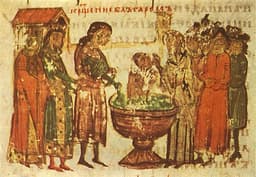
Boris I accepted Christianity from the Byzantine Empire, baptizing himself and his court. This act aligned Bulgaria with Christian Europe, reduced Byzantine cultural pressure, and laid the foundation for the Bulgarian Orthodox Church.
ChristianizationState ReligionByzantine Influence
Impact: regionalconstructive
889 AD
Abdication and entry into monasteryPolitical Action◆ Major
Boris I abdicated the throne to become a monk. He later returned from the monastery in 893 to depose his son Vladimir-Rasate, who had reverted to paganism, and installed his younger son Simeon I as ruler.
AbdicationMonasticismDynastic Crisis
Impact: national
893 AD
Council of PreslavPolitical Action◆ Major
Boris I convened a council that replaced Greek with Old Church Slavonic as the official liturgical and literary language. This decision promoted Slavic culture and literacy, strengthening Bulgarian national identity.
Language ReformSlavic LiteracyCultural Policy
Impact: regionalconstructive
Dmitry Donskoy — Complete Timeline
1359 AD
Became Grand Prince of MoscowPolitical Action◆ Major
Dmitry inherited the throne at age nine after his father Ivan II died. His regency was managed by Metropolitan Alexius, who secured the Mongol yarlyk for Moscow against claims from Suzdal and other rivals.
MoscowSuccessionRegency
Impact: regional
1378 AD
Battle of the Vozha RiverWar
Dmitry defeated a Mongol army led by Murza Begich on the Vozha River in Ryazan. This was the first Russian victory over a major Mongol force and a prelude to the Battle of Kulikovo.
Golden HordeRyazanPrelude
Impact: regional
1380 AD
Battle of KulikovoWar
Dmitry Donskoy led a coalition of Russian principalities to defeat the Mongol army of Mamai at Kulikovo Field near the Don River. This was the first major Russian victory over the Golden Horde, though Mongol rule continued for another century.
Golden HordeMamaiRussian Victory
Impact: regional
1382 AD
Burned Moscow to Prevent Mongol CaptureWar◆ Major
After Khan Tokhtamysh besieged Moscow, Dmitry fled to Kostroma. The Mongols sacked the city, killing thousands. Dmitry returned to rebuild but was forced to resume tribute payments to the Horde.
MoscowTokhtamyshSiege
Impact: regionaltragic
Expert Analysis
Origins
Boris I (c. 828–907) was the son of Khan Presian of Bulgaria. Born into a pagan Bulgar ruling elite, he inherited a state that was a formidable power in the Balkans, controlling territory from the Black Sea to the Adriatic. His early life was shaped by the constant tension between the Bulgar military aristocracy and the Slavic majority, as well as the looming influence of the Byzantine Empire. Dmitry Donskoy (1350–1389) was born as the son of Ivan II of Moscow. Orphaned at age nine, he became Grand Prince of Moscow under the regency of Metropolitan Alexius. His youth was marked by the Golden Horde's dominance over Russian principalities and the bitter rivalry between Moscow and Tver. Dmitry's formative years were spent learning to navigate the complex politics of Mongol suzerainty and inter-princely warfare.
Rise to Power
Boris I became Khan in 852 after the death of his father. His early reign was marked by military campaigns against the Byzantines and the Franks, but his major turning point came in 864 when he accepted Christianity from the Byzantine Empire. This act, prompted by a Byzantine invasion and a famine, was a calculated political move to integrate Bulgaria into Christian Europe and reduce Byzantine cultural influence. Boris was baptized, taking the name Michael, and imposed Christianity on his subjects. In 893, after abdicating to become a monk, he returned to depose his pagan son Vladimir-Rasate and secured the succession of his other son, Simeon. Dmitry Donskoy became Grand Prince of Moscow in 1359 at age nine. His early rule was overshadowed by the regent Metropolitan Alexius, who secured the Mongol yarlyk (patent) for Moscow. Dmitry's rise to prominence came through his confrontations with the Golden Horde. In 1378, he defeated a Mongol army at the Vozha River, the first major Russian victory over the Mongols. This set the stage for the Battle of Kulikovo in 1380, where Dmitry led a coalition of Russian princes to defeat Mamai's army, earning his epithet 'Donskoy' (of the Don).
Leadership & Governance
Boris I's leadership was characterized by strategic statecraft and cultural engineering. He centralized the Bulgarian state by adopting Christianity as the state religion, which unified the diverse ethnic groups under a common faith. He convened the Council of Preslav in 893, which replaced Greek with Old Church Slavonic as the official liturgical language, fostering a distinct Slavic identity and reducing Byzantine cultural dominance. Boris also established the Bulgarian Patriarchate, asserting ecclesiastical independence. His governance was pragmatic: he abdicated to manage succession crises from a monastery, showing a long-term view of stability. Dmitry Donskoy's leadership was more martial and reactive. He consolidated Moscow's power by defeating rivals like Tver and Ryazan, and by building the first stone Kremlin in Moscow (1367). His governance was shaped by the need to balance Mongol demands with Russian aspirations. Dmitry's military focus was on breaking Mongol dominance, but his political acumen was weaker: he fled Moscow when Khan Tokhtamysh besieged it in 1382, leading to the city's sack and a return to tribute payments. His political score of 68.0 reflects this mixed record, while Boris's 70.3 indicates a more consistent strategic vision.
Triumph & Tragedy
Boris I's greatest triumph was the Christianization of Bulgaria, which integrated the country into the European cultural sphere and created a lasting Slavic literary tradition through the use of Old Church Slavonic. His decision to depose his pagan son and secure Simeon's succession ensured the continuity of his reforms. However, his abdication and later return from the monastery caused instability, and his imposition of Christianity was initially met with resistance, including a revolt by the nobility in 866. Dmitry Donskoy's triumph was the Battle of Kulikovo (1380), where his coalition defeated Mamai, breaking the myth of Mongol invincibility. This victory boosted Russian morale and Moscow's prestige. His tragedy was the sack of Moscow by Tokhtamysh in 1382, which forced him to resume tribute payments and submit to the Horde. His military score of 70.0 is high for his era, but his leadership score of 40.0 reflects his inability to capitalize on Kulikovo due to political missteps.
Character & Destiny
Boris I was a shrewd, patient, and calculating ruler. He prioritized long-term cultural and religious transformation over immediate military glory. His willingness to abdicate and later return from a monastery shows a flexible approach to power. Historians note his 'visionary statesmanship' in creating a Slavic Christian civilization. Dmitry Donskoy was a brave warrior but a flawed strategist. His personal courage at Kulikovo inspired his troops, but his flight from Moscow in 1382 reveals impulsiveness and poor judgment. His character was molded by the harsh realities of Mongol rule, leading to a focus on military confrontation rather than diplomatic consolidation. His destiny was to be remembered as a national hero despite ultimate submission to the Horde.
Legacy
Boris I's legacy is profound: he Christianized Bulgaria, leading to its cultural flourishing under Simeon I. The creation of the Cyrillic alphabet and Old Church Slavonic literature directly stems from his policies. His legacy score of 80.0 reflects the enduring impact of his religious and cultural reforms. Bulgaria became a center of Slavic Orthodoxy, and his model of state-sponsored Christianity influenced other Slavic states. Dmitry Donskoy's legacy is more symbolic: he is venerated as a saint in the Russian Orthodox Church and is considered a precursor to the eventual liberation from the Mongol yoke. However, his legacy score of 52.0 is lower because his victory was temporary and did not end Mongol rule. The Battle of Kulikovo became a nationalist myth, but its practical impact was limited. Moscow's rise continued, but Dmitry's failures set back the cause.
Conclusion
Boris I had a greater historical impact than Dmitry Donskoy. Boris's total score of 67.7 surpasses Dmitry's 55.5 by 12.2 points. While Dmitry's military achievements at Kulikovo were dramatic, they did not achieve lasting independence from the Mongols. In contrast, Boris's Christianization of Bulgaria created a cultural and religious identity that persists to this day. His political and strategic foresight in promoting Slavic language and liturgy had a multiplier effect across the Orthodox world. Dmitry's legacy is important for Russian nationalism, but Boris's reforms fundamentally transformed a pagan state into a Christian nation, influencing the entire Slavic world. Therefore, Boris I is the more significant figure in the long arc of history.
Rankings
🥇
Boris I of BulgariaLeader
Mil: 40.0Pol: 70.3Inf: 65.0
67.7
🥈
Dmitry Donskoy
Mil: 70.0Pol: 68.0Inf: 55.0
55.5
+12.2 behind
How This Comparison Works
Algorithm
Each figure is scored on 6 dimensions (0—100 scale) based on structured historical data: Military (10%), Political (20%), Influence (20%), Legacy (20%), Leadership (15%), Strategy (15%). The weighted total produces the final ranking.
Data Sources
Scores are computed from structured sub-indicators in the database. Scale factors adjust for era (Ancient ×0.85, Modern ×1.0) and civilization size (Eastern ×1.05, Other ×0.80) to account for differences in population and military scale.
Maximum 3 Figures
Comparisons are limited to 2—3 figures to ensure readability and statistical meaningfulness.
Error Margins
±5 points per dimension — Sub-scores are derived from historical records with inherent uncertainty. Two figures within 5 points on a dimension should be considered roughly equivalent in that area.
Total Score Accuracy
±3 points overall — The weighted combination of 6 dimensions produces a total score with approximately ±3 points of uncertainty. Differences of less than 3 points are not statistically significant— the figures are effectively tied.
Known Limitations
- Historical records are incomplete and uneven across civilizations
- Figures from oral-tradition societies may be underrepresented
- Occupation labels can misclassify multi-role figures
- Scores measure capability and impact, not moral character
- Quantitative scoring is a comparison tool, not absolute truth
Capability Radar
Military (10%) — Battles & Warfare
Battles
45
65
Win Rate
50
60
Expansion
40
60
Political (20%) — Governance & Reform
Reform
95
55
Diplomacy
90
65
Economy
70
50
Influence (20%) — Cultural & Global Reach
Cultural
85
60
Global
70
55
Legacy (20%) — Historical Impact
Historical
90
70
Longevity
85
65
Leadership (15%) — Power & Stability
Tenure
85
60
Stability
80
55
Strategy (15%) — Tactics & Innovation
Strategy
55
65
Tactics
40
70
Reform
60
55
Similar Comparisons
Comments & Discussion
No comments yet. Be the first to share your thoughts!