Loading...
Boris I of Bulgaria vs Napoleon Bonaparte
Napoleon Bonaparte leads by 3.2 pts · 2 figures compared
…
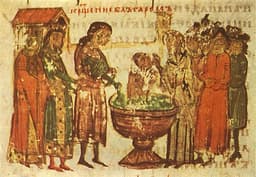
Boris I of Bulgaria
Emperor · Medieval
67.7Total

Napoleon Bonaparte
General · Modern
70.9Total
Basic Information
Born
828
1769
Died
907
1821
Era
Medieval
Modern
Nationality
Bulgaria
France
Occupation
Emperor
General
Civilization
Western
Western
Score Comparison
Military (10%)
40.0
94.0
Political (20%)
70.3
72.0
Influence (20%)
65.0
40.0
Legacy (20%)
80.0
80.0
Leadership (15%)
78.0
78.0
Strategy (15%)
52.5
90.0
TOTAL
67.7
70.9
Boris I of Bulgaria — Complete Timeline
864 AD
Adoption of Christianity as state religionReform
Boris I accepted Christianity from the Byzantine Empire, baptizing himself and his court. This act aligned Bulgaria with Christian Europe, reduced Byzantine cultural pressure, and laid the foundation for the Bulgarian Orthodox Church.
ChristianizationState ReligionByzantine Influence
Impact: regionalconstructive
889 AD
Abdication and entry into monasteryPolitical Action◆ Major
Boris I abdicated the throne to become a monk. He later returned from the monastery in 893 to depose his son Vladimir-Rasate, who had reverted to paganism, and installed his younger son Simeon I as ruler.
AbdicationMonasticismDynastic Crisis
Impact: national
893 AD
Council of PreslavPolitical Action◆ Major
Boris I convened a council that replaced Greek with Old Church Slavonic as the official liturgical and literary language. This decision promoted Slavic culture and literacy, strengthening Bulgarian national identity.
Language ReformSlavic LiteracyCultural Policy
Impact: regionalconstructive
Napoleon Bonaparte — Complete Timeline
1799 AD
Coup of 18 BrumaireOther◆ Major
Napoleon Bonaparte, with support from his brother Lucien and key political figures, overthrew the Directory in a bloodless coup. He established the Consulate with himself as First Consul, effectively becoming the ruler of France. This event ended the French Revolution's most unstable period.
French RevolutionCoupRise to Power
Impact: regional
1804 AD
Promulgation of the Napoleonic CodeOther◆ Major
Napoleon enacted the Civil Code of the French, known as the Napoleonic Code, a comprehensive set of laws that replaced the fragmented feudal legal systems. The code established legal equality, protected property rights, and secularized law. It became the basis for legal systems in many European and world countries.
Legal ReformNapoleonic CodeCivil Law
Impact: globalconstructive
1805 AD
Battle of AusterlitzWar◆ Major
Napoleon's Grande Arm
Napoleonic WarsBattleDecisive Victory
Impact: global
1812 AD
Invasion of RussiaWar◆ Major
Napoleon led the Grande Arm
Napoleonic WarsInvasionDisaster
Impact: globaldestructive
1815 AD
Battle of WaterlooWar◆ Major
Napoleon's French army was defeated by the combined forces of the Duke of Wellington's Anglo-Allied army and Gebhard Leberecht von Bl
Napoleonic WarsBattleFinal Defeat
Impact: globaldestructive
Expert Analysis
boris-i-of-bulgaria-vs-napoleon-bonaparte
# The Conqueror and the Convert: Napoleon and Boris I
In the winter of 864, a Bulgarian khan knelt in a baptismal font, emerging not simply as a new Christian but as the architect of a nation's soul. A thousand miles and a thousand years away, another man—short, restless, and burning with ambition—would stand before the Pyramids and declare to his army that forty centuries were looking down upon them. One built an empire of faith that outlasted the centuries; the other built an empire of steel that crumbled in a decade. What separates a figure who reshapes history from one who merely storms across it? The answer lies not in the size of their conquests, but in the depth of their foundations.
Origins
Napoleon Bonaparte was born in 1769 on the island of Corsica, a land recently purchased by France, into a minor noble family of Italian descent. He was an outsider in every sense—too Corsican for the French, too French for the Corsicans—and this hunger for belonging would drive him relentlessly. The French Revolution, which erupted when he was twenty, shattered the old order and offered a ladder for men of talent. Napoleon seized it with both hands.
Boris I, born in 828, inherited a very different world. Bulgaria was a pagan khanate, a fearsome steppe power that had terrified Byzantium for generations. But by Boris's time, the old ways were failing. The empire of the Bulgars was surrounded by Christian states—the Franks, the Byzantines, the Serbs—and its tribal polytheism left it isolated and vulnerable. Where Napoleon saw opportunity, Boris saw a trap closing in.
Rise to Power
Napoleon's ascent was meteoric. At twenty-four, he drove the British out of Toulon; at twenty-six, he crushed a royalist uprising in Paris with a "whiff of grapeshot"; at twenty-seven, he led a ragged army into Italy and dismantled the Austrian Empire. By 1799, at just thirty years old, he staged a coup and made himself First Consul. His path was paved with cannon smoke and audacity.
Boris's rise was quieter, but no less decisive. He became khan of Bulgaria in 852, inheriting a realm that was militarily strong but spiritually adrift. For twelve years, he waged inconclusive wars against the Byzantines and the Franks, learning a bitter lesson: Bulgaria could not defeat its enemies by sword alone. The turning point came in 864, when a Byzantine invasion forced his hand. Rather than fight a war he could not win, Boris made a choice that would define his reign: he accepted Christianity from Constantinople.
Leadership & Governance
Napoleon governed through sheer force of will. He centralized the French state, created the Bank of France, and most famously, codified French law into the Napoleonic Code—a system that enshrined equality before the law, religious toleration, and meritocracy. As a military commander, he was unmatched: he won sixty battles, outmaneuvered every coalition Europe could throw at him, and invented modern warfare through speed, deception, and the concentration of force. His political score of 75 reflects a leader who could organize but could not compromise.
Boris governed through patience and calculation. He did not merely convert his people; he engineered a national transformation. In 889, after thirty-seven years of rule, he abdicated to become a monk—a stunning act of self-effacement. When his son Vladimir-Rasate reverted to paganism, Boris left his monastery in 893, deposed his own son, and convened the Council of Preslav. There, he made a decision of staggering consequence: he replaced Greek with Old Church Slavonic as the official language of the Bulgarian Church. This single act preserved Bulgarian identity for a millennium.
Triumph & Tragedy
Napoleon's triumph was Austerlitz, 1805, where he destroyed the combined armies of Russia and Austria in a single day. His tragedy was Waterloo, 1815, where a rain-soaked field and a Prussian arrival ended his hundred-day return. He died in exile on Saint Helena, a prisoner of the British, at fifty-one.
Boris's triumph was subtler but more enduring. By Christianizing Bulgaria, he pulled his people into the orbit of European civilization. His tragedy was personal: he outlived his own sons, watched his dynasty falter, and died in 907 as a monk, having surrendered power twice. Yet his work survived. Unlike Napoleon's empire, which shattered at his fall, Boris's Bulgaria endured for centuries.
Character & Destiny
Napoleon was a creature of ambition, driven by an insatiable need to prove himself. "Impossible," he once said, "is a word to be found only in the dictionary of fools." His ego was his engine and his undoing: he could not stop, could not share power, could not accept limits. He invaded Russia in 1812 with 600,000 men; fewer than 100,000 returned.
Boris was a creature of prudence. He understood that true power lies not in conquest but in transformation. He could humble himself before a priest, abandon his throne for a monastery, and return to correct his own mistakes. His humility was his strength. Where Napoleon built a monument to himself, Boris built a foundation for his people.
Legacy
Napoleon's legacy is a paradox. He spread the ideals of the French Revolution—nationalism, legal equality, secular governance—across Europe, but he did so at the barrel of a cannon. His military innovations influenced warfare for a century, and his legal code remains the basis of civil law in much of the world. Yet his name is forever linked with war, ambition, and fall.
Boris I is remembered as a saint in the Bulgarian Orthodox Church, the man who gave his people a faith and a written language. His military score of 34.6 is modest, but his political score of 80 and leadership score of 77.7 tell a deeper story. He did not conquer; he converted. He did not command; he convinced. And in doing so, he achieved what Napoleon never could: he built something that outlasted him.
Conclusion
Standing before the Pyramids, Napoleon told his men that forty centuries were watching. He was wrong. Forty centuries have passed, and we remember the Pharaohs—but we also remember the Bulgars, the Slavs, the people who Boris I united under a single faith and a single tongue. The conqueror's name echoes in battlefields and textbooks; the convert's name echoes in churches and prayers. One reshaped borders; the other reshaped souls. History, it turns out, remembers both—but it is the quiet builders, not the loud destroyers, who endure.
Rankings
🥇
Napoleon BonaparteLeader
Mil: 94.0Pol: 72.0Inf: 40.0
70.9
🥈
Boris I of Bulgaria
Mil: 40.0Pol: 70.3Inf: 65.0
67.7
+3.2 behind
How This Comparison Works
Algorithm
Each figure is scored on 6 dimensions (0—100 scale) based on structured historical data: Military (10%), Political (20%), Influence (20%), Legacy (20%), Leadership (15%), Strategy (15%). The weighted total produces the final ranking.
Data Sources
Scores are computed from structured sub-indicators in the database. Scale factors adjust for era (Ancient ×0.85, Modern ×1.0) and civilization size (Eastern ×1.05, Other ×0.80) to account for differences in population and military scale.
Maximum 3 Figures
Comparisons are limited to 2—3 figures to ensure readability and statistical meaningfulness.
Error Margins
±5 points per dimension — Sub-scores are derived from historical records with inherent uncertainty. Two figures within 5 points on a dimension should be considered roughly equivalent in that area.
Total Score Accuracy
±3 points overall — The weighted combination of 6 dimensions produces a total score with approximately ±3 points of uncertainty. Differences of less than 3 points are not statistically significant— the figures are effectively tied.
Known Limitations
- Historical records are incomplete and uneven across civilizations
- Figures from oral-tradition societies may be underrepresented
- Occupation labels can misclassify multi-role figures
- Scores measure capability and impact, not moral character
- Quantitative scoring is a comparison tool, not absolute truth
Capability Radar
Military (10%) — Battles & Warfare
Battles
45
95
Win Rate
50
90
Expansion
40
95
Political (20%) — Governance & Reform
Reform
95
95
Diplomacy
90
80
Economy
70
85
Influence (20%) — Cultural & Global Reach
Cultural
85
85
Global
70
90
Legacy (20%) — Historical Impact
Historical
90
95
Longevity
85
90
Leadership (15%) — Power & Stability
Tenure
85
85
Stability
80
70
Strategy (15%) — Tactics & Innovation
Strategy
55
95
Tactics
40
98
Reform
60
92
Similar Comparisons
Comments & Discussion
塞外铁骑控6/17/2026
拿破仑粉丝天天吹他多能打,结果呢?滑铁卢一败,帝国灰飞烟灭。鲍里斯一世才是真狠人——他面对的不只是拜占庭大军,还有整个东正教文明的压力。他聪明地把基督教收为己用,既让保加利亚站稳脚跟,又没沦为希腊人的附庸。这叫战略,不叫莽撞打仗。法国人该学学什么叫百年大计。
EuroFactChecker6/17/2026
Let's not over-romanticize Boris. His "conversion" was a political insurance policy—Byzantium had him cornered, and Christianity was the only way to prevent cultural absorption. Napoleon at least fought his way to glory through sheer, audacious ambition. Yes, he fell, but he remade Europe's political map in a decade. Boris played defense; Napoleon played offense. Which is more impressive? Depends if you value survival or spectacle.
神罗老学究6/17/2026
比较这两个人根本是关公战秦琼,但非要选,鲍里斯更有文明厚度。拿破仑不过是启蒙运动的一声回响,鲍里斯却是东欧千年转型的开关。他引进西里尔字母、建立保加利亚教会,直接让斯拉夫文明有了自己的文字和信仰框架。拿破仑的《民法典》再牛,也没能阻止波旁复辟。鲍里斯种下的树,今天还活着。
BattlefieldStatistician6/17/2026
Numbers don't lie: Napoleon commanded over 600,000 men in his 1812 invasion alone—larger than Boris's entire kingdom. Boris's "empire" was a regional power with maybe 200,000 souls total. Napoleon fought 60+ battles, won 50. Boris fought fewer than a dozen major engagements. One man redefined warfare; the other chose a quiet cultural takeover. Different leagues, different objectives. Let's stop pretending they're comparable.
HussarHistorian6/17/2026
Napoleon was a tactical genius with a candle's lifespan; Boris I built a furnace that still burns. The Little Corporal conquered Europe in a decade and lost it all, exiled twice. Boris? He didn't just win battles against Byzantium—he out-thought them, baptizing his entire nation and forging a Slavic-Christian identity that outlasted empires. Leadership isn't about ego; it's about legacy. One man built monuments, the other built a people.