Loading...
This comparison has not been analyzed yet.
One-time AI generation (~1 minute). Scores and timeline are already available below.
Bohdan Khmelnytsky vs M. A. G. Osmani
Bohdan Khmelnytsky leads by 3.1 pts · 2 figures compared
…
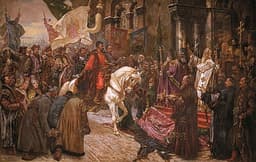
Bohdan Khmelnytsky
General · Modern
61.2Total

M. A. G. Osmani
General · Modern
58.1Total
Basic Information
Born
1595
1918
Died
1657
1984
Era
Modern
Modern
Nationality
Ukraine
Bangladesh
Occupation
General
General
Civilization
Western
Indian
Score Comparison
Military (10%)
61.7
65.0
Political (20%)
62.7
48.0
Influence (20%)
58.3
58.3
Legacy (20%)
52.0
52.0
Leadership (15%)
80.0
68.0
Strategy (15%)
60.7
66.3
TOTAL
61.2
58.1
Bohdan Khmelnytsky — Complete Timeline
1648 AD
Battle of Zhovti VodyWar◆ Major
Khmelnytsky's Cossack forces, allied with Crimean Tatars, defeated a Polish army at Zhovti Vody. This victory marked the beginning of the Khmelnytsky Uprising, leading to widespread rebellion across Ukraine.
BattleUprisingPoland
Impact: regional
Election as Hetman of the Zaporozhian HostPolitical Action◆ Major
Bohdan Khmelnytsky was elected Hetman of the Zaporozhian Cossacks at a council on the Dnieper River. This election formalized his leadership of the Cossack uprising against the Polish-Lithuanian Commonwealth.
ElectionCossackHetman
Impact: regionalconstructive
1649 AD
Siege of ZbarazhWar◆ Major
Khmelnytsky besieged the Polish fortress of Zbarazh for over six weeks. The siege ended with the Treaty of Zboriv, which granted autonomy to the Cossack Hetmanate but failed to achieve full independence.
SiegePolandTreaty
Impact: regional
1651 AD
Battle of BerestechkoWar◆ Major
Khmelnytsky's forces suffered a major defeat at Berestechko against the Polish army, with heavy Cossack casualties. This battle forced him to sign the unfavorable Treaty of Bila Tserkva, reducing Cossack autonomy.
BattleDefeatPoland
Impact: regionaltragic
1654 AD
Treaty of PereiaslavPolitical Action
Khmelnytsky signed the Treaty of Pereiaslav with Tsar Alexis of Russia, placing the Cossack Hetmanate under Russian protection. This treaty shifted Ukraine's allegiance from Poland to Russia, with lasting geopolitical consequences.
TreatyRussiaUkraine
Impact: regional
M. A. G. Osmani — Complete Timeline
1971 AD
Surrender of Pakistani ForcesWar◆ Major
On December 16, 1971, Osmani was present at the surrender of Pakistani forces in Dhaka. The surrender ended the Bangladesh Liberation War and established Bangladesh as an independent nation. Osmani's leadership was crucial to the military victory.
SurrenderIndependenceBangladesh
Impact: nationalconstructive
Appointment as Commander-in-Chief of Bangladesh ForcesPolitical Action
On April 17, 1971, Colonel M. A. G. Osmani was appointed Commander-in-Chief of the Bangladesh Liberation Forces. He organized and led the Mukti Bahini guerrilla forces against the Pakistan Army during the nine-month Bangladesh Liberation War.
Bangladesh Liberation WarMukti BahiniMilitary Command
Impact: nationalconstructive
1972 AD
Resignation from Bangladesh ArmyPolitical Action
After the war, Osmani resigned from the Bangladesh Army in 1972 due to disagreements with the government of Sheikh Mujibur Rahman over military policy and the treatment of freedom fighters. He later entered politics but remained a respected figure.
ResignationPoliticsBangladesh Army
Impact: national
This comparison has not been analyzed yet.
One-time AI generation (~1 minute). Scores and timeline are already available below.
Rankings
🥇
Bohdan KhmelnytskyLeader
Mil: 61.7Pol: 62.7Inf: 58.3
61.2
🥈
M. A. G. Osmani
Mil: 65.0Pol: 48.0Inf: 58.3
58.1
+3.1 behind
How This Comparison Works
Algorithm
Each figure is scored on 6 dimensions (0—100 scale) based on structured historical data: Military (10%), Political (20%), Influence (20%), Legacy (20%), Leadership (15%), Strategy (15%). The weighted total produces the final ranking.
Data Sources
Scores are computed from structured sub-indicators in the database. Scale factors adjust for era (Ancient ×0.85, Modern ×1.0) and civilization size (Eastern ×1.05, Other ×0.80) to account for differences in population and military scale.
Maximum 3 Figures
Comparisons are limited to 2—3 figures to ensure readability and statistical meaningfulness.
Error Margins
±5 points per dimension — Sub-scores are derived from historical records with inherent uncertainty. Two figures within 5 points on a dimension should be considered roughly equivalent in that area.
Total Score Accuracy
±3 points overall — The weighted combination of 6 dimensions produces a total score with approximately ±3 points of uncertainty. Differences of less than 3 points are not statistically significant— the figures are effectively tied.
Known Limitations
- Historical records are incomplete and uneven across civilizations
- Figures from oral-tradition societies may be underrepresented
- Occupation labels can misclassify multi-role figures
- Scores measure capability and impact, not moral character
- Quantitative scoring is a comparison tool, not absolute truth
Capability Radar
Military (10%) — Battles & Warfare
Battles
65
65
Win Rate
70
70
Expansion
60
50
Political (20%) — Governance & Reform
Reform
50
30
Diplomacy
60
55
Economy
45
20
Influence (20%) — Cultural & Global Reach
Cultural
60
60
Global
50
50
Legacy (20%) — Historical Impact
Historical
65
70
Longevity
55
55
Leadership (15%) — Power & Stability
Tenure
55
40
Stability
40
35
Strategy (15%) — Tactics & Innovation
Strategy
65
75
Tactics
60
60
Reform
55
80
Similar Comparisons
Comments & Discussion
No comments yet. Be the first to share your thoughts!