Loading...
Bohdan Khmelnytsky vs Julius Caesar
Julius Caesar leads by 21.6 pts · 2 figures compared
…
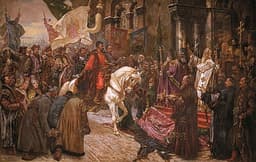
Bohdan Khmelnytsky
General · Modern
61.2Total

Julius Caesar
General · Ancient
82.8Total
Basic Information
Born
1595
-100
Died
1657
-44
Era
Modern
Ancient
Nationality
Ukraine
Roman Republic
Occupation
General
General
Civilization
Western
Western
Score Comparison
Military (10%)
61.7
88.0
Political (20%)
62.7
78.0
Influence (20%)
58.3
85.0
Legacy (20%)
52.0
82.0
Leadership (15%)
80.0
80.0
Strategy (15%)
60.7
85.0
TOTAL
61.2
82.8
Bohdan Khmelnytsky — Complete Timeline
1648 AD
Battle of Zhovti VodyWar◆ Major
Khmelnytsky's Cossack forces, allied with Crimean Tatars, defeated a Polish army at Zhovti Vody. This victory marked the beginning of the Khmelnytsky Uprising, leading to widespread rebellion across Ukraine.
BattleUprisingPoland
Impact: regional
Election as Hetman of the Zaporozhian HostPolitical Action◆ Major
Bohdan Khmelnytsky was elected Hetman of the Zaporozhian Cossacks at a council on the Dnieper River. This election formalized his leadership of the Cossack uprising against the Polish-Lithuanian Commonwealth.
ElectionCossackHetman
Impact: regionalconstructive
1649 AD
Siege of ZbarazhWar◆ Major
Khmelnytsky besieged the Polish fortress of Zbarazh for over six weeks. The siege ended with the Treaty of Zboriv, which granted autonomy to the Cossack Hetmanate but failed to achieve full independence.
SiegePolandTreaty
Impact: regional
1651 AD
Battle of BerestechkoWar◆ Major
Khmelnytsky's forces suffered a major defeat at Berestechko against the Polish army, with heavy Cossack casualties. This battle forced him to sign the unfavorable Treaty of Bila Tserkva, reducing Cossack autonomy.
BattleDefeatPoland
Impact: regionaltragic
1654 AD
Treaty of PereiaslavPolitical Action
Khmelnytsky signed the Treaty of Pereiaslav with Tsar Alexis of Russia, placing the Cossack Hetmanate under Russian protection. This treaty shifted Ukraine's allegiance from Poland to Russia, with lasting geopolitical consequences.
TreatyRussiaUkraine
Impact: regional
Julius Caesar — Complete Timeline
58 BC
Gallic WarsWar◆ Major
Caesar, as proconsul of Gaul, launched a series of campaigns that conquered all of Gaul (modern France, Belgium, and parts of Switzerland). He fought numerous battles, including against the Helvetii, the Belgae, and the Gallic chieftain Vercingetorix. The wars brought immense wealth and a loyal army to Caesar.
Gallic WarsConquestRoman Expansion
Impact: regional
49 BC
Crossing the RubiconPolitical Action◆ Major
Caesar led Legio XIII across the Rubicon River into Italy, defying the Roman Senate's order to disband his army. This act triggered a civil war against Pompey and the Optimates, ultimately leading to Caesar's dictatorship and the end of the Roman Republic.
Roman Civil WarEnd of RepublicPower Struggle
Impact: global
48 BC
Battle of PharsalusWar◆ Major
Caesar's outnumbered army defeated the larger forces of Pompey the Great at Pharsalus in Greece. Caesar's tactical use of a reserve line to counter Pompey's cavalry charge proved decisive. Pompey fled to Egypt, where he was assassinated, leaving Caesar as the undisputed master of the Roman world.
Roman Civil WarBattleDecisive Victory
Impact: regional
44 BC
Appointment as Dictator for LifePolitical Action◆ Major
The Roman Senate appointed Caesar dictator perpetuo (dictator for life), granting him unprecedented personal power. This move concentrated military, legislative, and judicial authority in one person, effectively ending the Roman Republic's traditional system of checks and balances and alarming many senators.
DictatorshipEnd of RepublicPower Consolidation
Impact: regionaldestructive
Assassination on the Ides of MarchPolitical Action◆ Major
A group of Roman senators, led by Marcus Junius Brutus and Gaius Cassius Longinus, stabbed Caesar to death at a meeting of the Senate in the Theatre of Pompey. The assassination was intended to restore the Republic, but instead triggered another civil war that led to the rise of the Roman Empire.
AssassinationRoman PoliticsEnd of Republic
Impact: globaldestructive
Expert Analysis
bohdan-khmelnytsky-vs-julius-caesar
### The Dictator and the Hetman: Two Paths to Power, Two Different Fates
On the banks of the Rubicon, a Roman general weighed a choice that would echo through millennia. On the banks of the Dnieper, a Cossack leader raised his mace to unite a people scattered by oppression. Both men—Julius Caesar and Bohdan Khmelnytsky—stood at the precipice of history, each driven by personal grievance and grand ambition. Yet their outcomes could not have been more different: one forged an empire and was deified; the other created a nation that would be devoured by the very ally he trusted. What explains the gulf between triumph and tragedy?
**Origins**
Caesar was born into the patrician *gens Julia*, a family claiming descent from the goddess Venus. His Rome was the undisputed master of the Mediterranean, a republic already creaking under the weight of its conquests. His education was aristocratic—rhetoric, philosophy, military theory—and his early life was a dance through debt and political intrigue. He was a man of the city, of the Senate, of the Forum.
Khmelnytsky emerged from the Ukrainian frontier, a world of steppe and fortress. Born a minor noble, he was educated at a Jesuit college in Lviv and served in the Polish-Lithuanian Commonwealth’s cavalry. His world was one of shifting loyalties: Cossack brotherhood, Polish magnates, Tatar raiders. Where Caesar’s Rome was a single, coherent state, Khmelnytsky’s Ukraine was a patchwork of contested borders and clashing faiths. The difference in their starting points was not merely geography—it was the difference between a civilization at its zenith and a people struggling to be born.
**Rise to Power**
Caesar’s ascent was a masterpiece of calculated risk. He climbed the *cursus honorum*—quaestor, aedile, praetor—spending fortunes on games and bribes. His break came in 60 BCE, when he formed the First Triumvirate with Pompey and Crassus. Then came Gaul: eight years of ruthless war that made him a military legend and, crucially, gave him a loyal army. When the Senate ordered him to disband, he crossed the Rubicon in 49 BCE, a deliberate act of rebellion that ignited civil war. His power was seized from a system he knew intimately.
Khmelnytsky’s rise was a reaction to personal catastrophe. In 1647, a Polish nobleman seized his estate and killed his son. When the Polish king refused justice, Khmelnytsky fled to the Zaporozhian Sich, the Cossack stronghold. There, his eloquence and military experience won him the hetman’s mace in 1648. Unlike Caesar, who manipulated an existing system, Khmelnytsky had to build his army from scratch, forging an alliance with the Crimean Tatars. His first victory at Zhovti Vody in 1648 was not a calculated step in a political game—it was a desperate strike against an empire that had stripped him of everything.
**Leadership & Governance**
Caesar governed as a master of propaganda and pragmatism. As dictator, he reformed the calendar, granted citizenship to provincials, and launched public works that employed the poor. His military genius was in speed and surprise—the siege of Alesia (52 BCE) remains a textbook example of double-envelopment. Yet his political wisdom had limits: he pardoned his enemies, but never disguised his contempt for the old oligarchy. “The Republic is nothing,” he reportedly said, “a mere name without body or form.” He ruled through personal authority, not institutional reform.
Khmelnytsky governed in constant crisis. After the 1648 revolt, he established the Cossack Hetmanate, a quasi-state ruled by a council of officers. He proved a skilled diplomat, negotiating treaties with Poland, the Ottoman Empire, and Muscovy. His military strategy was defensive and mobile—guerrilla warfare on horseback. But he lacked Caesar’s institutional vision. The Hetmanate had no fixed bureaucracy, no standing army beyond the Cossack host, and no clear succession. Every victory was temporary; every alliance, conditional.
**Triumph & Tragedy**
Caesar’s greatest moment was his triumph in 46 BCE, when he celebrated victories over Gaul, Egypt, and his Roman rivals. He was appointed dictator for life, his image stamped on coins, his name synonymous with power. His tragedy came on the Ides of March, 44 BCE, when sixty senators—men he had pardoned—stabbed him to death. He died not in battle, but in a theater of betrayal he helped create.
Khmelnytsky’s triumph was the Siege of Zbarazh in 1649, where his forces pinned down a Polish army for six weeks, forcing the Treaty of Zboriv that recognized Cossack autonomy. His tragedy was the Battle of Berestechko in 1651, where his army was crushed by Polish cavalry, the Tatar allies betraying him mid-battle. Desperate, he signed the Treaty of Pereiaslav in 1654, placing Ukraine under Russian protection. It was a decision born of exhaustion, not strength—and it would cost his people their sovereignty for centuries.
**Character & Destiny**
Caesar was a gambler who believed in his own star. He wrote his own commentaries, controlled his own narrative, and died with his boots on. His personality—arrogant, generous, relentless—shaped a destiny that ended the Republic. As the historian Suetonius noted, he often said, “The die is cast.” He never looked back.
Khmelnytsky was a man of fury and grief. His revolt was ignited by a personal wrong, and his decisions were haunted by the need for security. He trusted the Tsar because he had no other option. His destiny was to create a nation he could not defend. Where Caesar died as a tyrant, Khmelnytsky died in 1657 as a hetman whose state was already slipping into vassalage.
**Legacy**
Caesar’s name became a title—Kaiser, Tsar—and his reforms laid the foundation for the Roman Empire. He is remembered as a military genius and a cautionary tale about ambition. His assassination did not save the Republic; it hastened its end.
Khmelnytsky is remembered as the father of Ukrainian statehood. His uprising broke the Polish grip on Ukraine and gave birth to a national consciousness. But his legacy is ambiguous: the Treaty of Pereiaslav is celebrated by some as a union of brothers, condemned by others as a fatal submission. He is a hero with a wound that never healed.
**Conclusion**
Caesar and Khmelnytsky both stood at the crossroads of history. One built an empire that lasted a thousand years; the other sparked a nation that still fights for its soul. Their differences are not merely personal—they are the difference between a man who could seize a system and a man who had to invent one. Caesar’s tragedy was that he destroyed the world he mastered. Khmelnytsky’s tragedy was that he could not build the world he imagined. Both remind us that power, in the end, is not just about victory—it is about what survives when the battle is over.
Rankings
🥇
Julius CaesarLeader
Mil: 88.0Pol: 78.0Inf: 85.0
82.8
🥈
Bohdan Khmelnytsky
Mil: 61.7Pol: 62.7Inf: 58.3
61.2
+21.6 behind
How This Comparison Works
Algorithm
Each figure is scored on 6 dimensions (0—100 scale) based on structured historical data: Military (10%), Political (20%), Influence (20%), Legacy (20%), Leadership (15%), Strategy (15%). The weighted total produces the final ranking.
Data Sources
Scores are computed from structured sub-indicators in the database. Scale factors adjust for era (Ancient ×0.85, Modern ×1.0) and civilization size (Eastern ×1.05, Other ×0.80) to account for differences in population and military scale.
Maximum 3 Figures
Comparisons are limited to 2—3 figures to ensure readability and statistical meaningfulness.
Error Margins
±5 points per dimension — Sub-scores are derived from historical records with inherent uncertainty. Two figures within 5 points on a dimension should be considered roughly equivalent in that area.
Total Score Accuracy
±3 points overall — The weighted combination of 6 dimensions produces a total score with approximately ±3 points of uncertainty. Differences of less than 3 points are not statistically significant— the figures are effectively tied.
Known Limitations
- Historical records are incomplete and uneven across civilizations
- Figures from oral-tradition societies may be underrepresented
- Occupation labels can misclassify multi-role figures
- Scores measure capability and impact, not moral character
- Quantitative scoring is a comparison tool, not absolute truth
Capability Radar
Military (10%) — Battles & Warfare
Battles
65
95
Win Rate
70
92
Expansion
60
97
Political (20%) — Governance & Reform
Reform
50
90
Diplomacy
60
85
Economy
45
82
Influence (20%) — Cultural & Global Reach
Cultural
60
88
Global
50
94
Legacy (20%) — Historical Impact
Historical
65
95
Longevity
55
96
Leadership (15%) — Power & Stability
Tenure
55
75
Stability
40
60
Strategy (15%) — Tactics & Innovation
Strategy
65
94
Tactics
60
96
Reform
55
88
Similar Comparisons
Comments & Discussion
SCEPTRED-AGED6/17/2026
As a military historian, this comparison glorifies Caesar unnecessarily. Caesar's campaigns were logistical masterpieces against fragmented tribes and stationary armies—predictable opponents. Khmelnytsky faced a mobile, multi-ethnic siege: Poles, Tatars, Lithuanian magnates. In 1648, his Zaporozhian Cossacks, heavily outnumbered, crushed the Polish crown army at Zhovti Vody using guerrilla tactics and steppe warfare. Caesar never fought such a complex asymmetrical war. The Rubicon was a dry rive
赫赫鞭者6/17/2026
军事史角度就是个异端,拿凯撒和赫梅利尼茨基比,这简直是自焚祭品式比较。凯撒的征服是建立在熟读兵书的等级制文明基础上,而赫梅利尼茨基面对的是波兰-立陶宛联邦的层层迫害和鞑靼人的暗箭。1648年,他带着五千哥萨克硬撼波兰两万精锐,利沃夫城下那场仗,哥萨克把波兰军官的眼珠当勋章。凯撒可没这个胆量,他只会在元老院里搞刺字。
河山旧吏6/17/2026
共和国之死与哥萨克溃散,其实是同一种命运:权力的个人化。凯撒跨卢比孔河时就想要终身独裁,赫梅利尼茨基1654年签《佩列亚斯拉夫协议》时认为找到了守护者,却不知俄罗斯沙皇和古罗马元老院一样虚伪。凯撒被刺杀在元老院,赫梅利尼茨基被自己的盟友帝国毒死了灵魂。两个野心家,一个死得壮烈,一个活得憋屈,历史给了他们同样的墓碑:“权力只能独自享用,不能共享”。