Loading...
Bohdan Khmelnytsky vs Hermann von Wissmann
Bohdan Khmelnytsky leads by 17.3 pts · 2 figures compared
…
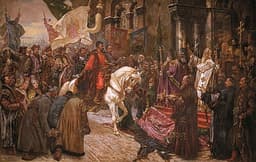
Bohdan Khmelnytsky
General · Modern
61.2Total

Hermann von Wissmann
General · Modern
43.9Total
Basic Information
Born
1595
1853
Died
1657
1905
Era
Modern
Modern
Nationality
Ukraine
Germany
Occupation
General
General
Civilization
Western
Western
Score Comparison
Military (10%)
61.7
30.0
Political (20%)
62.7
35.1
Influence (20%)
58.3
56.4
Legacy (20%)
52.0
43.3
Leadership (15%)
80.0
43.8
Strategy (15%)
60.7
41.7
TOTAL
61.2
43.9
Bohdan Khmelnytsky — Complete Timeline
1648 AD
Battle of Zhovti VodyWar◆ Major
Khmelnytsky's Cossack forces, allied with Crimean Tatars, defeated a Polish army at Zhovti Vody. This victory marked the beginning of the Khmelnytsky Uprising, leading to widespread rebellion across Ukraine.
BattleUprisingPoland
Impact: regional
Election as Hetman of the Zaporozhian HostPolitical Action◆ Major
Bohdan Khmelnytsky was elected Hetman of the Zaporozhian Cossacks at a council on the Dnieper River. This election formalized his leadership of the Cossack uprising against the Polish-Lithuanian Commonwealth.
ElectionCossackHetman
Impact: regionalconstructive
1649 AD
Siege of ZbarazhWar◆ Major
Khmelnytsky besieged the Polish fortress of Zbarazh for over six weeks. The siege ended with the Treaty of Zboriv, which granted autonomy to the Cossack Hetmanate but failed to achieve full independence.
SiegePolandTreaty
Impact: regional
1651 AD
Battle of BerestechkoWar◆ Major
Khmelnytsky's forces suffered a major defeat at Berestechko against the Polish army, with heavy Cossack casualties. This battle forced him to sign the unfavorable Treaty of Bila Tserkva, reducing Cossack autonomy.
BattleDefeatPoland
Impact: regionaltragic
1654 AD
Treaty of PereiaslavPolitical Action
Khmelnytsky signed the Treaty of Pereiaslav with Tsar Alexis of Russia, placing the Cossack Hetmanate under Russian protection. This treaty shifted Ukraine's allegiance from Poland to Russia, with lasting geopolitical consequences.
TreatyRussiaUkraine
Impact: regional
Hermann von Wissmann — Complete Timeline
1880 AD
Exploration of the Congo BasinOther◆ Major
Wissmann led an expedition across central Africa from the west coast to the east coast, crossing the Congo Basin. He mapped large areas of the Kasai River region and collected scientific data on geography and ethnography.
ExplorationAfricaCongo
Impact: regional
1889 AD
Suppressed the Abushiri RevoltWar◆ Major
Wissmann was appointed Reichskommissar and led a military campaign to suppress the Abushiri Revolt against German rule in East Africa. He used a force of African soldiers (askaris) and German officers to defeat the rebels, securing German control.
Colonial WarEast AfricaRevolt
Impact: regionaldestructive
1895 AD
Appointed Governor of German East AfricaPolitical Action◆ Major
Wissmann was appointed Governor of German East Africa, the highest colonial authority in the territory. He implemented administrative reforms, expanded infrastructure, and continued military campaigns to pacify the colony.
ColonialismAdministrationEast Africa
Impact: regional
Expert Analysis
Origins
Bohdan Khmelnytsky was born in 1595 into a Ukrainian noble family in Subotiv, near Chyhyryn. He was educated at the Jesuit Collegium in Lviv and served in the Polish-Lithuanian Commonwealth's military. His early career included participation in the 1620 Battle of Cecora against the Ottomans, where he was captured and held for two years. After his release, he became a registered Cossack and later a senior officer (sotnyk) in the Chyhyryn regiment. His personal conflict with the local Polish magnate, Daniel Czapliński, who seized his estate and killed his son, became a catalyst for his later uprising.
Hermann von Wissmann was born on September 4, 1853, in Frankfurt an der Oder, Prussia. He studied at the University of Göttingen and later joined the Prussian Army, serving as a lieutenant in the 2nd Guards Regiment. In 1880, he was recruited by the German Africa Society to explore central Africa. His early expeditions (1880-1887) took him across the Congo Basin, where he mapped the Kasai River and established contacts with local rulers. These experiences shaped his future role as a colonial administrator.
Rise to Power
Khmelnytsky's rise began in 1648 when he was elected Hetman of the Zaporozhian Host at a council on the Dnieper River. He had previously attempted to seek justice from King Władysław IV of Poland for his grievances, but failed. After forming an alliance with the Crimean Tatars, he led a series of victories against Polish forces: the Battle of Zhovti Vody (May 1648), the Battle of Korsuń (May 1648), and the Battle of Pyliavtsi (September 1648). By the end of 1648, he controlled most of Ukraine. His military score of 61.7 reflects his tactical successes, though his reliance on Tatar support was a strategic weakness.
Wissmann's rise came from his exploration achievements and colonial service. In 1888, the German colonial administration appointed him Reichskommissar for East Africa to suppress the Abushiri Revolt (1888-1889). He raised a force of African mercenaries, German officers, and Sudanese soldiers, and used modern weapons to defeat the rebels. His success led to his appointment as Governor of German East Africa in 1890. He held this position until 1895, implementing administrative reforms and expanding German control inland. His political score of 35.1 reflects his limited authority as a colonial governor subordinate to Berlin.
Leadership & Governance
Khmelnytsky's leadership style was charismatic and military-focused. He governed the Cossack Hetmanate as a de facto state, issuing decrees (universals) and maintaining a council (rada) of Cossack elders. His key governance act was the Treaty of Pereiaslav (1654), which placed the Hetmanate under the protection of Tsar Alexis of Russia. This treaty secured military support against Poland but also began Ukraine's subordination to Moscow. Khmelnytsky's leadership score of 80.0 indicates his ability to mobilize diverse groups, but his political score of 62.7 shows the limitations of his state-building.
Wissmann governed German East Africa with a focus on economic exploitation and military control. He established a system of forts, promoted plantation agriculture (especially cotton and coffee), and suppressed resistance. His administration faced criticism for harsh treatment of Africans, including forced labor. He also explored and mapped the interior, contributing to geographical knowledge but at the cost of local autonomy. His strategy score of 41.7 reflects his reliance on military force rather than diplomatic integration.
Triumph & Tragedy
Khmelnytsky's greatest triumph was the creation of an independent Cossack state, recognized by the Treaty of Zboriv (1649), which granted autonomy to the Cossack Hetmanate. His greatest failure was the Battle of Berestechko (1651), where his forces suffered a catastrophic defeat due to Tatar betrayal, leading to the harsh Treaty of Bila Tserkva. His later alliance with Russia also proved tragic, as it led to the gradual erosion of Ukrainian autonomy. His legacy score of 52.0 reflects his mixed long-term impact.
Wissmann's triumph was the suppression of the Abushiri Revolt, which secured German control over coastal East Africa and allowed for further colonization. His expeditions also contributed to European knowledge of central Africa. His tragedy was the violent nature of his campaigns, including the destruction of local economies and loss of life. He also failed to establish sustainable governance, as German East Africa faced continued uprisings after his tenure. His influence score of 56.4 is higher than his other scores due to his exploration legacy.
Character & Destiny
Khmelnytsky was driven by personal vengeance and a desire for Ukrainian autonomy. His character was marked by pragmatism, as shown by his alliances with Tatars and Russians, but also by a short temper that led to hasty decisions. His destiny was tied to the geopolitical struggle between Poland, Russia, and the Ottoman Empire. He died in 1657 from a stroke, possibly exacerbated by stress and illness. Historians view him as a national hero in Ukraine but also as a figure who inadvertently facilitated Russian domination.
Wissmann was a product of European colonialism: ambitious, methodical, and ethnocentric. His character was typical of the 'explorer-administrator' archetype, valuing order and economic exploitation over indigenous rights. His destiny was to be a tool of German imperialism, and he died in 1905 in relative obscurity. His legacy is contested: some see him as a pioneer of African exploration, others as a brutal colonizer.
Legacy
Khmelnytsky's legacy is immense in Ukrainian national identity. He is celebrated as the founder of the Cossack Hetmanate and a symbol of resistance. However, his alliance with Russia is criticized for leading to the loss of Ukrainian independence. The Treaty of Pereiaslav remains a controversial event. His military and political scores (61.7 and 62.7) reflect his role in shaping Eastern European history.
Wissmann's legacy is primarily in German colonial history. Several places were named after him (e.g., Wissmann Bay, Wissmann Street) but many were renamed after decolonization. His exploration maps are still used, but his methods are condemned. His total score of 43.9 places him far below Khmelnytsky, reflecting his narrower impact.
Conclusion
Bohdan Khmelnytsky had a greater historical impact than Hermann von Wissmann. With a total score of 61.2 against 43.9, Khmelnytsky's influence on the formation of modern Ukraine and his role in the geopolitical shift of Eastern Europe outweigh Wissmann's colonial administration. Khmelnytsky's actions directly affected the fate of millions and created a national narrative that persists today. Wissmann, while notable in German colonialism, operated within a system of European domination that was already in place. Khmelnytsky's leadership score of 80.0 and strategy score of 60.7 further underscore his superior capabilities. Thus, Khmelnytsky emerges as the more significant historical figure.
Rankings
🥇
Bohdan KhmelnytskyLeader
Mil: 61.7Pol: 62.7Inf: 58.3
61.2
🥈
Hermann von Wissmann
Mil: 30.0Pol: 35.1Inf: 56.4
43.9
+17.3 behind
How This Comparison Works
Algorithm
Each figure is scored on 6 dimensions (0—100 scale) based on structured historical data: Military (10%), Political (20%), Influence (20%), Legacy (20%), Leadership (15%), Strategy (15%). The weighted total produces the final ranking.
Data Sources
Scores are computed from structured sub-indicators in the database. Scale factors adjust for era (Ancient ×0.85, Modern ×1.0) and civilization size (Eastern ×1.05, Other ×0.80) to account for differences in population and military scale.
Maximum 3 Figures
Comparisons are limited to 2—3 figures to ensure readability and statistical meaningfulness.
Error Margins
±5 points per dimension — Sub-scores are derived from historical records with inherent uncertainty. Two figures within 5 points on a dimension should be considered roughly equivalent in that area.
Total Score Accuracy
±3 points overall — The weighted combination of 6 dimensions produces a total score with approximately ±3 points of uncertainty. Differences of less than 3 points are not statistically significant— the figures are effectively tied.
Known Limitations
- Historical records are incomplete and uneven across civilizations
- Figures from oral-tradition societies may be underrepresented
- Occupation labels can misclassify multi-role figures
- Scores measure capability and impact, not moral character
- Quantitative scoring is a comparison tool, not absolute truth
Capability Radar
Military (10%) — Battles & Warfare
Battles
65
35
Win Rate
70
40
Expansion
60
45
Political (20%) — Governance & Reform
Reform
50
25
Diplomacy
60
20
Economy
45
15
Influence (20%) — Cultural & Global Reach
Cultural
60
20
Global
50
20
Legacy (20%) — Historical Impact
Historical
65
25
Longevity
55
15
Leadership (15%) — Power & Stability
Tenure
55
30
Stability
40
10
Strategy (15%) — Tactics & Innovation
Strategy
65
25
Tactics
60
30
Reform
55
20
Similar Comparisons
Comments & Discussion
No comments yet. Be the first to share your thoughts!