Loading...
Bohdan Khmelnytsky vs Chung Il-kwon
Bohdan Khmelnytsky leads by 7.1 pts · 2 figures compared
…
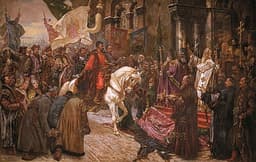
Bohdan Khmelnytsky
General · Modern
61.2Total

Chung Il-kwon
General · Modern
54.1Total
Basic Information
Born
1595
1917
Died
1657
1994
Era
Modern
Modern
Nationality
Ukraine
South Korea
Occupation
General
General
Civilization
Western
Eastern
Score Comparison
Military (10%)
61.7
40.0
Political (20%)
62.7
68.0
Influence (20%)
58.3
51.0
Legacy (20%)
52.0
43.3
Leadership (15%)
80.0
80.0
Strategy (15%)
60.7
43.3
TOTAL
61.2
54.1
Bohdan Khmelnytsky — Complete Timeline
1648 AD
Battle of Zhovti VodyWar◆ Major
Khmelnytsky's Cossack forces, allied with Crimean Tatars, defeated a Polish army at Zhovti Vody. This victory marked the beginning of the Khmelnytsky Uprising, leading to widespread rebellion across Ukraine.
BattleUprisingPoland
Impact: regional
Election as Hetman of the Zaporozhian HostPolitical Action◆ Major
Bohdan Khmelnytsky was elected Hetman of the Zaporozhian Cossacks at a council on the Dnieper River. This election formalized his leadership of the Cossack uprising against the Polish-Lithuanian Commonwealth.
ElectionCossackHetman
Impact: regionalconstructive
1649 AD
Siege of ZbarazhWar◆ Major
Khmelnytsky besieged the Polish fortress of Zbarazh for over six weeks. The siege ended with the Treaty of Zboriv, which granted autonomy to the Cossack Hetmanate but failed to achieve full independence.
SiegePolandTreaty
Impact: regional
1651 AD
Battle of BerestechkoWar◆ Major
Khmelnytsky's forces suffered a major defeat at Berestechko against the Polish army, with heavy Cossack casualties. This battle forced him to sign the unfavorable Treaty of Bila Tserkva, reducing Cossack autonomy.
BattleDefeatPoland
Impact: regionaltragic
1654 AD
Treaty of PereiaslavPolitical Action
Khmelnytsky signed the Treaty of Pereiaslav with Tsar Alexis of Russia, placing the Cossack Hetmanate under Russian protection. This treaty shifted Ukraine's allegiance from Poland to Russia, with lasting geopolitical consequences.
TreatyRussiaUkraine
Impact: regional
Chung Il-kwon — Complete Timeline
1940 AD
Served as an officer in the Manchukuo Imperial ArmyWar◆ Major
Chung Il-kwon graduated from the Japanese Military Academy and served as an officer in the Manchukuo Imperial Army. He fought in the Second Sino-Japanese War, gaining military experience under Japanese command.
World War IIManchukuoMilitary Service
Impact: regional
1946 AD
Defected to South Korea and joined the ROK ArmyPolitical Action◆ Major
After Japan's defeat, Chung Il-kwon defected to South Korea and joined the Republic of Korea Army. He was among the first Korean officers to be trained by the U.S. military, rising quickly through the ranks.
Korean ArmyDefectionPost-War
Impact: nationalconstructive
1950 AD
Commanded the ROK 3rd Division during the Korean WarWar◆ Major
As commander of the ROK 3rd Division, Chung Il-kwon led his troops in the defense of the Pusan Perimeter and later in the UN counteroffensive. His division recaptured Seoul in September 1950, a key victory in the war.
Korean WarPusan PerimeterSeoul
Impact: regional
1964 AD
Served as Prime Minister of South KoreaPolitical Action◆ Major
Chung Il-kwon served as Prime Minister of South Korea from 1964 to 1970 under President Park Chung-hee. He oversaw economic development and administrative reforms during a period of rapid industrialization.
Korean PoliticsEconomic DevelopmentPrime Minister
Impact: nationalconstructive
Expert Analysis
Origins
Bohdan Khmelnytsky was born in 1595 into a Ukrainian noble family (szlachta) in Subotiv. He was educated at the Jesuit college in Lviv and later served in the Polish-Lithuanian Commonwealth's military. His father was killed in the Battle of Cecora (1620), and Khmelnytsky himself was captured and spent two years in Ottoman captivity. This experience, along with personal grievances against Polish magnates, fueled his later rebellion.
Chung Il-kwon was born in 1917 in Ulsan, Korea, during Japanese colonial rule. He graduated from the Japanese Military Academy in 1939 and served as an officer in the Manchukuo Imperial Army, fighting in the Second Sino-Japanese War. After Japan's defeat in 1945, he defected to South Korea and joined the Republic of Korea Army (ROKA). His background in Japanese military training shaped his command style.
Rise to Power
Khmelnytsky's rise began in 1647 when a Polish official seized his estate and killed his son. He fled to the Zaporozhian Sich, where he was elected hetman in 1648. He forged an alliance with the Crimean Tatars and launched the Khmelnytsky Uprising. The first major victory at the Battle of Zhovti Vody (1648) saw Cossack-Tatar forces defeat a Polish army, establishing Khmelnytsky as a leader. Subsequent victories at Korsuń and Pyliavtsi expanded his control over much of Ukraine.
Chung Il-kwon rose after the Korean War began in 1950. Initially a colonel, he commanded the ROK 3rd Division during the defense of the Pusan Perimeter. His division held key positions against North Korean assaults. During the UN counteroffensive, his troops advanced into North Korea. After the war, he served as Army Chief of Staff from 1954 to 1956 and later as Prime Minister from 1964 to 1970 under President Park Chung-hee.
Leadership & Governance
Khmelnytsky's leadership score of 80.0 reflects his ability to unite disparate Cossack groups and forge alliances with the Crimean Khanate and later Tsarist Russia. However, his political score of 62.7 indicates challenges in governance. He established the Cossack Hetmanate, a quasi-state with a military-administrative structure. The Treaty of Pereiaslav (1654) placed the Hetmanate under Russian protection, a move that ultimately led to the erosion of Ukrainian autonomy. His governance relied on a council of officers (starshina) but struggled with internal dissent.
Chung Il-kwon's political score of 68.0 is higher than his military score of 40.0. As Prime Minister, he oversaw economic development plans under Park's authoritarian regime. His governance focused on industrialization and infrastructure, but he operated within a repressive political system. His leadership style was authoritarian, reflecting his military background. He had no significant political reforms to his name.
Triumph & Tragedy
Khmelnytsky's greatest success was the creation of the Cossack Hetmanate, which became a symbol of Ukrainian statehood. His military campaigns, scoring 61.7, included victories like the Siege of Zbarazh (1649) and the Battle of Batih (1652). However, his major defeat at Berestechko (1651) forced the Treaty of Bila Tserkva, which reduced Cossack autonomy. His decision to ally with Russia at Pereiaslav is often seen as a tragedy, as it led to the gradual absorption of Ukraine into the Russian Empire.
Chung Il-kwon's triumph was commanding the ROK 3rd Division during the Korean War, contributing to the defense of South Korea. His division's performance at the Pusan Perimeter was notable. However, his military score of 40.0 reflects limited strategic impact. His service in the Manchukuo Imperial Army is a controversial aspect of his career, seen as collaboration with Japanese imperialism. As Prime Minister, he was part of a regime that suppressed democratic movements.
Character & Destiny
Khmelnytsky was characterized by ambition and strategic acumen, but also by a temper and a tendency to overreach. His personal grievances against the Polish nobility drove his rebellion. His decision to ally with Russia was pragmatic but short-sighted. Historians note that he lacked a long-term vision for Ukrainian independence. He died in 1657 from a stroke, leaving a succession crisis.
Chung Il-kwon was disciplined and authoritarian, shaped by Japanese military training. His defection to South Korea showed adaptability. He was loyal to President Park and played a role in the authoritarian governance of the 1960s. His legacy is mixed: he is remembered as a war hero by some but criticized for his colonial past and political role.
Legacy
Khmelnytsky's legacy score of 52.0 reflects his enduring symbol as a national hero in Ukraine. The Khmelnytsky Uprising transformed Ukrainian society, eliminating Polish influence and establishing a Cossack identity. However, his alliance with Russia set the stage for centuries of Russian domination. In modern Ukraine, he is commemorated with statues and a city named after him.
Chung Il-kwon's legacy score of 43.3 is lower. He is remembered as a Korean War commander and a prime minister during economic growth. However, his collaboration with Japan tarnishes his reputation. He is not widely celebrated in South Korea compared to other figures like General Paik Sun-yup.
Conclusion
Bohdan Khmelnytsky had a greater historical impact than Chung Il-kwon. Despite a lower total score of 61.2 vs 54.1, Khmelnytsky's actions fundamentally altered the course of Eastern European history. The Cossack Hetmanate he founded became a cornerstone of Ukrainian national identity, and his uprising reshaped the power dynamics between Poland, Russia, and the Ottoman Empire. Chung Il-kwon, while contributing to South Korea's survival in the Korean War and its economic development, operated within a larger framework and did not create enduring institutions. Khmelnytsky's influence on Ukrainian statehood and identity outweighs Chung Il-kwon's more localized and transitory impact.
Rankings
🥇
Bohdan KhmelnytskyLeader
Mil: 61.7Pol: 62.7Inf: 58.3
61.2
🥈
Chung Il-kwon
Mil: 40.0Pol: 68.0Inf: 51.0
54.1
+7.1 behind
How This Comparison Works
Algorithm
Each figure is scored on 6 dimensions (0—100 scale) based on structured historical data: Military (10%), Political (20%), Influence (20%), Legacy (20%), Leadership (15%), Strategy (15%). The weighted total produces the final ranking.
Data Sources
Scores are computed from structured sub-indicators in the database. Scale factors adjust for era (Ancient ×0.85, Modern ×1.0) and civilization size (Eastern ×1.05, Other ×0.80) to account for differences in population and military scale.
Maximum 3 Figures
Comparisons are limited to 2—3 figures to ensure readability and statistical meaningfulness.
Error Margins
±5 points per dimension — Sub-scores are derived from historical records with inherent uncertainty. Two figures within 5 points on a dimension should be considered roughly equivalent in that area.
Total Score Accuracy
±3 points overall — The weighted combination of 6 dimensions produces a total score with approximately ±3 points of uncertainty. Differences of less than 3 points are not statistically significant— the figures are effectively tied.
Known Limitations
- Historical records are incomplete and uneven across civilizations
- Figures from oral-tradition societies may be underrepresented
- Occupation labels can misclassify multi-role figures
- Scores measure capability and impact, not moral character
- Quantitative scoring is a comparison tool, not absolute truth
Capability Radar
Military (10%) — Battles & Warfare
Battles
65
35
Win Rate
70
40
Expansion
60
25
Political (20%) — Governance & Reform
Reform
50
40
Diplomacy
60
45
Economy
45
35
Influence (20%) — Cultural & Global Reach
Cultural
60
20
Global
50
15
Legacy (20%) — Historical Impact
Historical
65
30
Longevity
55
20
Leadership (15%) — Power & Stability
Tenure
55
55
Stability
40
40
Strategy (15%) — Tactics & Innovation
Strategy
65
30
Tactics
60
30
Reform
55
20
Similar Comparisons
Comments & Discussion
No comments yet. Be the first to share your thoughts!