Loading...
Berengar II vs Urus Khan
Urus Khan leads by 2.8 pts · 2 figures compared
…
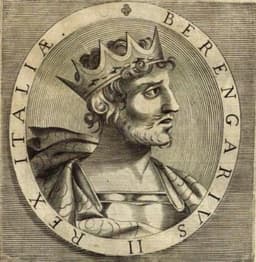
Berengar II
Emperor · Medieval
42.9Total
Urus Khan
Emperor · Medieval
45.7Total
Basic Information
Born
900
1340
Died
966
1377
Era
Medieval
Medieval
Nationality
Italy
Golden Horde
Occupation
Emperor
Emperor
Civilization
Western
Eastern
Score Comparison
Military (10%)
45.0
50.0
Political (20%)
30.8
35.1
Influence (20%)
49.4
48.6
Legacy (20%)
39.2
40.0
Leadership (15%)
51.9
48.4
Strategy (15%)
38.3
60.0
TOTAL
42.9
45.7
Berengar II — Complete Timeline
950 AD
Crowned King of ItalyPolitical Action◆ Major
Berengar II was crowned King of Italy in Pavia after the death of Lothair II. His rule was contested by the German king Otto I, who claimed the Italian throne through his marriage to Lothair's widow, Adelaide.
CoronationItalyKingship
Impact: regional
955 AD
Defeated by Otto I at the Battle of the LechfeldWar
Berengar II was defeated by Otto I at the Battle of the Lechfeld, where Otto also crushed the Magyars. This defeat forced Berengar to submit to Otto's suzerainty, reducing him to a vassal and ending independent Italian rule.
BattleOtto ISubmission
Impact: regionaltragic
962 AD
Rebellion against Otto IWar
Berengar II rebelled against Otto I's authority, attempting to regain full control of Italy. The rebellion failed, leading to Otto's second invasion of Italy and Berengar's eventual capture, solidifying Otto's control over the kingdom.
RebellionOtto IItaly
Impact: regionaldestructive
963 AD
Imprisonment by Otto IOther◆ Major
After a failed rebellion, Berengar II was captured by Otto I and imprisoned in Bamberg, Germany. He died in captivity in 966, marking the end of the independent Lombard kingdom of Italy and the beginning of direct German rule.
ImprisonmentItalyEnd of Independence
Impact: regionaltragic
Urus Khan — Complete Timeline
1376 AD
Conflict with TokhtamyshWar◆ Major
Urus Khan, ruler of the Blue Horde, fought against Tokhtamysh, a claimant to the Golden Horde throne. Tokhtamysh, supported by Tamerlane, challenged Urus Khan's authority, leading to military engagements that weakened Urus Khan's position.
Golden HordeCivil WarTokhtamysh
Impact: regionaldestructive
1377 AD
Death in battleWar◆ Major
Urus Khan died in battle against Tokhtamysh's forces. His death marked the end of his rule over the Blue Horde and allowed Tokhtamysh to consolidate power, eventually reuniting the Golden Horde under his leadership.
Golden HordeDeathTokhtamysh
Impact: regionaltragic
Expert Analysis
Origins
Berengar II was born around 900 into the Ivrea dynasty, a powerful noble family in northern Italy. His father, Adalbert I of Ivrea, was a margrave, and his mother, Gisela of Friuli, was a descendant of Charlemagne. Berengar grew up amid the fractious politics of post-Carolingian Italy, where local lords vied for the throne. He inherited the March of Ivrea in 923 and quickly became a key player in the kingdom's power struggles.
Urus Khan, also known as Urus, was born around 1300 into the Jochid dynasty, the ruling family of the Golden Horde. He was a descendant of Genghis Khan through his eldest son Jochi. Little is known about his early life, but he emerged as a leader of the Blue Horde, the eastern wing of the Golden Horde, during a period of fragmentation and civil war. His upbringing was shaped by the nomadic steppe traditions and the complex politics of the Mongol successor states.
Rise to Power
Berengar II's rise began after the death of King Hugh of Italy in 947. Hugh's son Lothair II took the throne but died in 950, leaving a power vacuum. Berengar, already a powerful magnate, seized the opportunity and was crowned King of Italy in Pavia in 950. He immediately faced challenges from rival nobles and the German king Otto I, who claimed Italy through his wife Adelaide, Lothair's widow. Berengar's coronation was a turning point, but his authority was never secure.
Urus Khan rose to power as the khan of the Blue Horde in the 1360s, following the death of Khan Jani Beg and the ensuing chaos. The Golden Horde was split into several factions, and Urus asserted his rule over the eastern territories. His key turning point came when he faced Tokhtamysh, a rival claimant who sought to reunite the Horde. Urus initially held his ground, but his inability to eliminate Tokhtamysh, who was backed by Tamerlane, ultimately led to his downfall.
Leadership & Governance
Berengar II's leadership style was marked by opportunism and a reliance on feudal alliances. He attempted to consolidate his rule by marrying his son Adalbert to a Byzantine princess and by negotiating with the papacy. However, his governance was weak: he failed to build a broad coalition, alienated the powerful bishop of Milan, and could not mount effective resistance against Otto I. His military score of 45.0 reflects his inability to command decisive victories, while his political score of 30.8 indicates poor strategic alliances.
Urus Khan governed the Blue Horde through traditional Mongol institutions, relying on tribal loyalty and military strength. He maintained control over the steppe nomads but struggled to project power beyond his core territories. His political score of 35.1 is slightly higher than Berengar's, but his military score of 50.0 shows he was a competent battlefield commander. However, his strategy score of 60.0 suggests he was adept at planning, yet his conflict with Tokhtamysh ended in defeat due to external intervention.
Triumph & Tragedy
Berengar II's greatest success was becoming king of Italy and briefly reviving the independence of the Italian kingdom. He managed to hold power for over a decade despite internal and external pressures. His greatest failure was his defeat by Otto I at the Battle of the Lechfeld in 955, where Otto also crushed the Magyars. This battle forced Berengar to submit to Otto, and a subsequent rebellion led to his capture in 963. He died in prison in Bamberg in 966, ending the last independent Italian kingdom before the Holy Roman Empire.
Urus Khan's triumph was his consolidation of the Blue Horde and his resistance against Tokhtamysh for several years. He successfully defended his realm and even launched campaigns against his rivals. His tragedy was his death in battle against Tokhtamysh's forces, which allowed Tokhtamysh to unite the Golden Horde and challenge Tamerlane. Urus's legacy was overshadowed by his more successful adversary, and his death marked the end of Blue Horde independence.
Character & Destiny
Berengar II was ambitious but politically inept. He repeatedly overestimated his own strength and underestimated Otto I. His decision to rebel after submitting to Otto was a strategic blunder that cost him his freedom. Historical assessments depict him as a capable local lord who lacked the vision and resources to compete with a rising imperial power. His leadership score of 51.9 is average, reflecting his inability to inspire loyalty or execute a coherent strategy.
Urus Khan was a determined steppe warrior, stubborn in his refusal to compromise with Tokhtamysh. His character was shaped by the Mongol tradition of khans ruling by force, but he failed to secure the support of Tamerlane, who backed his enemy. His death in battle shows a willingness to fight, but his strategic score of 60.0 could not overcome the combination of Tokhtamysh's ambition and Tamerlane's intervention. Historians see him as a figure who resisted the reunification of the Golden Horde but ultimately fell to a more dynamic rival.
Legacy
Berengar II's legacy is minimal: he is remembered as the last independent king of Italy before the Ottonian takeover. His defeat paved the way for Otto I to be crowned Holy Roman Emperor in 962, reshaping European politics. His influence score of 49.4 is modest; his actions had limited long-term impact beyond Italy. The institution of the Italian kingdom was absorbed into the empire, and Berengar's name survives mainly in historical footnotes.
Urus Khan's legacy is slightly more significant. He is considered a key figure in the history of the Golden Horde, representing the Blue Horde's resistance to centralization. His conflict with Tokhtamysh was part of the larger struggle that led to the Horde's eventual decline. His influence score of 48.6 is comparable to Berengar's, but his strategic score of 60.0 indicates his military planning was notable. However, his overall total score of 45.7 is only 2.8 points higher than Berengar's 42.9.
Conclusion
Between Berengar II and Urus Khan, Urus Khan had a slightly greater impact, as reflected in his higher total score of 45.7 versus 42.9. While both were ultimately unsuccessful rulers who lost to more powerful adversaries, Urus Khan's role in the internal dynamics of the Golden Horde and his military competence (score 50.0) edge out Berengar's weak political and military performance. Berengar's failure to secure Italian independence was more decisive, as his kingdom vanished entirely, whereas Urus's Blue Horde continued under Tokhtamysh. Therefore, Urus Khan is the more influential figure, albeit by a narrow margin.
Rankings
🥇
Urus KhanLeader
Mil: 50.0Pol: 35.1Inf: 48.6
45.7
🥈
Berengar II
Mil: 45.0Pol: 30.8Inf: 49.4
42.9
+2.8 behind
How This Comparison Works
Algorithm
Each figure is scored on 6 dimensions (0—100 scale) based on structured historical data: Military (10%), Political (20%), Influence (20%), Legacy (20%), Leadership (15%), Strategy (15%). The weighted total produces the final ranking.
Data Sources
Scores are computed from structured sub-indicators in the database. Scale factors adjust for era (Ancient ×0.85, Modern ×1.0) and civilization size (Eastern ×1.05, Other ×0.80) to account for differences in population and military scale.
Maximum 3 Figures
Comparisons are limited to 2—3 figures to ensure readability and statistical meaningfulness.
Error Margins
±5 points per dimension — Sub-scores are derived from historical records with inherent uncertainty. Two figures within 5 points on a dimension should be considered roughly equivalent in that area.
Total Score Accuracy
±3 points overall — The weighted combination of 6 dimensions produces a total score with approximately ±3 points of uncertainty. Differences of less than 3 points are not statistically significant— the figures are effectively tied.
Known Limitations
- Historical records are incomplete and uneven across civilizations
- Figures from oral-tradition societies may be underrepresented
- Occupation labels can misclassify multi-role figures
- Scores measure capability and impact, not moral character
- Quantitative scoring is a comparison tool, not absolute truth
Capability Radar
Military (10%) — Battles & Warfare
Battles
35
45
Win Rate
30
40
Expansion
20
55
Political (20%) — Governance & Reform
Reform
20
25
Diplomacy
30
35
Economy
25
30
Influence (20%) — Cultural & Global Reach
Cultural
15
20
Global
10
10
Legacy (20%) — Historical Impact
Historical
20
25
Longevity
15
15
Leadership (15%) — Power & Stability
Tenure
45
40
Stability
20
20
Strategy (15%) — Tactics & Innovation
Strategy
25
50
Tactics
30
50
Reform
10
30
Similar Comparisons
Comments & Discussion
No comments yet. Be the first to share your thoughts!