Loading...
Benjamin Disraeli vs Julius Caesar
Julius Caesar leads by 25.3 pts · 2 figures compared
…
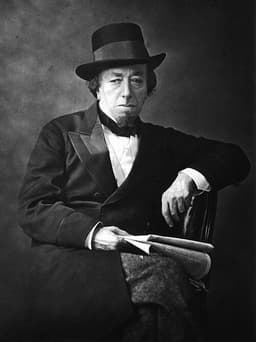
Benjamin Disraeli
Politician · Modern
57.5Total

Julius Caesar
General · Ancient
82.8Total
Basic Information
Born
1804
-100
Died
1881
-44
Era
Modern
Ancient
Nationality
United Kingdom
Roman Republic
Occupation
Politician
General
Civilization
Western
Western
Score Comparison
Military (10%)
47.4
88.0
Political (20%)
62.7
78.0
Influence (20%)
55.0
85.0
Legacy (20%)
55.0
82.0
Leadership (15%)
78.0
80.0
Strategy (15%)
41.7
85.0
TOTAL
57.5
82.8
Benjamin Disraeli — Complete Timeline
1867 AD
Reform Act 1867Reform
As Chancellor of the Exchequer, Disraeli steered the Reform Act 1867 through Parliament, which doubled the electorate by extending the vote to many urban working-class men. This 'leap in the dark' was a major political reform that reshaped British democracy.
Electoral ReformDemocracyWorking Class
Impact: nationalprogressive
1868 AD
Became Prime MinisterPolitical Action
Disraeli became Prime Minister for the first time on February 27, 1868, after the resignation of Lord Derby. His first ministry lasted only 10 months, but he passed the Reform Act 1867 during his time as Chancellor of the Exchequer, which expanded the electorate.
Prime MinisterConservative PartyReform
Impact: national
1875 AD
Purchase of Suez Canal SharesPolitical Action◆ Major
Disraeli arranged the purchase of a 44% stake in the Suez Canal Company from the Khedive of Egypt for
Suez CanalImperialismFinance
Impact: globalconstructive
1876 AD
Royal Titles Act 1876Political Action
Disraeli's government passed the Royal Titles Act 1876, which added 'Empress of India' to Queen Victoria's titles. This formalized British imperial rule in India and was a symbolic assertion of British power, though it was criticized as flattery of the monarch.
MonarchyIndiaImperial Title
Impact: global
1878 AD
Congress of BerlinPolitical Action◆ Major
Disraeli attended the Congress of Berlin in June-July 1878, representing Britain. He secured revisions to the Treaty of San Stefano, limiting Russian influence in the Balkans and gaining Cyprus for Britain. He returned claiming 'peace with honour', boosting his popularity.
Foreign PolicyBalkansDiplomacy
Impact: global
Julius Caesar — Complete Timeline
58 BC
Gallic WarsWar◆ Major
Caesar, as proconsul of Gaul, launched a series of campaigns that conquered all of Gaul (modern France, Belgium, and parts of Switzerland). He fought numerous battles, including against the Helvetii, the Belgae, and the Gallic chieftain Vercingetorix. The wars brought immense wealth and a loyal army to Caesar.
Gallic WarsConquestRoman Expansion
Impact: regional
49 BC
Crossing the RubiconPolitical Action◆ Major
Caesar led Legio XIII across the Rubicon River into Italy, defying the Roman Senate's order to disband his army. This act triggered a civil war against Pompey and the Optimates, ultimately leading to Caesar's dictatorship and the end of the Roman Republic.
Roman Civil WarEnd of RepublicPower Struggle
Impact: global
48 BC
Battle of PharsalusWar◆ Major
Caesar's outnumbered army defeated the larger forces of Pompey the Great at Pharsalus in Greece. Caesar's tactical use of a reserve line to counter Pompey's cavalry charge proved decisive. Pompey fled to Egypt, where he was assassinated, leaving Caesar as the undisputed master of the Roman world.
Roman Civil WarBattleDecisive Victory
Impact: regional
44 BC
Appointment as Dictator for LifePolitical Action◆ Major
The Roman Senate appointed Caesar dictator perpetuo (dictator for life), granting him unprecedented personal power. This move concentrated military, legislative, and judicial authority in one person, effectively ending the Roman Republic's traditional system of checks and balances and alarming many senators.
DictatorshipEnd of RepublicPower Consolidation
Impact: regionaldestructive
Assassination on the Ides of MarchPolitical Action◆ Major
A group of Roman senators, led by Marcus Junius Brutus and Gaius Cassius Longinus, stabbed Caesar to death at a meeting of the Senate in the Theatre of Pompey. The assassination was intended to restore the Republic, but instead triggered another civil war that led to the rise of the Roman Empire.
AssassinationRoman PoliticsEnd of Republic
Impact: globaldestructive
Expert Analysis
benjamin-disraeli-vs-julius-caesar
# The General and the Gambler
On a January morning in 49 BCE, a fifty-year-old Roman general stood at the bank of a narrow river in northern Italy. The Rubicon marked the boundary of his command, the line he was forbidden to cross with his army. Julius Caesar hesitated—then plunged forward, uttering what would become the most famous gamble in history: *"Alea iacta est"*—the die is cast. Eighteen centuries later, in a different kind of crossing, a dandyish Jewish-born novelist stood before the British Parliament, steering through a bill that would double the electorate and reshape his nation. Benjamin Disraeli had no legions, no Rubicon—only words and nerve. Both men defied their eras; both rose to the summit of power. But one built an empire of stone and blood, the other an empire of ink and influence. What drove them, and what divided their fates?
Origins
Caesar was born into the chaos of the late Roman Republic, a world of civil wars, senatorial intrigue, and crumbling traditions. His family, the Julii, claimed descent from the goddess Venus—a pedigree that mattered in a society where ancestry was currency. But his father died when Caesar was sixteen, leaving him to navigate a treacherous political landscape with little more than a name and a razor-sharp intellect. He was shaped by violence: as a young man, he barely escaped execution under the dictator Sulla, who warned that "there are many Mariuses in that boy."
Disraeli, by contrast, was born in 1804 into a world of order—Victorian Britain, a constitutional monarchy with a stable Parliament and a global empire. But he was an outsider from birth. His father, a Jewish literary scholar, had him baptized as a child after a synagogue dispute, but the stigma of Jewish ancestry clung to him in an age when such things barred doors to power. Disraeli had no classical education, no family estate, no military glory. He was a novelist before he was a politician, learning human nature from the page rather than the battlefield. Where Caesar inherited a claim to divine blood, Disraeli had to invent himself.
Rise to Power
Caesar’s path was forged in steel. He climbed the Roman political ladder—the *cursus honorum*—through military command. His conquest of Gaul (58–50 BCE) was not just a war but a masterpiece of strategy and propaganda. He wrote his own accounts, crafted to make Rome see him as its savior. When the Senate ordered him to disband his army, he chose civil war instead. The crossing of the Rubicon was not a decision for glory but for survival: he knew that without power, he was a dead man.
Disraeli’s rise was slower, more tortuous, and far less dramatic. He failed as a novelist before succeeding, and his early parliamentary speeches were laughed down. "You will hear me," he told his tormentors—and he did, because he adapted. He reinvented the Conservative Party, not by leading armies but by forging coalitions. The Reform Act of 1867 was his Rubicon: he, a Conservative, pushed through a bill that doubled the electorate, enfranchising working-class men. It was a betrayal of his party’s principles and a masterstroke of political survival. He did not cross a river; he crossed a class divide.
Leadership & Governance
Caesar ruled as a dictator, first for ten years, then for life. He centralized power, reformed the calendar, granted citizenship to provincials, and launched public works. But his governance was a paradox: he sought to heal the Republic by destroying its traditions. He was a military genius—his siege of Alesia remains a textbook example of encirclement—but his political wisdom was brittle. He pardoned his enemies, only to be stabbed by them.
Disraeli governed through persuasion, not force. His military score is a mere 37.5, but his political score of 79.1 reflects a different kind of strategy: the art of the possible. As Prime Minister, he passed public health acts, improved housing for the poor, and—most famously—purchased a 44% stake in the Suez Canal in 1875, a secret deal that gave Britain control over the route to India. He did not conquer Egypt; he bought it. At the Congress of Berlin in 1878, he secured peace through negotiation, returning to London with "peace with honor." Where Caesar wielded a sword, Disraeli wielded a checkbook and a smile.
Triumph & Tragedy
Caesar’s greatest moment was his triumph over Gaul and his defeat of Pompey at Pharsalus. He was hailed as *dictator perpetuo*—dictator for life. But his tragedy was his assassination on the Ides of March, 44 BCE, at the hands of senators he had spared. He died not on a battlefield but in the Senate chamber, betrayed by the men he trusted.
Disraeli’s triumph was the Suez Canal purchase—a stroke of imperial genius that made Britain the master of a global waterway. His tragedy came later: the Second Anglo-Afghan War and the Zulu War drained his popularity, and his government fell in 1880. He died the following year, a defeated man but a revered figure. His tragedy was not a violent end but a quiet fading, watching his empire begin to fray.
Character & Destiny
Caesar was arrogant, calculating, and ruthless. He believed in his own star—literally, as he traced his lineage to Venus. His personality drove him to risk everything: the Rubicon, the civil war, the dictatorship. He could not stop, because stopping meant death. His destiny was to transform the Republic into an empire, but he never lived to see it. His adopted heir, Octavian, would become Augustus.
Disraeli was vain, witty, and resilient. He wore velvet coats and curled his hair, a peacock in a Parliament of crows. He believed in destiny too, but a different kind: the destiny of the British Empire, which he saw as a force for civilization. His personality allowed him to charm Queen Victoria, who adored him, and to outmaneuver his rival, William Gladstone. He did not seek immortality through conquest but through legacy—the Suez Canal shares, the Royal Titles Act that made Victoria Empress of India. He died knowing he had shaped his age.
Legacy
Caesar’s legacy is the Roman Empire. His name became synonymous with power: *Kaiser* and *Tsar* derive from it. He is remembered as a military genius, a political revolutionary, and a cautionary tale about ambition. His writings—the *Commentaries on the Gallic War*—are still studied. But his assassination proved that even the greatest can fall.
Disraeli’s legacy is more subtle but equally enduring. He transformed British Conservatism, giving it a social conscience. He expanded the Empire at its zenith, and his purchase of the Suez Canal shaped global trade for a century. He is remembered as a wit, a statesman, and a novelist—one of the few Prime Ministers to write fiction. His influence score of 66.7 is lower than Caesar’s 85.0, but his impact on the modern world is tangible: every ship that passes through Suez travels through Disraeli’s ambition.
Conclusion
One crossed a river; the other crossed a floor. Caesar gambled with armies; Disraeli gambled with votes. Both were outsiders who remade their worlds. Caesar’s tragedy was that he could not stop fighting; Disraeli’s was that he could not stop dreaming. In the end, we remember Caesar for how he died—betrayed by friends—and Disraeli for how he lived—charming a queen and buying an empire. The general built a world of iron and laws; the politician built one of influence and ink. Both were gamblers. But only one knew when to stop.
Rankings
🥇
Julius CaesarLeader
Mil: 88.0Pol: 78.0Inf: 85.0
82.8
🥈
Benjamin Disraeli
Mil: 47.4Pol: 62.7Inf: 55.0
57.5
+25.3 behind
How This Comparison Works
Algorithm
Each figure is scored on 6 dimensions (0—100 scale) based on structured historical data: Military (10%), Political (20%), Influence (20%), Legacy (20%), Leadership (15%), Strategy (15%). The weighted total produces the final ranking.
Data Sources
Scores are computed from structured sub-indicators in the database. Scale factors adjust for era (Ancient ×0.85, Modern ×1.0) and civilization size (Eastern ×1.05, Other ×0.80) to account for differences in population and military scale.
Maximum 3 Figures
Comparisons are limited to 2—3 figures to ensure readability and statistical meaningfulness.
Error Margins
±5 points per dimension — Sub-scores are derived from historical records with inherent uncertainty. Two figures within 5 points on a dimension should be considered roughly equivalent in that area.
Total Score Accuracy
±3 points overall — The weighted combination of 6 dimensions produces a total score with approximately ±3 points of uncertainty. Differences of less than 3 points are not statistically significant— the figures are effectively tied.
Known Limitations
- Historical records are incomplete and uneven across civilizations
- Figures from oral-tradition societies may be underrepresented
- Occupation labels can misclassify multi-role figures
- Scores measure capability and impact, not moral character
- Quantitative scoring is a comparison tool, not absolute truth
Capability Radar
Military (10%) — Battles & Warfare
Battles
31
95
Win Rate
34
92
Expansion
36
97
Political (20%) — Governance & Reform
Reform
80
90
Diplomacy
85
85
Economy
70
82
Influence (20%) — Cultural & Global Reach
Cultural
65
88
Global
65
94
Legacy (20%) — Historical Impact
Historical
75
95
Longevity
70
96
Leadership (15%) — Power & Stability
Tenure
75
75
Stability
70
60
Strategy (15%) — Tactics & Innovation
Strategy
39
94
Tactics
38
96
Reform
42
88
Similar Comparisons
Comments & Discussion
RUBICON_MADMAN6/17/2026
Caesar crossed the Rubicon with a single die. Disraeli crossed the aisle with a thousand bills. One man needed one river to change the world; the other needed one speech to double the electorate. But let's be brutally honest—Caesar's gamble conquered Gaul and reshaped Western civilization. Disraeli's gamble gave factory workers a vote and then promptly ignored their poverty. The novelist won the game; the general changed the rules. No contest.
江边赌徒6/17/2026
拿凯撒和迪斯雷利比?简直可笑。凯撒在卢比孔河赌的是罗马的生死存亡,六万军团跨河而出、内战四年、奥古斯都百年大业。迪斯雷利赌的不过是一纸《改革法案》,把三十万城里人和地主拉进投票箱。一个是罗马的征服者,一个是维多利亚的公关大臣。前者永久;后者早已是历史脚注。别把帝国建设者和党派策略家相提并论。
DATA_DEMON6/17/2026
Let's talk numbers. In 49 BCE, Caesar controlled Gaul, Illyricum, and Cisalpine Gaul—roughly 30 million people under his direct or indirect rule, generating enough tax revenue to fund a full-scale civil war. Disraeli's Reform Act of 1867 added about a million voters to the rolls—out of 21 million British citizens. Excluding women, of course. Caesar didn't need to expand the vote; he expanded the empire. Disraeli expanded the base. One scaled power; the other scaled participation. Both moved the
图拉真夫人6/17/2026
作为古典学研究者,我发现这个对比本身就错位。凯撒的遗产是具体的:他改革历法、重建城市、击败高卢、镇压庞培——这些有考古证据、铭文记录和文献支撑。迪斯雷利的遗产呢?维多利亚时代的帝国扩张、犹太人的民权、以及他那套浪漫的"一国保守主义"——大多数只存在于报纸专栏和议会记录中。一个在永恒之城留下血迹与石雕;另一个在茶杯里留下涟漪。显然,凯撒才是改变文明进程的人。
BRILLIANT_BENJY6/17/2026
You critics are missing the point. Caesar built an empire of death—Gaul genocide estimated at one million dead, one million enslaved. Disraeli? He built an empire of prosperity—the Suez Canal shares bought for £4 million, Victoria crowned Empress of India, the Public Health Act of 1875 saving countless lives. One man's legacy is genocide. The other's is civic reform, cultural preservation, and imperial stewardship. I'd rather stand in Parliament than on a battlefield. Blood doesn't build lasting