Loading...
Barham Salih vs Julius Caesar
Julius Caesar leads by 26.4 pts · 2 figures compared
…
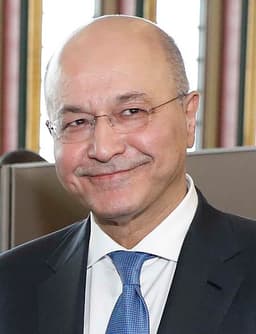
Barham Salih
Politician · Modern
56.4Total

Julius Caesar
General · Ancient
82.8Total
Basic Information
Born
1960
-100
Died
—
-44
Era
Modern
Ancient
Nationality
Iraq
Roman Republic
Occupation
Politician
General
Civilization
Middle Eastern
Western
Score Comparison
Military (10%)
50.0
88.0
Political (20%)
72.0
78.0
Influence (20%)
54.9
85.0
Legacy (20%)
42.5
82.0
Leadership (15%)
80.0
80.0
Strategy (15%)
42.0
85.0
TOTAL
56.4
82.8
Barham Salih — Complete Timeline
2018 AD
Elected President of IraqPolitical Action◆ Major
Barham Salih was elected President of Iraq by parliament, succeeding Fuad Masum. As a Kurdish politician, his election continued the tradition of a Kurdish president in the post-2005 political system.
PresidencyKurdish Leadership
Impact: nationalconstructive
2019 AD
Proposed Reform AgendaReform
Salih proposed a reform agenda including anti-corruption measures, economic diversification, and improved governance. His proposals came amid widespread protests demanding political change and better public services.
ReformAnti-CorruptionProtests
Impact: nationalconstructive
2022 AD
Left Office after Single TermPolitical Action
Barham Salih left the presidency after his single term ended, following the 2022 presidential election. He was succeeded by Abdul Latif Rashid, another Kurdish politician.
End of TermPolitical Transition
Impact: national
Julius Caesar — Complete Timeline
58 BC
Gallic WarsWar◆ Major
Caesar, as proconsul of Gaul, launched a series of campaigns that conquered all of Gaul (modern France, Belgium, and parts of Switzerland). He fought numerous battles, including against the Helvetii, the Belgae, and the Gallic chieftain Vercingetorix. The wars brought immense wealth and a loyal army to Caesar.
Gallic WarsConquestRoman Expansion
Impact: regional
49 BC
Crossing the RubiconPolitical Action◆ Major
Caesar led Legio XIII across the Rubicon River into Italy, defying the Roman Senate's order to disband his army. This act triggered a civil war against Pompey and the Optimates, ultimately leading to Caesar's dictatorship and the end of the Roman Republic.
Roman Civil WarEnd of RepublicPower Struggle
Impact: global
48 BC
Battle of PharsalusWar◆ Major
Caesar's outnumbered army defeated the larger forces of Pompey the Great at Pharsalus in Greece. Caesar's tactical use of a reserve line to counter Pompey's cavalry charge proved decisive. Pompey fled to Egypt, where he was assassinated, leaving Caesar as the undisputed master of the Roman world.
Roman Civil WarBattleDecisive Victory
Impact: regional
44 BC
Appointment as Dictator for LifePolitical Action◆ Major
The Roman Senate appointed Caesar dictator perpetuo (dictator for life), granting him unprecedented personal power. This move concentrated military, legislative, and judicial authority in one person, effectively ending the Roman Republic's traditional system of checks and balances and alarming many senators.
DictatorshipEnd of RepublicPower Consolidation
Impact: regionaldestructive
Assassination on the Ides of MarchPolitical Action◆ Major
A group of Roman senators, led by Marcus Junius Brutus and Gaius Cassius Longinus, stabbed Caesar to death at a meeting of the Senate in the Theatre of Pompey. The assassination was intended to restore the Republic, but instead triggered another civil war that led to the rise of the Roman Empire.
AssassinationRoman PoliticsEnd of Republic
Impact: globaldestructive
Expert Analysis
barham-salih-vs-julius-caesar
The Rubicon and the Ballot Box
In January of 49 BCE, a Roman general stood on the banks of a small river in northern Italy. He knew that crossing it with his army would mean civil war, the destruction of the Republic he had sworn to serve, and his own elevation to absolute power. He crossed anyway, famously declaring "the die is cast." Two thousand years later, in October of 2018, an Iraqi Kurdish politician stood before a parliament in Baghdad, not with legions but with a speech. He accepted a presidency that was largely ceremonial, promising reform in a country scarred by invasion, sectarian war, and decades of dictatorship. One man changed the world forever. The other kept a fragile democracy alive for a single term. The contrast between Julius Caesar and Barham Salih is not merely one of scale—it is a story of how two men, both ambitious and intelligent, navigated utterly different eras, and how the structures of power in their respective worlds dictated their fates.
Origins
Caesar was born into the twilight of the Roman Republic, a world of aristocratic competition, endless civil wars, and a political system that was already creaking under the weight of empire. His family, the Julii, claimed descent from the goddess Venus, but their fortunes had faded. Caesar grew up in a Rome where power was won by military glory, bribery, and oratory, not by legal procedure. His uncle, Gaius Marius, had been a populist general who marched on Rome itself. This was the air Caesar breathed: politics and war were the same game.
Barham Salih was born in 1960 in the Kurdish region of Iraq, a land that had never known stable self-rule. His people had been bombed, gassed, and ethnically cleansed by Saddam Hussein’s regime. Salih’s father was a prominent Kurdish nationalist, and the family fled to Britain after a failed uprising in the 1970s. Salih studied engineering and then political science, earning a PhD. His world was not the forum and the battlefield, but the university, the exile community, and the negotiation table. Where Caesar learned to command armies, Salih learned to navigate bureaucracies and international diplomacy.
Rise to Power
Caesar’s path was swift and violent. He served as a military tribune, then quaestor, then aedile, spending vast sums on games and public works to win popular favor. He formed the First Triumvirate with Pompey and Crassus, a backroom deal that gave him command of Gaul. There, over eight years, he conquered a territory larger than Italy itself, slaughtering perhaps a million people and enslaving another million. His Commentaries on the Gallic Wars are not just history—they are propaganda, crafted to make him a legend in Rome. When the Senate ordered him to disband his army, he refused. The Rubicon crossing was the logical endpoint of a life lived by the sword.
Salih’s rise was slow and institutional. He returned to Iraq after the 2003 invasion and served as deputy prime minister, then as prime minister of the Kurdistan Regional Government. He was a technocrat, known for competence in a system riddled with corruption. In 2018, after months of political deadlock, Iraq’s parliament elected him president. The presidency of Iraq is a weak office, designed to be a symbol of national unity. Salih did not cross a river with an army; he walked into a chamber of squabbling factions and accepted a role with limited power.
Leadership & Governance
Caesar’s rule was a whirlwind of reform and autocracy. As dictator, he overhauled the calendar, granted citizenship to Gauls, reformed debt laws, and initiated massive building projects. He also centralized power, packed the Senate with his supporters, and had himself declared dictator for life. His military genius was undeniable—his siege of Alesia remains a textbook example of tactical brilliance. But his political wisdom was flawed. He pardoned his enemies, but he also humiliated them. He believed his personal authority could replace the Republic’s institutions. He was wrong.
Salih’s governance was the opposite: cautious, procedural, and constrained. He proposed an anti-corruption agenda and called for economic diversification away from oil. He faced a parliament dominated by Shia Islamist parties, a powerful prime minister, and the lingering influence of Iranian-backed militias. He could not command an army to enforce his will. His only weapons were persuasion and the moral authority of his office. In 2019, when mass protests erupted against corruption and Iranian influence, Salih supported the demonstrators but could not deliver their demands. He was a reformer without a sword.
Triumph & Tragedy
Caesar’s greatest moment was his triumph over Pompey at the Battle of Pharsalus in 48 BCE, where he defeated a larger army through superior tactics. His greatest tragedy was his assassination on the Ides of March, 44 BCE. He had been warned; he ignored it. His murder did not restore the Republic—it plunged Rome into another civil war, ending with the rise of his adopted son, Octavian, as the first emperor. Caesar’s tragedy was that he destroyed the old order but could not build a stable one.
Salih’s triumph was simpler: he completed a single term as president, a rarity in Iraq’s volatile politics. He left office peacefully in 2022, after the election of a new president. His tragedy is that his reforms largely failed. Iraq remains corrupt, oil-dependent, and dominated by militias. Salih’s legacy is not a dramatic fall, but a quiet disappointment. He was a good man in a broken system, and goodness alone could not fix it.
Character & Destiny
Caesar was arrogant, brilliant, and ruthless. He believed he was destined for greatness, and he was. But his arrogance blinded him to the limits of his power. He thought he could be a monarch in a republic that hated kings. His character made him a conqueror but also a victim.
Salih is patient, pragmatic, and idealistic. He believed in institutions, in dialogue, in the slow work of reform. His character made him a survivor but not a transformative leader. In a system designed to resist change, patience can look like weakness.
Legacy
Caesar’s legacy is the Roman Empire. His name became a title—Kaiser, Tsar. He changed the course of Western history. He is remembered as a genius, a tyrant, and a martyr.
Salih’s legacy is more modest. He is remembered as a decent president in a difficult time. He kept the Kurdish seat at the table. He did not start a war. He did not steal from the treasury. In the long history of Iraq, that may be enough.
Conclusion
Standing on the banks of the Rubicon, Caesar chose war. Standing before the Iraqi parliament, Salih chose peace. One man’s ambition remade the world; the other’s caution preserved a fragile order. The difference between them is not talent or courage—it is the age they lived in. Caesar’s world rewarded the sword. Salih’s world demands patience. Both men did what their time asked of them. The question is not who was greater, but what their stories tell us about power: that it is never just about the man, but about the river he crosses—or refuses to cross.
Rankings
🥇
Julius CaesarLeader
Mil: 88.0Pol: 78.0Inf: 85.0
82.8
🥈
Barham Salih
Mil: 50.0Pol: 72.0Inf: 54.9
56.4
+26.4 behind
How This Comparison Works
Algorithm
Each figure is scored on 6 dimensions (0—100 scale) based on structured historical data: Military (10%), Political (20%), Influence (20%), Legacy (20%), Leadership (15%), Strategy (15%). The weighted total produces the final ranking.
Data Sources
Scores are computed from structured sub-indicators in the database. Scale factors adjust for era (Ancient ×0.85, Modern ×1.0) and civilization size (Eastern ×1.05, Other ×0.80) to account for differences in population and military scale.
Maximum 3 Figures
Comparisons are limited to 2—3 figures to ensure readability and statistical meaningfulness.
Error Margins
±5 points per dimension — Sub-scores are derived from historical records with inherent uncertainty. Two figures within 5 points on a dimension should be considered roughly equivalent in that area.
Total Score Accuracy
±3 points overall — The weighted combination of 6 dimensions produces a total score with approximately ±3 points of uncertainty. Differences of less than 3 points are not statistically significant— the figures are effectively tied.
Known Limitations
- Historical records are incomplete and uneven across civilizations
- Figures from oral-tradition societies may be underrepresented
- Occupation labels can misclassify multi-role figures
- Scores measure capability and impact, not moral character
- Quantitative scoring is a comparison tool, not absolute truth
Capability Radar
Military (10%) — Battles & Warfare
Battles
22
95
Win Rate
27
92
Expansion
29
97
Political (20%) — Governance & Reform
Reform
55
90
Diplomacy
60
85
Economy
45
82
Influence (20%) — Cultural & Global Reach
Cultural
30
88
Global
30
94
Legacy (20%) — Historical Impact
Historical
35
95
Longevity
20
96
Leadership (15%) — Power & Stability
Tenure
40
75
Stability
35
60
Strategy (15%) — Tactics & Innovation
Strategy
30
94
Tactics
35
96
Reform
37
88
Similar Comparisons
Comments & Discussion
No comments yet. Be the first to share your thoughts!