Loading...
Aung San Suu Kyi vs Julius Caesar
Julius Caesar leads by 34.4 pts · 2 figures compared
…
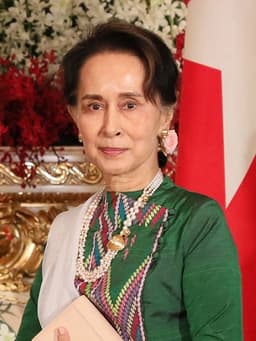
Aung San Suu Kyi
Politician · Modern
48.4Total

Julius Caesar
General · Ancient
82.8Total
Basic Information
Born
1945
-100
Died
—
-44
Era
Modern
Ancient
Nationality
Myanmar
Roman Republic
Occupation
Politician
General
Civilization
Eastern
Western
Score Comparison
Military (10%)
15.3
88.0
Political (20%)
46.6
78.0
Influence (20%)
55.0
85.0
Legacy (20%)
54.0
82.0
Leadership (15%)
64.0
80.0
Strategy (15%)
30.6
85.0
TOTAL
48.4
82.8
Aung San Suu Kyi — Complete Timeline
1989 AD
House arrest under SLORCPolitical Action◆ Major
Aung San Suu Kyi was placed under house arrest by the State Law and Order Restoration Council (SLORC) after leading pro-democracy protests. She was offered release if she left Myanmar but refused, remaining under detention for nearly 15 years total.
House arrestPro-democracySLORC
Impact: nationaldestructive
1991 AD
Nobel Peace Prize awardCultural◆ Major
Aung San Suu Kyi was awarded the Nobel Peace Prize for her non-violent struggle for democracy and human rights in Myanmar. Her sons accepted on her behalf as she remained under house arrest.
Nobel PrizePeaceDemocracy
Impact: globalconstructive
2010 AD
Release from house arrestPolitical Action◆ Major
Aung San Suu Kyi was released from house arrest six days after Myanmar's general election. Her release followed years of international pressure and marked a turning point in Myanmar's political transition.
ReleasePolitical transitionDemocracy
Impact: nationalprogressive
2012 AD
Elected to parliamentPolitical Action◆ Major
Aung San Suu Kyi won a seat in Myanmar's parliament in by-elections, becoming an opposition MP. Her National League for Democracy party won 43 of 45 contested seats, marking her entry into formal politics.
ElectionParliamentNLD
Impact: nationalprogressive
2016 AD
Appointed State CounsellorPolitical Action◆ Major
Aung San Suu Kyi was appointed State Counsellor of Myanmar, a position created for her, effectively making her the de facto leader. The constitution barred her from the presidency due to her foreign spouse and children.
State CounsellorLeadershipConstitution
Impact: nationalconstructive
2017 AD
Rohingya genocide defensePolitical Action◆ Major
Aung San Suu Kyi defended Myanmar's military actions against the Rohingya minority at the International Court of Justice, denying genocide allegations. This stance severely damaged her international reputation as a human rights icon.
RohingyaGenocideICJHuman rights
Impact: globaldestructive
2021 AD
Detained in 2021 coupPolitical Action◆ Major
Aung San Suu Kyi was detained by Myanmar's military in a coup that overturned the 2020 election results. She was charged with multiple offenses including corruption and violating the Official Secrets Act, leading to long prison sentences.
CoupDetentionMilitaryElection
Impact: nationaltragic
Julius Caesar — Complete Timeline
58 BC
Gallic WarsWar◆ Major
Caesar, as proconsul of Gaul, launched a series of campaigns that conquered all of Gaul (modern France, Belgium, and parts of Switzerland). He fought numerous battles, including against the Helvetii, the Belgae, and the Gallic chieftain Vercingetorix. The wars brought immense wealth and a loyal army to Caesar.
Gallic WarsConquestRoman Expansion
Impact: regional
49 BC
Crossing the RubiconPolitical Action◆ Major
Caesar led Legio XIII across the Rubicon River into Italy, defying the Roman Senate's order to disband his army. This act triggered a civil war against Pompey and the Optimates, ultimately leading to Caesar's dictatorship and the end of the Roman Republic.
Roman Civil WarEnd of RepublicPower Struggle
Impact: global
48 BC
Battle of PharsalusWar◆ Major
Caesar's outnumbered army defeated the larger forces of Pompey the Great at Pharsalus in Greece. Caesar's tactical use of a reserve line to counter Pompey's cavalry charge proved decisive. Pompey fled to Egypt, where he was assassinated, leaving Caesar as the undisputed master of the Roman world.
Roman Civil WarBattleDecisive Victory
Impact: regional
44 BC
Appointment as Dictator for LifePolitical Action◆ Major
The Roman Senate appointed Caesar dictator perpetuo (dictator for life), granting him unprecedented personal power. This move concentrated military, legislative, and judicial authority in one person, effectively ending the Roman Republic's traditional system of checks and balances and alarming many senators.
DictatorshipEnd of RepublicPower Consolidation
Impact: regionaldestructive
Assassination on the Ides of MarchPolitical Action◆ Major
A group of Roman senators, led by Marcus Junius Brutus and Gaius Cassius Longinus, stabbed Caesar to death at a meeting of the Senate in the Theatre of Pompey. The assassination was intended to restore the Republic, but instead triggered another civil war that led to the rise of the Roman Empire.
AssassinationRoman PoliticsEnd of Republic
Impact: globaldestructive
Expert Analysis
aung-san-suu-kyi-vs-julius-caesar
# The Ides of March and the Fall of the Dove
On a mild March morning in 44 BCE, Julius Caesar walked into the Senate chamber, ignoring a soothsayer’s warning and a colleague’s desperate note pressed into his hand. Moments later, sixty senators surrounded him with daggers. Across two millennia, in February 2021, Aung San Suu Kyi sat in her residence in Naypyidaw when soldiers arrived to detain her, ending a brief experiment in Myanmar’s democracy. One died by the blade of betrayal; the other lives under the shadow of her own. Two figures, separated by time and culture, yet both haunted by the same question: how does a champion of transformation become a prisoner of their own creation?
Origins
Julius Caesar was born into a patrician family that had fallen on hard times. The Roman Republic was already rotting—its Senate paralyzed by elite infighting, its streets ruled by mobs and mercenaries. Caesar’s uncle by marriage was Gaius Marius, a populist general who had reformed the army and clashed with the aristocracy. From childhood, Caesar absorbed the lesson that power flowed not from tradition but from the sword and the people’s voice. He was educated in rhetoric and war, but his real schooling came from watching the Republic devour its own sons.
Aung San Suu Kyi was born in 1945, the daughter of General Aung San, the independence hero who negotiated Burma’s freedom from Britain. When she was two, her father was assassinated by political rivals. She grew up in India and England, studying philosophy and politics at Oxford, marrying a British scholar. Unlike Caesar, she was an outsider to her own country’s power structures—a woman shaped by exile, not by the cutthroat politics of Rangoon. Her father’s legacy hung over her like a ghost, but she had no army, no fortune, no faction. She had only a name and a moral conviction.
Rise to Power
Caesar’s path was one of calculated risk. He borrowed fortunes to fund lavish games and bribe voters, winning election as consul in 59 BCE. He then secured command of Gaul, where over eight years he conquered a territory larger than Italy itself, slaughtering perhaps a million people and enslaving another million. His *Commentaries* turned this bloodshed into a story of Roman destiny. When the Senate ordered him to disband his army, he crossed the Rubicon River in 49 BCE, triggering civil war. By 45 BCE, he was dictator for life.
Suu Kyi’s rise was the opposite: a slow, non-violent accumulation of moral authority. In 1988, as Myanmar’s military crushed pro-democracy protests, she returned from abroad to care for her ailing mother and found herself thrust into leadership of the National League for Democracy. The military placed her under house arrest in 1989. She refused offers of exile. In 1991, while still confined, she won the Nobel Peace Prize. For fifteen years, she was a prisoner who never stopped speaking—her voice carried by smuggled letters and foreign radio. She was elected to parliament in 2012, and by 2016, she became State Counsellor, Myanmar’s de facto leader.
Leadership & Governance
Caesar governed as a revolutionary conservative. He reformed the calendar, granted citizenship to Gauls, launched public works, and curbed corruption. But he also centralized power, packed the Senate with his supporters, and accepted divine honors. His military genius was undeniable—he won battles against overwhelming odds at Alesia and Pharsalus—but his political wisdom was brittle. He pardoned his enemies, believing they would be grateful. Instead, they plotted.
Suu Kyi governed as a moral icon trapped by realpolitik. She inherited a military that still held vast economic and political power, a constitution written by generals, and a population that expected miracles. She failed to reform the army, failed to address ethnic conflicts, and failed to protect the Rohingya Muslim minority. In 2017, when the military launched a genocidal campaign against the Rohingya, she defended them at the International Court of Justice, arguing that allegations of genocide were exaggerated. Her Nobel Prize became a symbol not of hope but of betrayal.
Triumph & Tragedy
Caesar’s greatest moment was his triumph in 46 BCE, when he paraded through Rome with captives from Gaul, Egypt, and Pontus, displaying a golden throne and a statue of himself beside the kings. His tragedy came on the Ides of March, 44 BCE, when his closest allies—Brutus, Cassius, and others—stabbed him twenty-three times. His last words, according to tradition, were “*Et tu, Brute?*” Then he covered his face and fell.
Suu Kyi’s greatest moment was her release from house arrest in 2010, when tens of thousands lined the streets of Yangon to see her walk free. Her tragedy unfolded slowly, from 2017 onward, as the world watched her stand beside military leaders while Rohingya villages burned. In 2021, the military detained her again in a coup, but this time, few protested. She had become a symbol of what happens when idealism meets the machinery of power without the will to dismantle it.
Character & Destiny
Caesar was arrogant, brilliant, and relentless. He believed he could outsmart fate. He ignored warnings, dissolved the Republic, and trusted his charm to protect him. His personality drove him to seize absolute power, but it also blinded him to the hatred he inspired. His destiny was to die by the very violence he had mastered.
Suu Kyi was patient, principled, and isolated. Her years of house arrest forged a steely resolve but also a detachment from the messy compromises of governance. She believed that moral authority alone could tame the military. Her personality drove her to endure imprisonment with grace, but it also led her to defend the indefensible. Her destiny is to be remembered as a saint who failed in power, or a hypocrite who chose power over justice.
Legacy
Caesar’s legacy is the Roman Empire. His adopted heir, Octavian, learned from his death: never trust your enemies, never share power. The Republic died with Caesar, and the world changed. His name became synonymous with autocracy—*kaiser*, *tsar*—and his writings shaped Western military thought for two thousand years. He is remembered as both a tyrant and a visionary.
Suu Kyi’s legacy is fractured. For decades, she was the face of peaceful resistance, an icon for democracy movements worldwide. Now she is a cautionary tale. Her defenders say she was trapped by a military that never surrendered power. Her critics say she revealed her true colors. The truth is more uncomfortable: she was a woman of principle who could not translate principle into policy. Her name may one day be invoked as a warning about the limits of moral leadership when faced with institutional evil.
Conclusion
Two figures, two paths, two falls. Caesar died because he concentrated too much power; Suu Kyi failed because she never held enough. He was assassinated by senators who feared his ambition; she was overthrown by generals who exploited her weakness. Both believed they could reshape their worlds. One succeeded at the cost of his life. The other survived but lost her soul. The Ides of March and the February coup are mirrors reflecting the same truth: in politics, the distance between triumph and tragedy is measured not in years but in choices.
Rankings
🥇
Julius CaesarLeader
Mil: 88.0Pol: 78.0Inf: 85.0
82.8
🥈
Aung San Suu Kyi
Mil: 15.3Pol: 46.6Inf: 55.0
48.4
+34.4 behind
How This Comparison Works
Algorithm
Each figure is scored on 6 dimensions (0—100 scale) based on structured historical data: Military (10%), Political (20%), Influence (20%), Legacy (20%), Leadership (15%), Strategy (15%). The weighted total produces the final ranking.
Data Sources
Scores are computed from structured sub-indicators in the database. Scale factors adjust for era (Ancient ×0.85, Modern ×1.0) and civilization size (Eastern ×1.05, Other ×0.80) to account for differences in population and military scale.
Maximum 3 Figures
Comparisons are limited to 2—3 figures to ensure readability and statistical meaningfulness.
Error Margins
±5 points per dimension — Sub-scores are derived from historical records with inherent uncertainty. Two figures within 5 points on a dimension should be considered roughly equivalent in that area.
Total Score Accuracy
±3 points overall — The weighted combination of 6 dimensions produces a total score with approximately ±3 points of uncertainty. Differences of less than 3 points are not statistically significant— the figures are effectively tied.
Known Limitations
- Historical records are incomplete and uneven across civilizations
- Figures from oral-tradition societies may be underrepresented
- Occupation labels can misclassify multi-role figures
- Scores measure capability and impact, not moral character
- Quantitative scoring is a comparison tool, not absolute truth
Capability Radar
Military (10%) — Battles & Warfare
Battles
13
95
Win Rate
19
92
Expansion
18
97
Political (20%) — Governance & Reform
Reform
40
90
Diplomacy
55
85
Economy
20
82
Influence (20%) — Cultural & Global Reach
Cultural
65
88
Global
65
94
Legacy (20%) — Historical Impact
Historical
60
95
Longevity
55
96
Leadership (15%) — Power & Stability
Tenure
60
75
Stability
15
60
Strategy (15%) — Tactics & Innovation
Strategy
21
94
Tactics
26
96
Reform
32
88
Similar Comparisons
Comments & Discussion
BloodyToga6/17/2026
The real tragedy here isn't the downfall—it's that both leaders proved Caesar's own maxim: "It is easier to find men who will volunteer to die than to find those willing to endure pain with patience." Suu Kyi endured house arrest for democracy, then watched her own government bomb Rohingya villages. Caesar conquered Gaul, then crossed the Rubicon. Both became the tyrant they once opposed. Suu Kyi had 20,000 political prisoners; Caesar had Vercingetorix strangled in a dungeon. History repeats, bu
政变预言家6/17/2026
说Caesar无视占卜者预言?Suu Kyi才是真正的“无视预言家”。2015年她掌权后,明知军方随时会政变,却连国防部都不控制。Caesar至少在马赛和亚历山大港证明了自己会打仗;Suu Kyi连若开邦的种族冲突都平息不了。Caesar死前说“布鲁图斯,你也在内吗”,Suu Kyi被政变前说“我们要信任军队”。古罗马人还知道三月十五日是死期,缅甸人连日子都预测不了。
NumericNero6/17/2026
Let's look at the math: Caesar ruled for 5 years as dictator, survived 3 civil wars, and fell by 23 dagger wounds. Suu Kyi held power for 5 years, faced 0 civil wars (the army did all the heavy lifting via the 2008 constitution), and fell by 1 phone call. Caesar conquered 800 cities in Gaul; Suu Kyi's NLD gained 80% of parliamentary seats. One statistically outperformed in conquest, the other in representation. But here's the kicker: both failed because they never secured control of the military
庙堂戏子6/17/2026
你们都在谈政变和刺杀,可这两人本质是剧场对剧场。Caesar穿红靴子、戴月桂枝,在元老院演戏到最后一刻。Suu Kyi更精通——她穿缅甸笼基、手捧莲花,把自己包装成“甘地传人”。Caesar的《高卢战记》是自我宣传;Suu Kyi的Facebook主页也是自我宣传。区别在:Caesar至少承认自己在演戏,他临死前还整理袍子保持体面;Suu Kyi被软禁时真的相信自己是个圣人。政治不是道德剧,只是观众爱看悲剧。
QuaestorOfQuota6/17/2026
We're missing the structural irony. Caesar's assassins claimed they were saving the Republic, but instead triggered 13 more years of civil war ending with Augustus. Suu Kyi's captors claimed they were saving national stability, but so far their