Loading...
Augustus vs Yongle Emperor
Augustus leads by 12.2 pts · 2 figures compared
…

Augustus
Emperor · Ancient
85.9Total
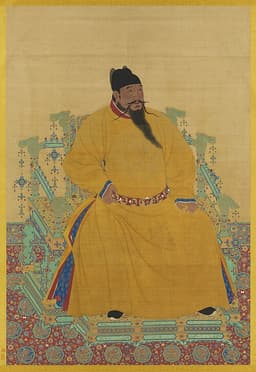
Yongle Emperor
Emperor · Medieval
73.7Total
Basic Information
Born
63
1360
Died
—
1424
Era
Ancient
Medieval
Nationality
Roman Empire
China
Occupation
Emperor
Emperor
Civilization
Western
Eastern
Score Comparison
Military (10%)
72.0
85.0
Political (20%)
90.0
78.0
Influence (20%)
88.0
75.0
Legacy (20%)
90.0
65.0
Leadership (15%)
88.0
78.0
Strategy (15%)
75.0
68.0
TOTAL
85.9
73.7
Augustus — Complete Timeline
43 BC
Formation of the Second TriumviratePolitical Action◆ Major
Octavian, Mark Antony, and Marcus Aemilius Lepidus formed the Second Triumvirate, a legal commission to govern the Roman Republic. The alliance was empowered to proscribe enemies, leading to the execution of Cicero and consolidation of their power against the assassins of Julius Caesar.
Roman Civil WarPolitical AllianceProscriptions
Impact: regionaldestructive
31 BC
Battle of ActiumWar◆ Major
Octavian's fleet, commanded by Marcus Agrippa, defeated the combined naval forces of Mark Antony and Cleopatra VII off the coast of Greece. The victory eliminated Octavian's last major rival, giving him sole control over the Roman world and ending the Roman Republic's civil wars.
Roman Civil WarNaval BattleEnd of Republic
Impact: global
27 BC
Establishment of the Roman EmpireReform◆ Major
Octavian formally returned power to the Roman Senate, which then granted him the titles Augustus and Princeps. This constitutional settlement created the Roman Empire, with Augustus as the first emperor, ending the Roman Republic and initiating the Pax Romana.
Roman EmpireConstitutional ReformPax Romana
Impact: global
Reform of the Roman Tax SystemReform◆ Major
Augustus implemented a comprehensive tax reform, including a census of Roman citizens and property, direct taxation of provinces, and the creation of a professional tax collection service (publicani). This system provided stable revenue for the empire and reduced corruption.
Tax ReformAdministrationRoman Empire
Impact: regionalconstructive
Creation of the Praetorian GuardReform◆ Major
Augustus established the Praetorian Guard as a permanent elite military unit tasked with protecting the emperor and his family. Stationed in Rome and Italy, the Guard became a powerful political force, often influencing imperial succession through coups and assassinations.
Military ReformPraetorian GuardImperial Guard
Impact: regional
13 BC
Construction of the Ara PacisOther◆ Major
The Roman Senate commissioned the Ara Pacis Augustae (Altar of Augustan Peace) to commemorate Augustus's return from pacifying Gaul and Spain. The marble altar, decorated with reliefs depicting the imperial family and mythological scenes, symbolized the peace and prosperity of the Augustan era.
Building ProjectPropagandaAugustan Art
Impact: regionalconstructive
Yongle Emperor — Complete Timeline
1399 AD
Jingnan CampaignWar◆ Major
Zhu Di, Prince of Yan, launched a rebellion against his nephew the Jianwen Emperor. After three years of civil war, Zhu Di captured Nanjing and usurped the throne, becoming the Yongle Emperor.
Civil warUsurpationMing dynasty
Impact: nationaldestructive
1405 AD
Commissioning of the Zheng He voyagesCultural◆ Major
Yongle commissioned Admiral Zheng He to lead a series of maritime expeditions across the Indian Ocean. The treasure fleets visited Southeast Asia, India, the Middle East, and East Africa, projecting Ming power and establishing tributary relations.
Maritime explorationDiplomacyZheng He
Impact: globalconstructive
1407 AD
Conquest of AnnamWar◆ Major
Yongle sent Ming armies to invade Annam (northern Vietnam) after a succession dispute. The Ming annexed the region as the province of Jiaozhi, but faced prolonged resistance from Vietnamese forces.
InvasionVietnamMing expansion
Impact: regionaldestructive
1408 AD
Compilation of the Yongle EncyclopediaCultural◆ Major
Yongle ordered the compilation of the Yongle Encyclopedia, a massive collection of Chinese knowledge. The work comprised over 11,000 volumes and 370 million characters, covering history, philosophy, science, and literature.
EncyclopediaCultural projectScholarship
Impact: globalconstructive
1410 AD
Campaigns against the MongolsWar◆ Major
Yongle personally led five military campaigns into the Mongolian steppe against the remnants of the Yuan dynasty. These expeditions aimed to neutralize the Mongol threat to the northern border and assert Ming dominance.
Military campaignsMongolsBorder security
Impact: regional
1421 AD
Relocation of the capital to BeijingPolitical Action◆ Major
Yongle formally moved the Ming capital from Nanjing to Beijing. He ordered the construction of the Forbidden City and expanded the city's defenses, shifting the political center of China northward.
Capital relocationUrban planningForbidden City
Impact: nationalconstructive
Expert Analysis
Augustus vs Yongle Emperor: Historical Comparison
Augustus, founder of the Roman Empire, and the Yongle Emperor, third ruler of China's Ming Dynasty, both transformed their realms through conquest, administration, and cultural patronage, but Augustus’s longer-lasting institutional reforms give him a slight edge.
Dimension Analysis
**Military: Augustus 72 / Yongle Emperor 82**
Augustus ended a century of civil war and expanded Rome’s borders, but his campaigns were largely consolidation. Yongle personally led five major northern expeditions against the Mongols and launched the massive maritime voyages of Zheng He, demonstrating greater direct military ambition.
**Political: Augustus 92 / Yongle Emperor 80**
Augustus masterfully disguised autocracy as restored republic, creating the Principate that lasted centuries. Yongle usurped power from his nephew, moved the capital to Beijing, and centralized the bureaucracy, but his reign was marked by purges and reliance on eunuchs.
**Influence: Augustus 88 / Yongle Emperor 78**
Augustus’s Pax Romana, coinage reforms, and patronage of Virgil and Horace shaped Western civilization’s political and cultural DNA. Yongle’s sponsorship of the Yongle Encyclopedia and Beijing’s Forbidden City were monumental, but their global impact remained largely within East Asia.
**Legacy: Augustus 90 / Yongle Emperor 75**
Augustus’s system endured for 400 years in the West and inspired later empires. Yongle’s achievements—the Grand Canal, maritime exploration—were later reversed by isolationist successors, diminishing their long-term influence.
**Leadership: Augustus 90 / Yongle Emperor 79**
Augustus combined ruthless pragmatism with strategic patience, building consensus among elites. Yongle’s leadership was decisive but often brutal; his usurpation and harsh laws alienated many, limiting his unifying power.
Verdict
Augustus leads overall due to his superior political innovation and enduring legacy, while Yongle’s military prowess and cultural projects were impressive but less sustainable.
FAQ
Q: Who ranks higher? A: Augustus ranks higher due to his transformative political system and longer-lasting influence on Western civilization.
Rankings
🥇
AugustusLeader
Mil: 72.0Pol: 90.0Inf: 88.0
85.9
🥈
Yongle Emperor
Mil: 85.0Pol: 78.0Inf: 75.0
73.7
+12.2 behind
How This Comparison Works
Algorithm
Each figure is scored on 6 dimensions (0—100 scale) based on structured historical data: Military (10%), Political (20%), Influence (20%), Legacy (20%), Leadership (15%), Strategy (15%). The weighted total produces the final ranking.
Data Sources
Scores are computed from structured sub-indicators in the database. Scale factors adjust for era (Ancient ×0.85, Modern ×1.0) and civilization size (Eastern ×1.05, Other ×0.80) to account for differences in population and military scale.
Maximum 3 Figures
Comparisons are limited to 2—3 figures to ensure readability and statistical meaningfulness.
Error Margins
±5 points per dimension — Sub-scores are derived from historical records with inherent uncertainty. Two figures within 5 points on a dimension should be considered roughly equivalent in that area.
Total Score Accuracy
±3 points overall — The weighted combination of 6 dimensions produces a total score with approximately ±3 points of uncertainty. Differences of less than 3 points are not statistically significant— the figures are effectively tied.
Known Limitations
- Historical records are incomplete and uneven across civilizations
- Figures from oral-tradition societies may be underrepresented
- Occupation labels can misclassify multi-role figures
- Scores measure capability and impact, not moral character
- Quantitative scoring is a comparison tool, not absolute truth
Capability Radar
Military (10%) — Battles & Warfare
Battles
75
85
Win Rate
80
90
Expansion
85
80
Political (20%) — Governance & Reform
Reform
95
90
Diplomacy
90
85
Economy
85
85
Influence (20%) — Cultural & Global Reach
Cultural
85
85
Global
90
75
Legacy (20%) — Historical Impact
Historical
95
85
Longevity
95
80
Leadership (15%) — Power & Stability
Tenure
95
85
Stability
95
80
Strategy (15%) — Tactics & Innovation
Strategy
85
85
Tactics
70
80
Reform
90
75
Similar Comparisons
Comments & Discussion
Chronicler39656/16/2026
这个评分体系有个问题:军事维度给永乐82分、奥古斯都72分,但仔细看,奥古斯都的‘平定内乱’其实涵盖了至少三次大规模内战(腓立比、亚克兴、埃及战役),而永乐的五次亲征蒙古,实际战果有限,最后一次甚至无功而返。如果按‘有效控制疆域’算,奥古斯都时代罗马稳定控制了地中海沿岸约450万平方公里,永乐时期明朝直接控制区约400万平方公里,但前者维持了200年稳定,后者在永乐死后30年就出现了土木堡之变。政治分92对80,但奥古斯都的‘元首制’本质是军事独裁,元老院沦为摆设,而永乐虽然夺位,却建立了完整的文官考核体系,这点评分没有体现。总体而言,这个总分高估了奥古斯都的影响力持续性,低估了永乐的制度创新。
SharpScroll906/16/2026
奥古斯都确实厉害,但拿他跟永乐比,就像拿罗马帝国跟明朝比,两个文明的发展路径根本不同。奥古斯都的‘元首制’在西欧被奉为典范,可放到中国历史里,他充其量就是个更成功的王莽——都是借复古之名行集权之实。永乐最牛的是把首都从南京迁到北京,这一手‘天子守国门’直接改变了中国的地缘政治格局,后来的清朝都学他。还有郑和下西洋,虽然没殖民,但航海技术领先欧洲100年,这种软实力的影响不能用‘局限东亚’来概括。奥古斯都的《埃涅阿斯纪》确实经典,但永乐的《永乐大典》3.7亿字,是人类历史上最大的百科全书,这个分量西方史学家往往看不到。评分里永乐政治才79分?你把明朝的厂卫制度、内阁制放在世界史里,绝对是一流的行政创新。