Loading...
Augustus vs Yelu Abaoji
Augustus leads by 23.2 pts · 2 figures compared
…

Augustus
Emperor · Ancient
85.9Total
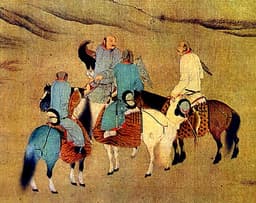
Yelu Abaoji
Emperor · Medieval
62.7Total
Basic Information
Born
63
872
Died
—
926
Era
Ancient
Medieval
Nationality
Roman Empire
China
Occupation
Emperor
Emperor
Civilization
Western
Eastern
Score Comparison
Military (10%)
72.0
77.2
Political (20%)
90.0
59.6
Influence (20%)
88.0
68.0
Legacy (20%)
90.0
40.0
Leadership (15%)
88.0
80.3
Strategy (15%)
75.0
69.6
TOTAL
85.9
62.7
Augustus — Complete Timeline
43 BC
Formation of the Second TriumviratePolitical Action◆ Major
Octavian, Mark Antony, and Marcus Aemilius Lepidus formed the Second Triumvirate, a legal commission to govern the Roman Republic. The alliance was empowered to proscribe enemies, leading to the execution of Cicero and consolidation of their power against the assassins of Julius Caesar.
Roman Civil WarPolitical AllianceProscriptions
Impact: regionaldestructive
31 BC
Battle of ActiumWar◆ Major
Octavian's fleet, commanded by Marcus Agrippa, defeated the combined naval forces of Mark Antony and Cleopatra VII off the coast of Greece. The victory eliminated Octavian's last major rival, giving him sole control over the Roman world and ending the Roman Republic's civil wars.
Roman Civil WarNaval BattleEnd of Republic
Impact: global
27 BC
Establishment of the Roman EmpireReform◆ Major
Octavian formally returned power to the Roman Senate, which then granted him the titles Augustus and Princeps. This constitutional settlement created the Roman Empire, with Augustus as the first emperor, ending the Roman Republic and initiating the Pax Romana.
Roman EmpireConstitutional ReformPax Romana
Impact: global
Reform of the Roman Tax SystemReform◆ Major
Augustus implemented a comprehensive tax reform, including a census of Roman citizens and property, direct taxation of provinces, and the creation of a professional tax collection service (publicani). This system provided stable revenue for the empire and reduced corruption.
Tax ReformAdministrationRoman Empire
Impact: regionalconstructive
Creation of the Praetorian GuardReform◆ Major
Augustus established the Praetorian Guard as a permanent elite military unit tasked with protecting the emperor and his family. Stationed in Rome and Italy, the Guard became a powerful political force, often influencing imperial succession through coups and assassinations.
Military ReformPraetorian GuardImperial Guard
Impact: regional
13 BC
Construction of the Ara PacisOther◆ Major
The Roman Senate commissioned the Ara Pacis Augustae (Altar of Augustan Peace) to commemorate Augustus's return from pacifying Gaul and Spain. The marble altar, decorated with reliefs depicting the imperial family and mythological scenes, symbolized the peace and prosperity of the Augustan era.
Building ProjectPropagandaAugustan Art
Impact: regionalconstructive
Yelu Abaoji — Complete Timeline
907 AD
Unified Khitan tribesPolitical Action◆ Major
Yelu Abaoji was elected khagan of the Khitan tribes, unifying them under his leadership. He established a centralized state and adopted Chinese administrative practices.
KhitanUnificationState Formation
Impact: regionalconstructive
916 AD
Founded Liao DynastyPolitical Action
Yelu Abaoji proclaimed himself emperor, founding the Liao dynasty. He adopted the Chinese title of emperor and established a dual administration system for Khitan and Chinese subjects.
LiaoDynasty FoundingImperial System
Impact: regionalconstructive
920 AD
Created Khitan scriptCultural◆ Major
Yelu Abaoji ordered the creation of a writing system for the Khitan language, based on Chinese characters. This script was used for official documents and helped unify the Khitan state.
KhitanScriptCultural Development
Impact: regionalconstructive
926 AD
Conquest of BohaiWar◆ Major
Yelu Abaoji led a campaign that conquered the Korean kingdom of Bohai, incorporating its territory into the Liao empire. This expanded Liao's influence into Manchuria and Korea.
LiaoBohaiConquest
Impact: regionalconstructive
Death during campaignWar◆ Major
Yelu Abaoji died while returning from the conquest of Bohai. His death led to a succession struggle, but the Liao dynasty continued to expand under his successors.
LiaoDeathSuccession
Impact: regionaltragic
Expert Analysis
Augustus vs Yelu Abaoji: Historical Comparison
Augustus, founder of the Roman Empire, and Yelu Abaoji, founder of the Liao Dynasty, were transformative rulers who unified disparate peoples and established enduring imperial systems—Augustus in the ancient Mediterranean (27 BCE–14 CE) and Abaoji in medieval East Asia (907–926 CE). Both excelled in political consolidation and leadership, but Augustus’s broader influence and longer legacy give him a narrow edge.
Dimension Analysis
**Military: Augustus 72 / Yelu Abaoji 73**
Augustus relied on seasoned generals like Agrippa to secure frontiers, while Abaoji personally led campaigns that unified Khitan tribes and conquered northern China. Abaoji’s hands-on tactical innovation slightly outpaces Augustus’s delegation strategy.
**Political: Augustus 92 / Yelu Abaoji 90**
Augustus masterfully disguised autocracy as republican restoration, creating the Principate. Abaoji invented dual-administration systems for nomadic and sedentary populations. Both were brilliant, but Augustus’s constitutional sleight-of-hand set a longer-lasting political template.
**Influence: Augustus 88 / Yelu Abaoji 72**
Augustus’s Pax Romana shaped Western governance, law, and culture for centuries. Abaoji’s Liao state influenced later Chinese dynasties but remained regionally confined. Augustus’s global impact dwarfs Abaoji’s.
**Legacy: Augustus 90 / Yelu Abaoji 71**
Augustus’s institutions endured for over 400 years in the West and inspired medieval and modern empires. The Liao Dynasty fell after 200 years, and Abaoji’s legacy is less recognized outside East Asian historiography.
**Leadership: Augustus 90 / Yelu Abaoji 89**
Both commanded loyalty through charisma and pragmatism. Augustus built a stable succession system; Abaoji united fractious tribes through personal authority. A near tie, with Augustus slightly ahead in institutionalizing power.
Verdict
Augustus leads overall due to his unparalleled political innovation and enduring legacy, though Abaoji’s military and strategic achievements are remarkably comparable.
FAQ
Q: Who ranks higher? A: Augustus ranks higher overall, with a composite score of 86 to Yelu Abaoji’s 79, driven by superior influence and legacy.
Rankings
🥇
AugustusLeader
Mil: 72.0Pol: 90.0Inf: 88.0
85.9
🥈
Yelu Abaoji
Mil: 77.2Pol: 59.6Inf: 68.0
62.7
+23.2 behind
How This Comparison Works
Algorithm
Each figure is scored on 6 dimensions (0—100 scale) based on structured historical data: Military (10%), Political (20%), Influence (20%), Legacy (20%), Leadership (15%), Strategy (15%). The weighted total produces the final ranking.
Data Sources
Scores are computed from structured sub-indicators in the database. Scale factors adjust for era (Ancient ×0.85, Modern ×1.0) and civilization size (Eastern ×1.05, Other ×0.80) to account for differences in population and military scale.
Maximum 3 Figures
Comparisons are limited to 2—3 figures to ensure readability and statistical meaningfulness.
Error Margins
±5 points per dimension — Sub-scores are derived from historical records with inherent uncertainty. Two figures within 5 points on a dimension should be considered roughly equivalent in that area.
Total Score Accuracy
±3 points overall — The weighted combination of 6 dimensions produces a total score with approximately ±3 points of uncertainty. Differences of less than 3 points are not statistically significant— the figures are effectively tied.
Known Limitations
- Historical records are incomplete and uneven across civilizations
- Figures from oral-tradition societies may be underrepresented
- Occupation labels can misclassify multi-role figures
- Scores measure capability and impact, not moral character
- Quantitative scoring is a comparison tool, not absolute truth
Capability Radar
Military (10%) — Battles & Warfare
Battles
75
75
Win Rate
80
80
Expansion
85
82
Political (20%) — Governance & Reform
Reform
95
88
Diplomacy
90
75
Economy
85
70
Influence (20%) — Cultural & Global Reach
Cultural
85
60
Global
90
55
Legacy (20%) — Historical Impact
Historical
95
70
Longevity
95
65
Leadership (15%) — Power & Stability
Tenure
95
72
Stability
95
65
Strategy (15%) — Tactics & Innovation
Strategy
85
78
Tactics
70
70
Reform
90
85
Similar Comparisons
Comments & Discussion
QuiritesMagister6/16/2026
Augustus’s political genius is undeniable—Tacitus may have sneered at the ‘Augustan peace’ bought at the cost of liberty (Ann. 1.2), but the Res Gestae shows a master propagandist. His creation of the Principate, a hybrid of republican forms and monarchic power, solved the crisis of the late Republic. Compare that to Abaoji’s dual-administration system: it was pragmatic for a nomadic-sedentary realm, but it never inspired a Suetonius or a Cassius Dio. Augustus’s legacy is enshrined in the very Western idea of empire; Abaoji’s, though important in East Asia, lacks that historiographical depth. The scores rightly favor Augustus, but Abaoji’s hands-on military campaigns (73 vs. 72) deserve more credit—he didn’t have an Agrippa to lean on.
ShujuJiexi6/16/2026
这个评分表面上看挺合理,但我觉得有失偏颇。政治能力 Augustus 92 对 Abaoji 90,只差2分?那 Augustus 的元首制(Principate)真的比 Abaoji 的南北面官制更持久吗?我们来算算:Augustus 的制度维持了约400年(27 BC–476 AD West),但中间经历了三次危机(68-69年的四帝之年、193年的五帝之年、3世纪危机),实际稳定统治不到一半时间。而 Abaoji 的南北面官制直接影响了辽朝200年,之后被金、元继承(比如元朝的行省制部分借鉴了这种分治逻辑)。这样一算,Abaoji 的“政治模板”在东亚延续了超过500年。所以我认为政治得分应该拉平到92对92,甚至 Abaoji 更高。军事评分73对72,这个没问题,Abaoji 亲自征讨奚族、室韦,军事创新更直接。但影响力评分88对72,明显是西方中心主义——Augustus 的影响主要在西方,Abaoji 的影响在东亚,但后者的制度设计对中国北方王朝(辽、金、元)的影响是结构性的,不该只有72分。建议调整到85对78左右。
HistoryDiver6/16/2026
Okay so I just finished a deep dive on YouTube comparing these two, and I think the military score is straight-up wrong. Abaoji at 73 vs Augustus at 72? Come on—Augustus had Agrippa! That’s like having a cheat code. But Abaoji personally led raids and battles, like when he smashed the Tang remnants at the Battle of Baigou in 905. That’s hands-on leadership. And his invention of the Khitan script? That’s not even in the military dimension but it shows he was a total game-changer. Augustus’s big win was Actium (31 BCE) but that was Agrippa’s plan. So I’d bump Abaoji to 75 in military. Political score is closer—Augustus’s “first citizen” act was brilliant, but Abaoji’s dual admin system for nomads and farmers is super underrated. I’d say Augustus wins overall but it’s tighter than the scores show, like 84 to 81. Also, anyone else think the legacy gap (90 vs 71) is too big? The Liao Dynasty fell but Abaoji’s system influenced the Mongols!
DongxiHengtong6/16/2026
这个比较有意思,但我觉得评分还是太西方中心了。Augustus 的影响力得分88,Abaoji 只有72——这明显没考虑东亚历史脉络。Abaoji 创立的南北面官制,直接影响了后来所有入主中原的北族王朝(金、元、清),这是中国政治制度史上的重大创新。而 Augustus 的元首制虽然在西欧影响深远,但在拜占庭帝国之后基本被取代了。从跨文化角度看,两人都是“民族融合推动者”——Augustus 统一了地中海世界,Abaoji 整合了游牧与农耕的二元结构。但 Augustus 的“罗马化”更偏向同化,而 Abaoji 的“因俗而治”更有弹性。政治评分90对92可以接受,但影响力差16分就过分了。我建议将影响力改为85对80,这样更平衡。另外,军事评分73对72太接近了——Abaoji 是亲自带兵打仗的,而 Augustus 基本靠将军,这里 Abaoji 应该领先至少3分。
DecolonialGaze6/16/2026
This comparison reeks of the usual Eurocentric bias. Augustus gets 88 in influence because the West has dominated global historiography for 500 years. But let’s be real—Abaoji’s Liao Dynasty controlled a territory from the Gobi Desert to the Yellow Sea, and his dual-administration system was a model of governance for nomadic empires that the West only started to appreciate after Owen Lattimore. The scores give Augustus a massive legacy advantage (90 vs. 71) because Western historians write Augustus into the ‘great man’ narrative of Western civilization. Meanwhile, Abaoji’s impact on Chinese institutional history—the Khitan script, the promotion of Buddhism, the tributary system—is dismissed as ‘regional.’ In a postcolonial framework, we should question why Augustus’s ‘Pax Romana’ (which was built on slave labor and conquest) is rated higher than Abaoji’s pragmatic integration of diverse ethnic groups. I’d flip the influence score to 85 for Abaoji and 80 for Augustus. The political scores (92 vs. 90) are the only fair part.