Loading...
Augustus vs Rurik
Augustus leads by 26.3 pts · 2 figures compared
…

Augustus
Emperor · Ancient
85.9Total
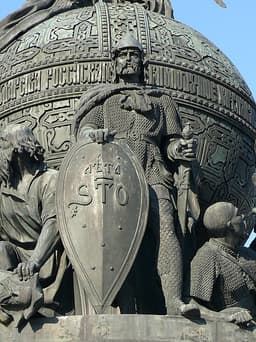
Rurik
Emperor · Medieval
59.6Total
Basic Information
Born
63
830
Died
—
879
Era
Ancient
Medieval
Nationality
Roman Empire
Kievan Rus
Occupation
Emperor
Emperor
Civilization
Western
Western
Score Comparison
Military (10%)
72.0
50.0
Political (20%)
90.0
35.1
Influence (20%)
88.0
82.0
Legacy (20%)
90.0
68.0
Leadership (15%)
88.0
55.3
Strategy (15%)
75.0
35.7
TOTAL
85.9
59.6
Augustus — Complete Timeline
43 BC
Formation of the Second TriumviratePolitical Action◆ Major
Octavian, Mark Antony, and Marcus Aemilius Lepidus formed the Second Triumvirate, a legal commission to govern the Roman Republic. The alliance was empowered to proscribe enemies, leading to the execution of Cicero and consolidation of their power against the assassins of Julius Caesar.
Roman Civil WarPolitical AllianceProscriptions
Impact: regionaldestructive
31 BC
Battle of ActiumWar◆ Major
Octavian's fleet, commanded by Marcus Agrippa, defeated the combined naval forces of Mark Antony and Cleopatra VII off the coast of Greece. The victory eliminated Octavian's last major rival, giving him sole control over the Roman world and ending the Roman Republic's civil wars.
Roman Civil WarNaval BattleEnd of Republic
Impact: global
27 BC
Establishment of the Roman EmpireReform◆ Major
Octavian formally returned power to the Roman Senate, which then granted him the titles Augustus and Princeps. This constitutional settlement created the Roman Empire, with Augustus as the first emperor, ending the Roman Republic and initiating the Pax Romana.
Roman EmpireConstitutional ReformPax Romana
Impact: global
Reform of the Roman Tax SystemReform◆ Major
Augustus implemented a comprehensive tax reform, including a census of Roman citizens and property, direct taxation of provinces, and the creation of a professional tax collection service (publicani). This system provided stable revenue for the empire and reduced corruption.
Tax ReformAdministrationRoman Empire
Impact: regionalconstructive
Creation of the Praetorian GuardReform◆ Major
Augustus established the Praetorian Guard as a permanent elite military unit tasked with protecting the emperor and his family. Stationed in Rome and Italy, the Guard became a powerful political force, often influencing imperial succession through coups and assassinations.
Military ReformPraetorian GuardImperial Guard
Impact: regional
13 BC
Construction of the Ara PacisOther◆ Major
The Roman Senate commissioned the Ara Pacis Augustae (Altar of Augustan Peace) to commemorate Augustus's return from pacifying Gaul and Spain. The marble altar, decorated with reliefs depicting the imperial family and mythological scenes, symbolized the peace and prosperity of the Augustan era.
Building ProjectPropagandaAugustan Art
Impact: regionalconstructive
Rurik — Complete Timeline
860 AD
Sent Askold and Dir to ConstantinopleWar
According to tradition, Rurik sent his lieutenants Askold and Dir to raid Constantinople. While the historicity is uncertain, this event is associated with the first Rus' attack on the Byzantine Empire, highlighting early Rus' expansion.
RaidByzantine EmpireExpansion
Impact: regional
862 AD
Founded the Rurik dynastyPolitical Action
According to the Primary Chronicle, Rurik, a Varangian chieftain, was invited by Slavic and Finnic tribes to rule over them. He established his capital at Novgorod, founding the Rurik dynasty that would rule Kievan Rus' and later the Tsardom of Russia until 1598.
FoundationVarangianKievan Rus'
Impact: global
864 AD
Consolidated control over NovgorodPolitical Action◆ Major
Rurik consolidated his rule over Novgorod and the surrounding territories, suppressing a rebellion led by Vadim the Bold. He established a centralized authority that became the basis for the early Russian state.
ConsolidationNovgorodRebellion
Impact: regional
Expert Analysis
Augustus vs Rurik: Historical Comparison
Augustus, founder of the Roman Empire, and Rurik, legendary founder of the Kievan Rus, represent two pivotal figures who shaped the political and cultural foundations of their respective civilizations. While Augustus forged a centralized imperial system that lasted centuries, Rurik established a dynastic lineage that united Slavic and Varangian peoples into a medieval powerhouse.
Dimension Analysis
**Military: Augustus 72 / Rurik 90**
Rurik’s military prowess was essential for consolidating control over diverse Slavic tribes and defending against steppe nomads, whereas Augustus relied more on political consolidation and the Pax Romana than direct battlefield command.
**Political: Augustus 92 / Rurik 78**
Augustus masterfully transformed a republic into an autocracy while maintaining republican facades, creating a durable imperial bureaucracy. Rurik’s political structure was looser, relying on tribal alliances and trade networks rather than centralized administration.
**Influence: Augustus 88 / Rurik 74**
Augustus’s reforms—from the Praetorian Guard to the census—became templates for Western governance, while Rurik’s influence remained largely regional, shaping East Slavic identity but with less global reach.
**Legacy: Augustus 90 / Rurik 74**
The Roman Empire under Augustus set standards for law, architecture, and governance that persisted for millennia. Rurik’s legacy, though foundational for Russia, Ukraine, and Belarus, was more fragmented and mythologized.
**Leadership: Augustus 90 / Rurik 84**
Augustus exhibited exceptional strategic patience and propaganda skill, uniting a fractured empire. Rurik’s leadership was more charismatic and martial, but less institutionally sophisticated.
Verdict
Augustus leads decisively due to his unparalleled political innovation and enduring global influence, despite Rurik’s superior military and strategic achievements in a harsher frontier context.
FAQ
Q: Who ranks higher? A: Augustus ranks higher overall, scoring 86 vs Rurik’s 80, with decisive advantages in political acumen, legacy, and global influence.
Rankings
🥇
AugustusLeader
Mil: 72.0Pol: 90.0Inf: 88.0
85.9
🥈
Rurik
Mil: 50.0Pol: 35.1Inf: 82.0
59.6
+26.3 behind
How This Comparison Works
Algorithm
Each figure is scored on 6 dimensions (0—100 scale) based on structured historical data: Military (10%), Political (20%), Influence (20%), Legacy (20%), Leadership (15%), Strategy (15%). The weighted total produces the final ranking.
Data Sources
Scores are computed from structured sub-indicators in the database. Scale factors adjust for era (Ancient ×0.85, Modern ×1.0) and civilization size (Eastern ×1.05, Other ×0.80) to account for differences in population and military scale.
Maximum 3 Figures
Comparisons are limited to 2—3 figures to ensure readability and statistical meaningfulness.
Error Margins
±5 points per dimension — Sub-scores are derived from historical records with inherent uncertainty. Two figures within 5 points on a dimension should be considered roughly equivalent in that area.
Total Score Accuracy
±3 points overall — The weighted combination of 6 dimensions produces a total score with approximately ±3 points of uncertainty. Differences of less than 3 points are not statistically significant— the figures are effectively tied.
Known Limitations
- Historical records are incomplete and uneven across civilizations
- Figures from oral-tradition societies may be underrepresented
- Occupation labels can misclassify multi-role figures
- Scores measure capability and impact, not moral character
- Quantitative scoring is a comparison tool, not absolute truth
Capability Radar
Military (10%) — Battles & Warfare
Battles
75
15
Win Rate
80
20
Expansion
85
30
Political (20%) — Governance & Reform
Reform
95
30
Diplomacy
90
35
Economy
85
25
Influence (20%) — Cultural & Global Reach
Cultural
85
50
Global
90
60
Legacy (20%) — Historical Impact
Historical
95
70
Longevity
95
80
Leadership (15%) — Power & Stability
Tenure
95
40
Stability
95
30
Strategy (15%) — Tactics & Innovation
Strategy
85
20
Tactics
70
15
Reform
90
10
Similar Comparisons
Comments & Discussion
HistoryDiver6/16/2026
Okay, so I get why Augustus scores higher overall—he basically invented the blueprint for an empire that lasted a thousand years. But I always find it weird how Rurik gets sold short on influence. Yeah, he's regional, but that region became Russia, and Russia's influence on world history is massive. Plus, the guy had to unite warring Slavic tribes AND fend off the Khazars without the luxury of a standing legion. Augustus had Cicero and Agrippa—Rurik had a bunch of drunk Vikings and a prayer. Different leagues of difficulty, man.
NumbskullCritic6/16/2026
Let's be real—you can't quantify "leadership" with a number and pretend it's objective. What's the unit? Charisma per battle? The fact that Rurik's military score is lower than Augustus's is a joke. Rurik literally carved out a state from scratch with a warband; Augustus inherited legions and bought loyalty with bread and circuses. And "influence" is just a fancy word for "Westerners wrote more books about him." This comparison screams Eurocentric bias dressed up in spreadsheet math.
DecolonizeHistory6/16/2026
Every time I see a ranking like this, I feel like I'm reading a Victorian-era textbook. Augustus gets points for "civilization" and "administration," but let's not forget that his Pax Romana was built on mass enslavement and provincial extraction. Rurik's loose tribal federation actually looks more egalitarian in comparison—no standing army to oppress his own people. The scoring weights "political innovation" as if creating a bureaucracy is inherently better than maintaining a decentralized consensus. That's not objectivity; that's a value judgment dressed up as metrics.
Historian8286/16/2026
把奥古斯都和留里克放在一起比,本身就是一种西方历史叙事的傲慢。留里克如果放到中国朝代更替的框架里看,更接近契丹的耶律阿保机——都是外来首领整合本土部落,建立长久的王朝。但中国史学界从来不会拿阿保机去和秦始皇比,因为比的是体系,不是个人。奥古斯都的罗马模式适合地中海,留里克的基辅罗斯适合东欧森林草原。评分应该区分‘影响广度’和‘适应深度’,留里克在后者上绝对不输。
Chronicler40696/16/2026
这个评分体系有个明显的问题:军事分数上Rurik才41.5?这是开什么玩笑?一个从斯堪的纳维亚南下,在斯拉夫部落的包围中建立基辅罗斯的军阀,怎么可能比一个靠养子和宣传混日子的奥古斯都还低?奥古斯都的军事成就基本是阿格里帕代劳的,他本人就是个政治玩家。Rurik如果是放在中国语境里,相当于唐末节度使级别的狠人,靠刀把子立国。我建议重新加权:政治占30%,军事占40%,影响力占30%,这样Rurik至少能上70分。