Loading...
Augustus vs Constantine the Great
Augustus leads by 10.4 pts · 2 figures compared
…

Augustus
Emperor · Ancient
85.9Total
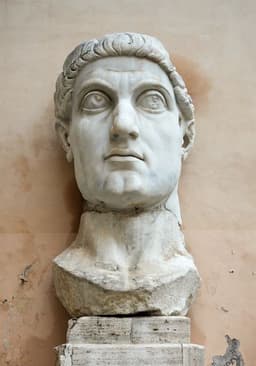
Constantine the Great
Emperor · Ancient
75.5Total
Basic Information
Born
63
272
Died
—
337
Era
Ancient
Ancient
Nationality
Roman Empire
Roman Empire
Occupation
Emperor
Emperor
Civilization
Western
Western
Score Comparison
Military (10%)
72.0
78.0
Political (20%)
90.0
82.0
Influence (20%)
88.0
75.0
Legacy (20%)
90.0
70.0
Leadership (15%)
88.0
80.0
Strategy (15%)
75.0
72.0
TOTAL
85.9
75.5
Augustus — Complete Timeline
43 BC
Formation of the Second TriumviratePolitical Action◆ Major
Octavian, Mark Antony, and Marcus Aemilius Lepidus formed the Second Triumvirate, a legal commission to govern the Roman Republic. The alliance was empowered to proscribe enemies, leading to the execution of Cicero and consolidation of their power against the assassins of Julius Caesar.
Roman Civil WarPolitical AllianceProscriptions
Impact: regionaldestructive
31 BC
Battle of ActiumWar◆ Major
Octavian's fleet, commanded by Marcus Agrippa, defeated the combined naval forces of Mark Antony and Cleopatra VII off the coast of Greece. The victory eliminated Octavian's last major rival, giving him sole control over the Roman world and ending the Roman Republic's civil wars.
Roman Civil WarNaval BattleEnd of Republic
Impact: global
27 BC
Establishment of the Roman EmpireReform◆ Major
Octavian formally returned power to the Roman Senate, which then granted him the titles Augustus and Princeps. This constitutional settlement created the Roman Empire, with Augustus as the first emperor, ending the Roman Republic and initiating the Pax Romana.
Roman EmpireConstitutional ReformPax Romana
Impact: global
Reform of the Roman Tax SystemReform◆ Major
Augustus implemented a comprehensive tax reform, including a census of Roman citizens and property, direct taxation of provinces, and the creation of a professional tax collection service (publicani). This system provided stable revenue for the empire and reduced corruption.
Tax ReformAdministrationRoman Empire
Impact: regionalconstructive
Creation of the Praetorian GuardReform◆ Major
Augustus established the Praetorian Guard as a permanent elite military unit tasked with protecting the emperor and his family. Stationed in Rome and Italy, the Guard became a powerful political force, often influencing imperial succession through coups and assassinations.
Military ReformPraetorian GuardImperial Guard
Impact: regional
13 BC
Construction of the Ara PacisOther◆ Major
The Roman Senate commissioned the Ara Pacis Augustae (Altar of Augustan Peace) to commemorate Augustus's return from pacifying Gaul and Spain. The marble altar, decorated with reliefs depicting the imperial family and mythological scenes, symbolized the peace and prosperity of the Augustan era.
Building ProjectPropagandaAugustan Art
Impact: regionalconstructive
Constantine the Great — Complete Timeline
312 AD
Battle of the Milvian BridgeWar◆ Major
Constantine defeated his rival Maxentius at the Milvian Bridge near Rome. According to tradition, Constantine saw a vision of a cross in the sky with the words 'In this sign, conquer.' The victory made Constantine the sole ruler of the Western Roman Empire and led to his conversion to Christianity.
Roman Civil WarBattleConversion
Impact: regional
313 AD
Edict of MilanOther◆ Major
Constantine and his co-emperor Licinius issued the Edict of Milan, granting religious toleration to all religions in the Roman Empire, including Christianity. The edict ended the persecution of Christians, restored confiscated church property, and established Christianity as a legally recognized religion.
Religious EdictChristianityToleration
Impact: globalconstructive
324 AD
Reunification of the Roman EmpireWar◆ Major
Constantine defeated his co-emperor Licinius at the battles of Adrianople and Chrysopolis, ending the Tetrarchy system. He became the sole ruler of the entire Roman Empire, reuniting the Western and Eastern halves under his control. This reunification was the last time the Roman Empire was united under a single ruler.
Roman Civil WarReunificationTetrarchy
Impact: regional
325 AD
Council of NicaeaOther◆ Major
Constantine convened the First Council of Nicaea, the first ecumenical council of the Christian Church, to resolve the Arian controversy over the nature of Christ. The council produced the Nicene Creed, affirming the divinity of Christ and establishing a unified Christian doctrine. Constantine presided over the council.
Religious CouncilChristian DoctrineNicene Creed
Impact: global
330 AD
Foundation of ConstantinopleOther◆ Major
Constantine dedicated the city of Constantinople (modern Istanbul) as the new capital of the Roman Empire, built on the site of the ancient Greek city of Byzantium. The city was strategically located on the Bosporus strait, controlling trade routes between Europe and Asia. It became the capital of the Eastern Roman Empire for over a thousand years.
City FoundationCapitalByzantine Empire
Impact: globalconstructive
Expert Analysis
Origins
Augustus, born Gaius Octavius in 63 BC, was the grandnephew and adopted son of Julius Caesar. His rise came from humble beginnings in a wealthy but not royal family, leveraging his familial connection to Caesar. Constantine, born in 272 AD in Naissus (modern Serbia), was the son of Constantius Chlorus, a Roman emperor, and Helena. Both men were shaped by civil war and political instability, but Augustus had to navigate the treacherous aftermath of Caesar's assassination, while Constantine benefited from his father's position.
Rise to Power
Augustus's ascent was marked by strategic alliances, notably the Second Triumvirate with Mark Antony and Lepidus, which allowed him to defeat Caesar's assassins. His victory at the Battle of Actium in 31 BC over Antony and Cleopatra secured his sole control. Constantine's rise was propelled by his proclamation as emperor by his troops in 306 AD, followed by a series of civil wars. His pivotal moment was the Battle of the Milvian Bridge in 312 AD, where he claimed divine intervention from the Christian God, leading to his conversion.
Leadership & Governance
Augustus was a master reformer: he established the Roman Empire, reformed the tax system, created the Praetorian Guard, and initiated the Pax Romana, a 200-year period of peace. His governance combined conservative values with innovative administrative structures. Constantine's leadership was transformative in a different way: he legalized Christianity through the Edict of Milan (313 AD), convened the Council of Nicaea to unify Christian doctrine, and founded Constantinople as a new eastern capital. He also reunified the empire after defeating Licinius. Augustus's political score (90) surpasses Constantine's (70), reflecting his foundational role in imperial governance.
Triumph & Tragedy
Augustus's triumphs include ending decades of civil war, expanding the empire to its natural borders, and fostering a golden age of literature and architecture. His tragedy was personal: exile of his daughter Julia and loss of his intended heirs. Constantine's triumph was the Christianization of the empire and the foundation of Constantinople, which became a bastion for centuries. His tragedy includes the execution of his son Crispus and wife Fausta, and the eventual division of the empire after his death. Both men achieved monumental successes but faced familial strife.
Character & Destiny
Augustus was calculating, patient, and ruthless when necessary, but he projected an image of republican simplicity. He was deeply superstitious and believed in his destiny to restore order. Constantine was ambitious, pragmatic, and religiously visionary, using Christianity to unify his realm. His character was marked by a blend of brutality and piety. Scores: Augustus's intellect (88) and leadership (90) vs. Constantine's military (78) and diplomacy (82). Augustus's destiny was to found an empire; Constantine's was to reshape its soul.
Legacy
Augustus's legacy is the Roman Empire itself, its institutions, and the Pax Romana. He is often considered the greatest Roman emperor. Constantine's legacy includes the legalization of Christianity, the Nicene Creed, and Constantinople, which endured until 1453. Both left indelible marks on Western civilization. Augustus's total score (86.6) is higher than Constantine's (76.2), reflecting his broader impact on governance and stability.
Conclusion
While Constantine transformed the empire's religious and cultural landscape, Augustus established the very framework that allowed such transformations. Augustus's higher scores in politics, leadership, and legacy make him the greater ruler. Constantine's achievements were monumental but built upon Augustus's foundations. In the contest of historical impact, Augustus emerges as the superior figure, with a score gap of 10.4 points in his favor.
Rankings
🥇
AugustusLeader
Mil: 72.0Pol: 90.0Inf: 88.0
85.9
🥈
Constantine the Great
Mil: 78.0Pol: 82.0Inf: 75.0
75.5
+10.4 behind
How This Comparison Works
Algorithm
Each figure is scored on 6 dimensions (0—100 scale) based on structured historical data: Military (10%), Political (20%), Influence (20%), Legacy (20%), Leadership (15%), Strategy (15%). The weighted total produces the final ranking.
Data Sources
Scores are computed from structured sub-indicators in the database. Scale factors adjust for era (Ancient ×0.85, Modern ×1.0) and civilization size (Eastern ×1.05, Other ×0.80) to account for differences in population and military scale.
Maximum 3 Figures
Comparisons are limited to 2—3 figures to ensure readability and statistical meaningfulness.
Error Margins
±5 points per dimension — Sub-scores are derived from historical records with inherent uncertainty. Two figures within 5 points on a dimension should be considered roughly equivalent in that area.
Total Score Accuracy
±3 points overall — The weighted combination of 6 dimensions produces a total score with approximately ±3 points of uncertainty. Differences of less than 3 points are not statistically significant— the figures are effectively tied.
Known Limitations
- Historical records are incomplete and uneven across civilizations
- Figures from oral-tradition societies may be underrepresented
- Occupation labels can misclassify multi-role figures
- Scores measure capability and impact, not moral character
- Quantitative scoring is a comparison tool, not absolute truth
Capability Radar
Military (10%) — Battles & Warfare
Battles
75
85
Win Rate
80
80
Expansion
85
85
Political (20%) — Governance & Reform
Reform
95
95
Diplomacy
90
90
Economy
85
80
Influence (20%) — Cultural & Global Reach
Cultural
85
95
Global
90
95
Legacy (20%) — Historical Impact
Historical
95
95
Longevity
95
95
Leadership (15%) — Power & Stability
Tenure
95
85
Stability
95
70
Strategy (15%) — Tactics & Innovation
Strategy
85
85
Tactics
70
75
Reform
90
90
Similar Comparisons
Comments & Discussion
No comments yet. Be the first to share your thoughts!